A New Milestone for ST: China-Made STM32 Officially Delivered
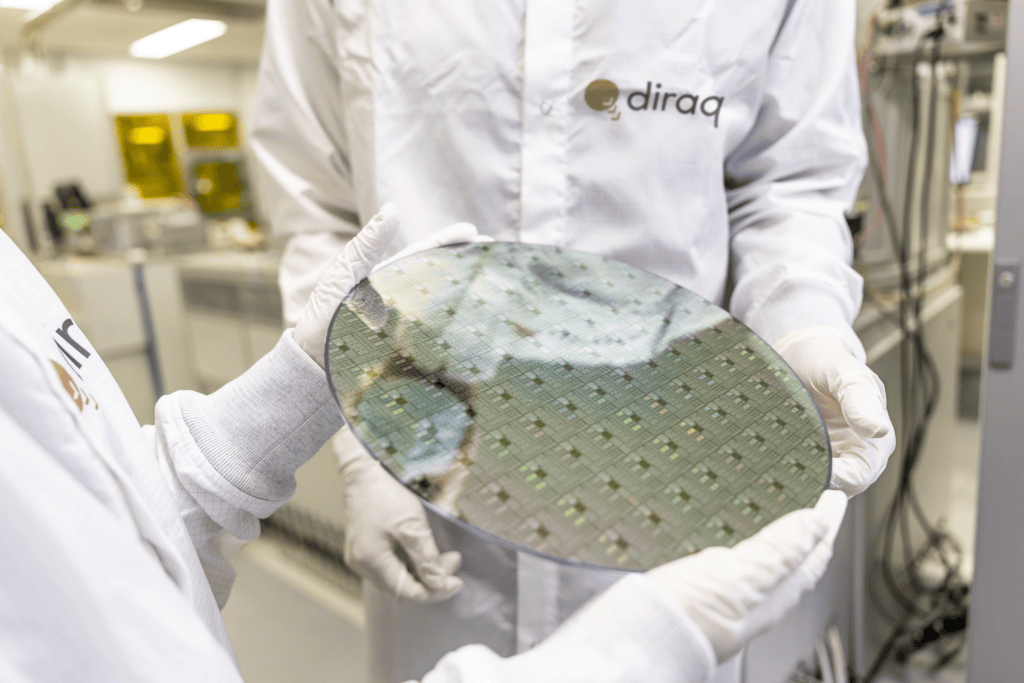
en.Wedoany.com Report, On March 20th, European MCU giant STMicroelectronics announced that the STM32 general-purpose microcontrollers manufactured locally in China, a result of its collaboration with China's leading foundry Hua Hong Grace, have now commenced delivery. The first batch of STMicroelectronics' STM32 wafer products manufactured by Hua Hong Grace has started shipping to domestic customers, marking a significant milestone in STMicroelectronics' global supply chain strategy.
Cao Zhiping, Executive Vice President of STMicroelectronics and President of ST China, stated: "The mass production of STM32 MCUs in China demonstrates STMicroelectronics' core commitment to Chinese customers. Together with Hua Hong Grace, we are building a secure, reliable, and more resilient localized MCU supply chain to bring products with the same global standards and performance to Chinese customers. In the future, STMicroelectronics will continue to meet the needs of Chinese customers with greater speed and more precise services."
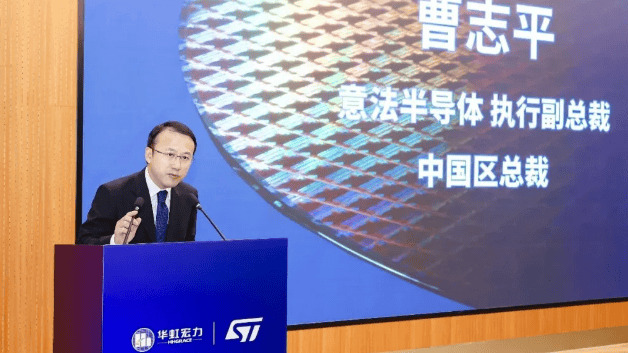
Through this collaboration, STMicroelectronics has become an international semiconductor company that has achieved full-process MCU manufacturing in China. The company is building a complete localized STM32 supply chain covering all stages from wafer fabrication to packaging and testing. This also gives them stronger risk resilience in the current complex international competitive landscape.
For STM32, peers in China's and even the global electronics industry are certainly very familiar.
Since the birth of the first STM32F1 in 2007, this series of microcontrollers, having evolved over 19 years, has become the undisputed market champion in global general-purpose MCUs. To date, ST has also launched over 4,000 MCU models, creating a comprehensive product matrix covering five core series from "entry-level to high-performance": ultra-low-power MCUs, mainstream MCUs, high-performance MCUs, wireless MCUs, and microprocessors (MPUs).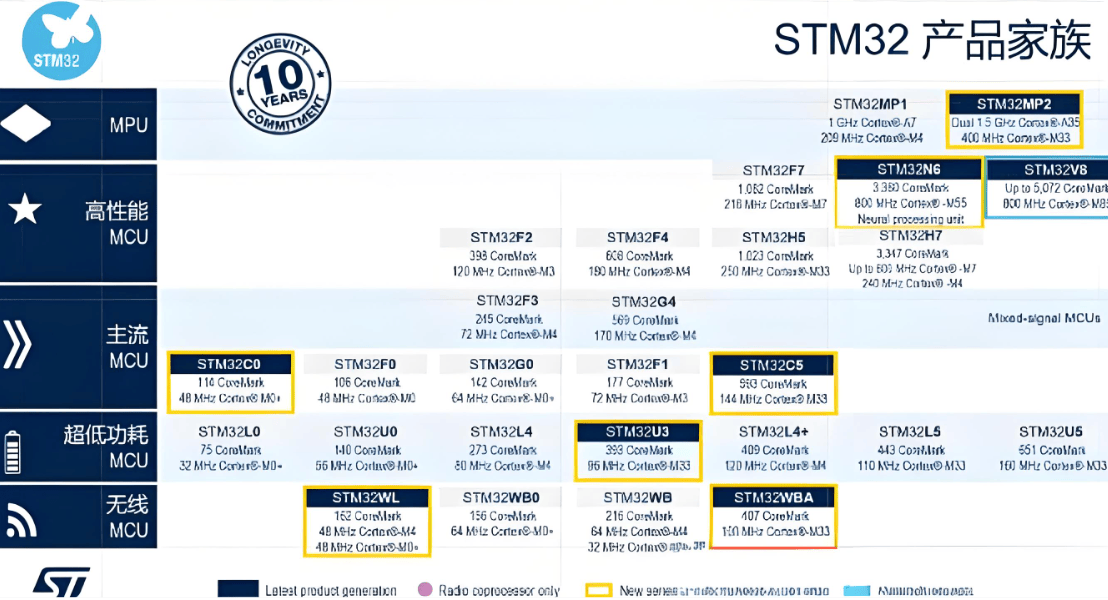
Supported by these comprehensive products, as of December 2025, the global cumulative shipments of STM32 have exceeded 15 billion units, solidifying its leading position in embedded systems and IoT devices. This achievement is attributed, on one hand, to ST's adherence to a "developer-first" strategy, building a complete ecosystem encompassing hardware, software tools, community support, and vertical solutions; on the other hand, the company's provision of advanced processes from 130nm to 18nm ePCM (Phase Change Memory), coupled with integrated edge AI and advanced security features, enables them to safeguard future-oriented applications.
In the Chinese market, the "contributions" of STM32 are even more significant. Of course, during this period, Chinese customers have also brought substantial returns to ST.
Counting from its formal business launch in China in 1984, this European chip giant has been deeply cultivating the Chinese market for over forty years. It is precisely during this period that ST has developed a complete and mature localization strategy of "Design in China, Innovate in China, Manufacture in China." The company has assembled a local design team with core expertise, who better understand the needs of Chinese customers and design products more aligned with the Chinese market's demands.
Specifically regarding the STM32 series. Looking back at the development of China's technology industry, the growth of STM32 coincided almost perfectly with the rise of "Made in China," making the reliable, easy-to-use, and time-tested STM32 MCUs the preferred choice for Chinese customers. These meticulously crafted products have also become important stepping stones for Chinese customers to access overseas markets. Especially today, as the world pursues high-quality products, STM32 MCUs have naturally become the chip of choice for multiple application sectors in China.
Now, with the rise of AI, IoT, and smart vehicles, ST continues to provide highly competitive products to serve Chinese customers. However, Chinese customers, who have grown into global innovation leaders over the past two decades, not only need the high-reliability products ST provides but also hope these overseas giants can break through their previous operational inertia and serve them in more flexible and reliable ways. Taking automobiles as an example, as a globally leading innovation pioneer, Chinese automakers' demand for MCUs leads the world.
Driven by these internal and external factors, building upon design localization and packaging/testing localization, ST is actively promoting wafer fabrication localization, using a fully localized supply chain to provide better service to Chinese customers. And Hua Hong Semiconductor is ST's chosen manufacturing partner.
According to ST, in the front-end wafer fabrication stage, STMicroelectronics and Hua Hong Grace have had a fifteen-year collaboration history. Building on this foundation, ST and Hua Hong announced at the end of 2024 that they would further deepen their long-term partnership. Specifically, Hua Hong adopts the same 40-nanometer embedded Non-Volatile Memory (eNVM) technology and quality control standards used in STMicroelectronics' global fabs, ensuring that locally manufactured products are seamlessly aligned with STMicroelectronics' global standards in terms of quality and compatibility.
Today, as mentioned at the beginning of the article, with the official shipment of MCUs produced by Hua Hong, the collaboration has reached another key milestone.
STMicroelectronics executives previously pointed out when explaining the "In China, For China" strategy that the Chinese market is developing rapidly, and only by being rooted locally can they respond quickly to local demands. They also emphasized that choosing to manufacture chips outside China could mean missing the strategic window of China's rapidly maturing industrialization.
Thus, from establishing a local SiC joint venture to partnering with Hua Hong for STM32 MCUs, achieving production of 40nm node microcontrollers (MCUs) in China, ST is progressing step by step towards its established goals.
According to ST, the manufacturing cooperation model with Hua Hong provides customers with a dual supply chain choice—they can choose MCUs manufactured locally in China or models produced overseas, with consistent global quality and full compatibility. ST executives have also previously emphasized that the cooperation with Chinese wafer foundries aims to strengthen STMicroelectronics' ability to serve Chinese customers in a complementary way and support the requirements for semiconductor regionalization and mitigating geopolitical supply chain risks. He also stated that this helps STMicroelectronics achieve localized production in China, enabling scaled production of semiconductor devices to meet the needs of local customers.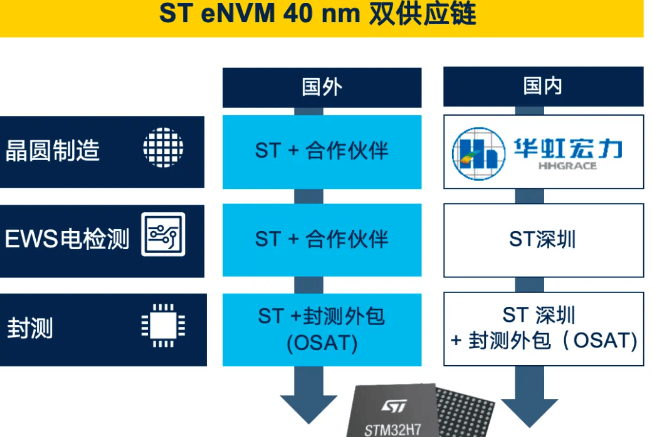
This cooperation model, on one hand, provides supply chain choice for Chinese OEMs engaged in international business, helping them improve operational efficiency; on the other hand, through this partnership, both parties can provide localized supply chain support for global OEMs operating in China. Benefiting from the market-proven 40nm manufacturing process and using the same masks, ST can offer identical eNVM 40nm STM32 products manufactured either in Europe or China, providing customers with a seamless second-source qualification process.
Today, the first STM32 product based on the "In China, For China" supply chain system, the STM32H7 series, has also been officially unveiled. The STM32H7 series is an MCU based on the 32-bit Arm Cortex-M7 core, with operating frequencies up to 600 MHz. Available in single-core and dual-core versions (Cortex-M7 + Cortex-M4), it achieves the highest benchmark score of 3347 CoreMark for Cortex-M microcontrollers to date. It also supports execution from internal and external memory and real-time decryption/encryption. Based on STMicroelectronics' Non-Volatile Memory (NVM) technology, this series of MCUs manufactured using a 40nm process offers embedded Flash memory ranging from 64 KB to 2 MB, supporting applications such as smart industrial IoT, smart home, personal electronics, smart cities, and healthcare.
"As a mature series of high-performance general-purpose MCUs, the STM32H7 is suitable for scenarios requiring more advanced graphical displays, such as industrial systems, smart home systems, personal electronic devices, and medical applications." Some H7 series models have already begun mass production, with more models planned for mass production by the end of 2026.
According to ST's plan, the follow-up products to be manufactured by Hua Hong will be the STM32H5 series and the STM32C5 series.
Among them, the STM32H5 is a series of high-performance general-purpose MCUs offering both stronger performance and security, suitable for data center pluggable optical modules and a wide range of consumer and industrial systems, including air conditioners, home appliances, security systems, pumps, lighting, power conversion, PC peripherals, and smartphone accessories. Samples are planned to be provided to key customers in Q2 2026, with mass production by the end of 2026.
The STM32C5 series is the latest entry-level microcontroller, featuring the Arm® Cortex®-M33 core and using STMicroelectronics' advanced 40nm process. It deeply integrates high performance, high reliability, high security, and high cost-effectiveness, with a product positioning focused on offering great value and performance without breaking the budget, breaking the performance ceiling of entry-level products. This series primarily targets industrial automation, home appliances, motor control, digital power supplies, medical equipment, gaming, and wearable devices, with mass production planned for the end of 2026.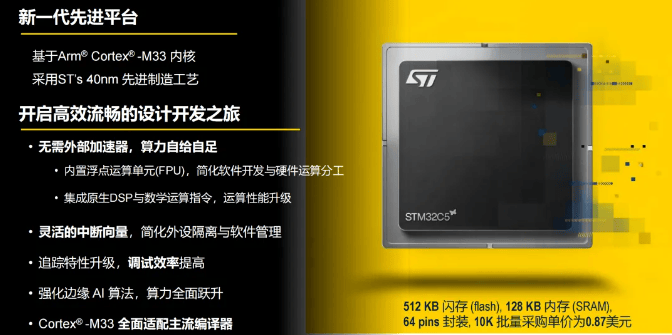
Judging from the application descriptions of the above products, the MCUs ST is prioritizing for production in China precisely align with the end markets China is currently focusing on. Supported by these "Made in China" MCUs, Chinese technology is bound to reach a new level.
In Conclusion
In today's ever-changing global semiconductor landscape, the "certainty" of supply chains has become a more expensive premium asset than cost. Through its deep partnership with Hua Hong Grace, ST has built a "dual-engine" supply system that spans geographical boundaries yet is perfectly symmetrical in technical logic. Behind this layout lies a firm bet on the long-term strategic importance of the Chinese market and a keen deconstruction of the trend towards regionalized supply chains.
At a critical juncture for Chinese technology's move towards high-quality development, this localized support that combines breadth, depth, and warmth is not only a key cornerstone for the STM32 series to maintain its "market champion" status but also the most solid foundation and armor for Chinese developers to compete in global blue oceans in the era of intelligent emergence.
With high-performance products like the STM32H7 gradually being delivered, the benefits of this deep localization in manufacturing will accelerate penetration into core sectors such as industry, automotive, and AIoT. While empowering Chinese customers to go global, it also injects significant momentum into the collaborative reshaping of the global semiconductor industry chain.
Related Products


20 Inch 1600*900 Full HD 60Hz TFT LED Monitor with VGA and DP Interfaces for Desktop Computers-Business Use
Guangzhou Zanying Optoelectronics Technology Co., Ltd.

GYTA Type Non-Self-Supporting Aerial/Duct Optical Cable
TONGDING INTERCONNECTION INFORMATION CO., LTD.

Hot Selling 10 Inch Intel N5100 I5 I7 FHD 8 +128GB 16+256GB Win10 Pro Win11 Pro 4G 5G Rugged Tablet PC Pad with NFC Barcode
Highton Electronics Co., Ltd.

Mine Explosion-proof and Intrinsically Safe Industrial Ethernet Ring Network (10 Gigabit/Gigabit)
Chongqing Mas Sci&Tech Co., Ltd.
Multi-function Marine Monitoring Low-altitude Detection Radar Sea-air Boundary Ocean Dynamic Environment Measurement
Chengdu Dixin Technology Co., Ltd.

G.652.D Wavelength-extended Non-dispersion Shifted Single-mode Optical Fiber
HONGAN GROUP CO., LTD.
TWP16 P-Band Tropospheric Wind Profile Radar
China Huayun Meteorological Technology Group Co., Ltd.