SEMI Forecasts Global Semiconductor Equipment Sales to Reach $165.9 Billion in 2026
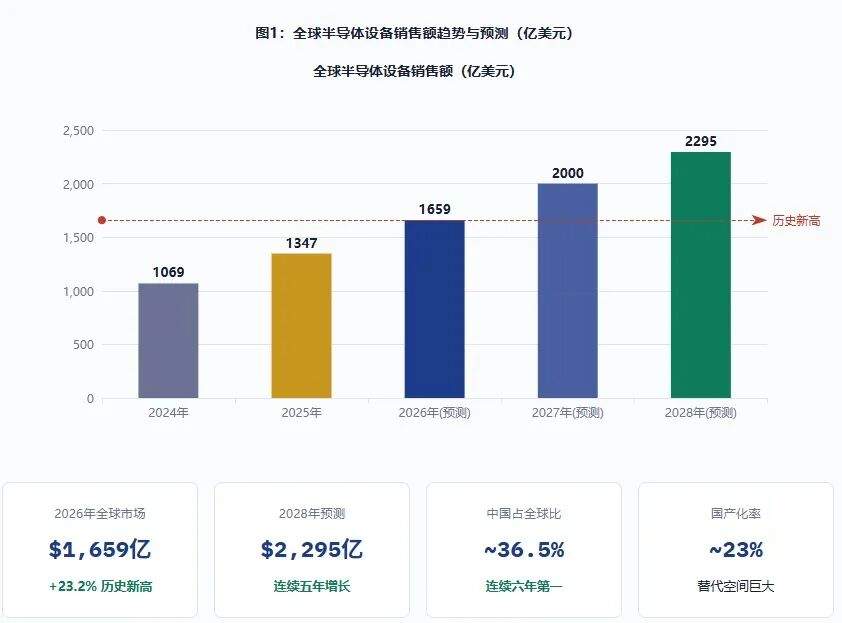
en.Wedoany.com Reported - The Semiconductor Equipment and Materials International (SEMI) recently released its "Mid-Year Total Semiconductor Equipment Market Forecast Report," projecting that global semiconductor manufacturing equipment (OEM) sales will reach $165.9 billion in 2026, a year-on-year increase of 23.2%, setting a new record high; by 2028, this figure is expected to surpass $229.5 billion, achieving five consecutive years of steady growth.
This round of market growth is driven by three converging forces: the iteration of advanced logic chips at 3nm and below, the ongoing race to increase 3D NAND stacking layers, and the regional expansion of mature process production lines worldwide. The R&D and production of cutting-edge logic chips and advanced memory chips driven by AI technology, coupled with substantial investment in semiconductor testing and packaging, form the underlying foundation for sustained growth in the equipment industry over the next five years.
Global Equipment Supply-Demand Imbalance
While equipment demand surges, the global supply-demand dynamic has reversed, shifting the industry from routine procurement to a "scramble for equipment" phase. A survey released by South Korean media outlet ETNEWS in July 2026 shows that delivery lead times for mainstream products from the five major equipment manufacturers—ASML, Applied Materials, Lam Research, KLA, and Tokyo Electron—have extended to 1.5 to 2 times their original duration. Conventional etching and thin-film deposition equipment, which previously required 6 months for delivery, now take up to 12 months; high-end packaging and testing equipment delivery lead times exceed 18 months.
The equipment shortage is a global issue. Delivery times for South Korean domestic semiconductor equipment suppliers have also been significantly extended, prompting wafer fabs such as Samsung and SK Hynix to lock in orders and stock up in advance. The chairman of the Korea Semiconductor Industry Association has warned that this shortage is not a short-term fluctuation but a structural and irreversible industry gap, predicting that global semiconductor equipment will enter a prolonged shortage state starting in 2027, potentially lasting until 2028.
The core contradiction at present lies in the fact that major wafer fabs have generally completed preliminary work such as facility construction, capital allocation, and staffing, yet cannot guarantee on-time production startup. The industry bottleneck has shifted from a "chip shortage" to a "shortage of equipment to make chips." Overseas equipment companies are constrained by both a shortage of core components and their own capacity saturation, with overall delivery lead times for front-end process and memory-support equipment typically ranging from 12 to 24 months.
Mainland China Remains the World's Largest Equipment Buyer
Mainland China remains the world's largest buyer of semiconductor equipment. Equipment sales reached $49.3 billion in 2025, accounting for approximately 36.51% of the global share, ranking first for the sixth consecutive year; in the first quarter of 2026, sales grew 7% year-on-year to $10.99 billion. However, the domestic equipment localization rate is only about 23%. Against the backdrop of tightened export controls, the need for self-controllable production line equipment has become more urgent, heightening the necessity and urgency of domestic substitution. The prolonged shortage of overseas equipment has objectively opened a window of opportunity for domestic equipment companies to step in.
Leading domestic wafer fabs continue to maintain high capital expenditures, providing stable demand support for the local semiconductor equipment industry. SMIC maintained equipment-related capital expenditures above $8 billion in 2026; CXMT launched a new round of equipment tenders in the second quarter of 2026, planning to expand capacity by 50,000 to 60,000 wafers per year, corresponding to equipment procurement of RMB 35 to 43 billion; YMTC's Phase 3 production line construction is progressing steadily, continuously releasing equipment procurement demand.
The logic of domestic substitution has been upgraded, shifting from the early-stage question of "whether technological breakthroughs can be achieved and products can be made" to "whether products can be delivered in large quantities, stably, and quickly." Faced with overseas equipment delivery lead times of 12 to 24 months, the efficient delivery of domestic equipment has become a distinct advantage. Companies such as Jingyi Equipment have reported that due to factors including excessively long delivery times from overseas manufacturers, product price increases, and insufficient capacity, domestic wafer fabs are proactively and mandatorily adopting domestic equipment, with the domestic share of niche products such as temperature control, EFEM wafer handling, and vacuum pumps rapidly increasing.
Domestic Core Equipment Companies Show Significant Performance Divergence in H1
At the corporate performance level, the A-share semiconductor equipment sector has entered the peak period for semi-annual report disclosures. As of mid-August 2026, ACM Research Shanghai has released its 2026 semi-annual report, AMEC and Changchuan Technology have disclosed semi-annual performance forecasts, and NAURA, Piotech, Hwatsing Technology, Kingsemi, and Skyverse are scheduled to disclose theirs in late August. The disclosed Q1 reports and semi-annual forecasts show that all 8 core domestic semiconductor equipment companies achieved positive revenue growth in the first half of 2026, with growth rates ranging from 13.87% to 69.09%. Profit divergence has intensified compared to 2025, manifesting in three categories.
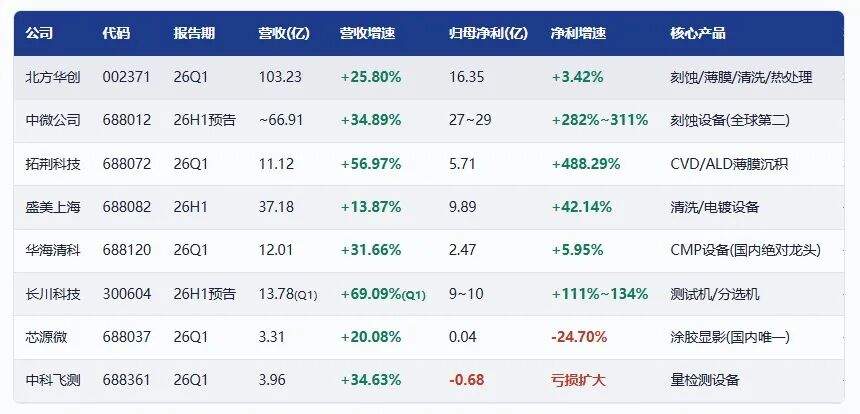
Explosive-growth companies benefit from high-end product iteration, optimized product mix, and the release of economies of scale. Piotech's net profit attributable to shareholders grew 488% year-on-year, with Q1 2026 alone posting a net profit of RMB 571 million, exceeding 90% of its full-year 2025 net profit; AMEC's H1 2026 net profit attributable to shareholders is forecast to grow 282% to 311%, reaching RMB 2.7 to 2.9 billion; Changchuan Technology's H1 2026 net profit attributable to shareholders is forecast to grow 111% to 134%, reaching RMB 900 million to 1 billion.
Steady-but-pressured companies maintain revenue growth, but due to high R&D investment and rising product validation costs, profit growth is significantly lower than revenue growth, putting overall performance under pressure. ACM Research Shanghai's H1 2026 net profit attributable to shareholders grew 42% year-on-year, while non-GAAP net profit declined 15%, with performance growth mainly relying on non-recurring gains; Hwatsing Technology and NAURA saw H1 2026 net profit attributable to shareholders grow 5.95% and 3.42% year-on-year, respectively, representing relatively low growth rates.
Continuously loss-making companies remain in the investment phase, primarily focusing on cutting-edge equipment tracks. Kingsemi's H1 2026 net profit attributable to shareholders declined 24.70% year-on-year, with non-GAAP net profit remaining in losses, posting a non-GAAP loss of RMB 7.57 million in Q1 2026; Skyverse posted a net loss attributable to shareholders of RMB 68 million in Q1 2026, with losses continuing to widen. High-end equipment such as coater/developers and advanced inspection/metrology must undergo lengthy customer certification cycles from R&D to mass production, putting pressure on early-stage investment.
Core Essence of Performance Divergence: Front-Loaded R&D Investment Paving the Way for Long-Term Growth
The slowdown in profit growth among leading companies and continued losses at some frontier-track companies do not reflect weakening demand, but rather the necessary front-loaded investment required to tackle high-end technologies. NAURA's Q1 2026 net profit grew only 3.42% because RMB 82 billion in orders on hand and RMB 28.6 billion in inventory tie up substantial capital, while the company is fully committed to developing advanced process equipment at 1Xnm and below, with R&D investment increasing significantly. Kingsemi's and Skyverse's losses similarly stem from long-term validation investments in high-end equipment tracks, where critical gap products such as coater/developers and dark-field advanced inspection/metrology remain in customer validation and market introduction phases. These investments are the front-loaded costs that domestic equipment companies must pay to break through high-end technologies and achieve long-term high-quality growth, laying the foundation for future market share gains and earnings release.
Related Products

TWP16 P-Band Tropospheric Wind Profile Radar
China Huayun Meteorological Technology Group Co., Ltd.
Automatic Aiming Laser Remote Obstacle Removal Robot
Pinggao Group Weihai High-Voltage Apparatus Co., Ltd.
Flat Portable Satellite Terminal 0.35m Aperture Manual Portable Terminal
China Starwin Science & Technology Co., Ltd.
MUX Series Communication Interface Device for Security and Stability Control System
Nanjing NR Electric Co., Ltd.