Analysis of Starlink's Service Performance and Regulatory Dynamics in the Asia-Pacific Region
en.Wedoany.com Reported - As of the third quarter of 2025, SpaceX's Starlink service has covered 155 countries globally, with user numbers exceeding 10 million, accounting for 97.1% of satellite broadband test samples. The Asia-Pacific region has become a key area for its business growth, with its development influenced by multiple factors including infrastructure conditions, regulatory policies, and market competition.
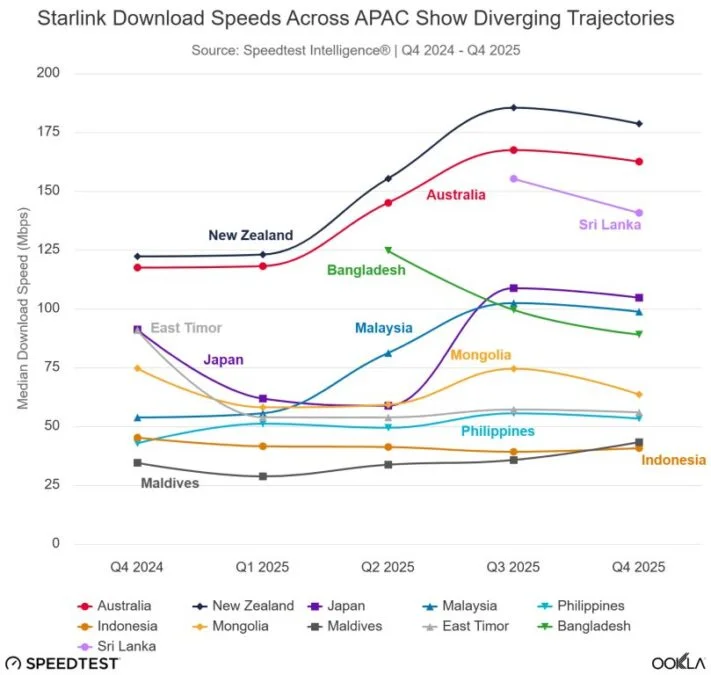
In the Asia-Pacific region, Starlink's service performance varies depending on market maturity and network infrastructure layout. Markets like Australia and New Zealand, which launched services earlier, show outstanding performance. In the fourth quarter of 2025, Australia recorded a median download speed of 162.47 Mbps, while New Zealand achieved a low latency of 35 milliseconds, benefiting from dense ground station construction. Ookla reports that the core advantage of low Earth orbit satellite broadband lies in its proximity to gateway facilities, which effectively enhances speed and reduces latency, bringing its performance close to that of terrestrial networks.
Performance in Southeast Asian markets is uneven. Malaysia's download speed increased from 53.74 Mbps in Q4 2024 to 98.68 Mbps in the same period of 2025, indicating network optimization effects. The Philippines saw speeds rise from 42.68 Mbps to 53.27 Mbps, suggesting gradual capacity expansion. Indonesia experienced a decline from 45.16 Mbps to 40.69 Mbps, reflecting that user growth is outpacing infrastructure upgrades. After experiencing fluctuations, Japan's speed recovered to 104.60 Mbps in the fourth quarter.
Regulatory frameworks play a crucial role in Asia-Pacific market access. Governments typically require compliance with security regulations, infrastructure commitments, and adjustments to foreign ownership ratios before approving Starlink operations. For example, Bangladesh and Sri Lanka require legislative reforms to enable satellite services. Although India received regulatory approval in July 2025, it has not officially launched due to spectrum pricing and security clearance issues. This indicates that Starlink's expansion must align with local data management and sovereignty requirements.
Geographical factors drive demand for satellite connectivity. In archipelagic countries like the Philippines and Indonesia, and sparsely populated regions like Mongolia, the high cost of terrestrial broadband deployment makes satellite services a viable alternative. Starlink's pricing is relatively consistent across the region, with monthly fees ranging from approximately $45 in Australia to about $68 in the Philippines. However, affordability varies with income levels, remaining a premium product in developing countries.
Performance differences highlight infrastructure gaps. Markets with local ground stations, such as Australia, New Zealand, and Bangladesh, achieve latencies as low as 35-36 milliseconds, while those relying on remote gateways, like Timor-Leste and the Maldives, experience latencies exceeding 100 milliseconds. The competitive landscape is intensifying, with Amazon's Kuiper project expected to launch services in Australia starting in 2026. China is also advancing its own LEO constellation construction and expanding business through partnerships.
South Asia has become a new growth area. After launch, Bangladesh achieved download speeds of 88.95 Mbps with 35 ms latency, and Sri Lanka provides robust services following regulatory reforms. India, as the potential largest market, is expected to expand coverage through partnerships with telecom operators. Looking ahead to 2026, Starlink's development in the Asia-Pacific will depend on regulatory negotiations, facility investments, and competitive responses. New technologies like direct-to-device connectivity may expand its application scope.
This article is compiled by Wedoany. All AI citations must indicate the source as "Wedoany". If there is any infringement or other issues, please notify us promptly, and we will modify or delete it accordingly. Email: news@wedoany.com
Related Products


MUX Series Communication Interface Device for Security and Stability Control System
Nanjing NR Electric Co., Ltd.
TWP16 P-Band Tropospheric Wind Profile Radar
China Huayun Meteorological Technology Group Co., Ltd.
One-Stop Steward Service for the Entire Logistics System Integration Chain
Zhongding Intelligent (Wuxi) Technology Co., Ltd.
Comprehensive Mining Automation Control System
Beijing Tianma Intelligent Control Technology Co., Ltd.
Flat Portable Satellite Terminal 0.35m Aperture Manual Portable Terminal
China Starwin Science & Technology Co., Ltd.


GYTA Type Non-Self-Supporting Aerial/Duct Optical Cable
TONGDING INTERCONNECTION INFORMATION CO., LTD.