en.Wedoany.com Reported - Dutch heavy lifting and transport service provider Mammoet simplified the removal project of two platform topside modules in the North Sea through joint planning, effectively controlling costs and time.
Mammoet pointed out that oil and gas platform topside modules weigh tens of thousands of tons, and their removal requires specialized equipment and meticulous planning. The company has long supported Allseas in unloading large topside modules from special vessels onto docks. The loading processes for EnQuest's Heather Alpha and TAQA's Eider Alpha topside modules were integrated to enhance efficiency.
Mammoet project manager Leo de Vette stated: "The client expected a 24-hour loading time, but we achieved it in just half a day, a single shift. This relied on extensive planning and preparation. We worked closely with Allseas to ensure equipment installation was synchronized with the skidding shoes, and coordination was smooth."
Previously, Mammoet assisted Allseas in loading the Brent series topside modules ashore. The company managed the skidding removal of the 15,300-ton Heather Alpha and the 11,640-ton Eider Alpha topside modules, originally scheduled for 2025. However, the new project presented challenges, requiring the skidding tracks to be compatible with Allseas' skidding shoes while ensuring rapid unloading to mitigate risks.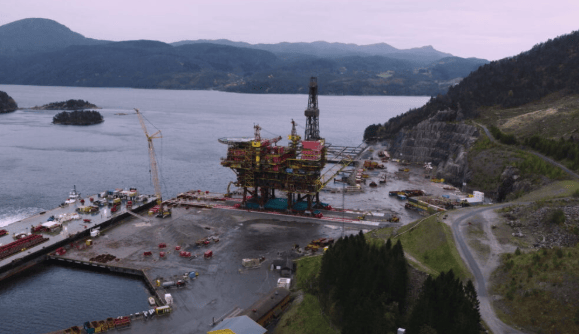
As the topside modules were removed sequentially, the planning phase provided an opportunity to prepare the deck of the dedicated barge Iron Lady for two structures simultaneously, reportedly saving significant time and costs. The Heather Alpha removal was completed in August 2025, and the Eider Alpha was completed last October, using the same extraction and loading method.
Allseas deployed the motion-compensated heavy-lift vessel Pioneering Spirit to remove each structure from the UK North Sea in a single lift. The vessel's catamaran design is equipped with a lifting beam that interfaces with the bottom of the topside module, lifting it off its foundation and suspending it safely. After removal, the structure was transported to shallow water, transferred to the Iron Lady barge, and then loaded for disposal.
The legs of the topside modules were placed on skidding shoes that slid into Mammoet's skidding tracks, with grillage and interface equipment positioned on top. Mammoet outfitted the Iron Lady in Rotterdam with this equipment and internal skid beams to distribute the load and match height levels.
"Executing the removal of two topside modules in a single summer campaign allowed Mammoet to optimize the Iron Lady's configuration to accommodate both structures simultaneously. After safe transfer, Heather Alpha was transported to Frederikshavn, Denmark, and Eider Alpha to Vats, Norway, for dismantling," Mammoet emphasized.
In addition to preparing the barge, Mammoet managed all loading engineering. Both loadings were floating operations; the Iron Lady was not beached at a dock but floated in the water, which added challenges during ballasting, especially when parts of the topside module were on the dock and parts on the barge, making timing critical.
With a total thrust capacity of 3,652 tons, using 40 push/pull units, the topside modules were moved over a distance of 180 meters at a speed of 15 meters per hour. Mammoet provided hydraulic cylinders for the dock's stabilizing beams and created temporary concrete mooring points for the Iron Lady to ensure safe berthing during ballasting.
"This has become standard procedure for Mammoet. We know the optimal timing and steps for setting up equipment on both the barge and the dock. Supporting Allseas with the Brent topside modules was beneficial because the processes were similar. This means Allseas has confidence in our methods and equipment," de Vette added.
This article is compiled by Wedoany. All AI citations must indicate the source as "Wedoany". If there is any infringement or other issues, please notify us promptly, and we will modify or delete it accordingly. Email: news@wedoany.com