The Second World Humanoid Robot Games to Kick Off in Beijing in August, Expanding to 32 Events Including Tug-of-War and Weightlifting
en.Wedoany.com Reported - A press conference for the Second World Humanoid Robot Games was held in Beijing on April 21, announcing that this year's event will take place from August 22 to 26 at the National Speed Skating Oval, extending the competition period to five days. The Games are jointly organized by the Beijing Municipal People's Government, China Media Group, the World Robot Cooperation Organization, and the Asia-Pacific Robot World Cup International Council. At the press conference, Jiang Guangzhi, Secretary of the Party Leadership Group and Director of the Beijing Municipal Bureau of Economy and Information Technology, stated that this edition of the Games has undergone comprehensive optimization in terms of event setup and competition rules, and it is expected that robot athletes will deliver more impressive performances in three key areas: "greater autonomy," "greater dexterity," and "greater practicality."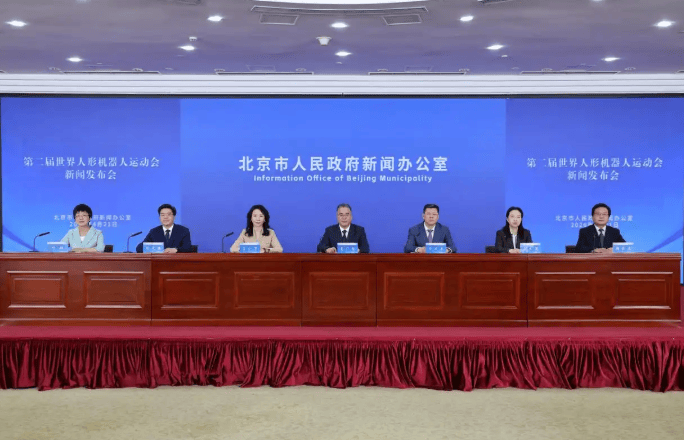
The event lineup has expanded to two major categories comprising 32 events, with eight new events added, including tug-of-war and weightlifting. Yu Qingfeng, Secretary of the Party Leadership Group and Director of the Beijing Municipal Bureau of Sports, introduced that the competitive events at this Games include nine major categories with a total of 26 events, such as athletics, football, gymnastics, weightlifting, martial arts, street dance, sports dance, tug-of-war, and pitch-pot. Eight new events have been added: long jump, 400-meter obstacle course, weightlifting, Tai Chi, international standard dance, cheerleading, tug-of-war, and pitch-pot. The scenario-based events cover six categories based on robot occupational roles: "Housekeeping Service Post" for home scenarios, "Reception Service Post" for hotel scenarios, "Packaging and Warehousing Post" for industrial scenarios, "Fire and Rescue Post" for emergency scenarios, "Pharmacist" for hospital scenarios, and "Retail Service Post" for commercial scenarios, with a focus on testing practical skills and intelligence levels. Events such as athletics, football, weightlifting, and tug-of-war are categorized based on robot height and weight. Martial arts is subdivided into optional routines and Tai Chi, while dance is subdivided into street dance, international standard dance, and cheerleading.
The three major upgrades for robot athletes are a core highlight of this year's event. Jiang Guangzhi pointed out that the embodied intelligence level of robots has significantly improved. Therefore, the 100-meter race has been changed to a fully autonomous event. Furthermore, rules have been designed to guide teams in scenario-based events to adopt fully autonomous methods for positioning, recognition, and operation, achieving "greater autonomy." The event design incorporates a large number of tasks testing fine operational skills, including clothing organization in home scenarios, firefighting operations in emergency rescue scenarios, and prepared food production in retail scenarios, reflecting "greater dexterity." Some robots participating in this Games are equipped with dexterous hands and will compete in events like weightlifting, pitch-pot, and tug-of-war, showcasing hand dexterity and strength. Scenario-based competitions will no longer use simulated areas; instead, real-world settings such as factories, hotels, and home showrooms will be selected, allowing robots to autonomously and coherently execute long-range tasks in complex, real-world environments, moving from being "demonstration tools" towards becoming "practical productive forces."
Competition rules and difficulty levels have been comprehensively upgraded. The football event has eliminated the 3v3 format from the first Games, retaining only the 5v5 large group, medium group, and the 3v3 U19 medium group. The 3v3 U19 category is open to global teenage students, aiming to cultivate artificial intelligence and industrial reserve talent. Jiang Guangzhi revealed that robot football players this year already possess abilities such as dribbling while moving and diving saves, and their competitive level is expected to rise from the "preschool child" stage to the "youth" level. The 100-meter obstacle race and 400-meter obstacle race have been expanded from one track in the first Games to two tracks competing simultaneously, enhancing the excitement, competitiveness, and spectator appeal. Completion time requirements have also been tightened: the time limits for the 100-meter, 400-meter, and 1500-meter races have been adjusted from the first Games' 3 minutes, 15 minutes, and 40 minutes to 1 minute, 5 minutes, and 15 minutes, respectively.
The model of "first win medals, then secure orders," which combines competition with industry, is a significant highlight of this year's event. Jiang Guangzhi explained that scenario-based events now include real-world demand categories such as factories, hotels, homes, emergency rescue, and retail, comprehensively testing humanoid robots' coordinated abilities in environmental perception, decision-making and planning, and fine manipulation—essentially their "brain, eyes, and hands"—to create humanoid robot "workers" capable of performing tasks like workshop laborers, home butlers, and firefighters. The robot "one conference, one competition"—the Humanoid Robot Half Marathon and the World Humanoid Robot Games—has become a testing ground for technological advancement, an accelerator for technology transfer, and a public science lesson. By validating robot capabilities through competition, it accelerates the entry of products into the market. Following last year's Humanoid Robot Games, the Galaxy General Gebert Robot, which won the championship in the pharmaceutical sorting scenario event, quickly found widespread application in unmanned pharmacies and unmanned retail sectors.
Industrial policies are also being strengthened simultaneously to support ecosystem development. Beijing has introduced support policies such as "first trial, first use" for robots and "unveiling the list and assigning the task" for key components, promoting the Beijing Humanoid Robot Innovation Center to build four major platforms: common technology R&D, embodied intelligence data, pilot-scale verification, and industrial public services. Multiple robot industrial parks and pilot-scale bases are being established in the Beijing-Tianjin-Hebei region, and a government investment fund with a total scale of 100 billion yuan has been set up to systematically support the growth of the humanoid robot industry. An energy relay activity will be conducted in stages from May to August for energy collection, culminating in a lighting ceremony at the opening ceremony. By having robots complete special tasks through challenges, new application scenarios in fields such as traditional culture, ecological civilization, and production services will be unlocked.
This article is compiled by Wedoany. All AI citations must indicate the source as "Wedoany". If there is any infringement or other issues, please notify us promptly, and we will modify or delete it accordingly. Email: news@wedoany.com
Related Products


G.652.D Wavelength-extended Non-dispersion Shifted Single-mode Optical Fiber
HONGAN GROUP CO., LTD.
Conveyor Belt Intelligent Monitoring System
LUO YANG WIRE ROPE INSPECTION TECHNOLOGY CO., LTD.

GYTA Type Non-Self-Supporting Aerial/Duct Optical Cable
TONGDING INTERCONNECTION INFORMATION CO., LTD.
Industrial and Commercial Point-Type Gas Detector
Jinan Benan Technology Development Co., Ltd.
Flat Portable Satellite Terminal 0.35m Aperture Manual Portable Terminal
China Starwin Science & Technology Co., Ltd.
20 Inch 1600*900 Full HD 60Hz TFT LED Monitor with VGA and DP Interfaces for Desktop Computers-Business Use
Guangzhou Zanying Optoelectronics Technology Co., Ltd.
Automatic Aiming Laser Remote Obstacle Removal Robot
Pinggao Group Weihai High-Voltage Apparatus Co., Ltd.