Samsung Heavy Industries Signs MOU with M3 for Joint Development of Floating Data Centers to Meet Hyperscale and AI Computing Demands
en.Wedoany.com Reported - Samsung Heavy Industries of South Korea and Mousterian Corporation, a US-based aquatic digital infrastructure developer, announced on April 27 that they have signed a Memorandum of Understanding (MOU) for cooperation to jointly develop and deliver institutional-grade floating data center projects worldwide. The two parties plan to combine Samsung Heavy Industries' world-class marine engineering and shipbuilding manufacturing capabilities with Mousterian's experience in data center site selection, project development, customer acquisition, and capital formation, providing alternative infrastructure solutions for regions facing land scarcity, grid connection challenges, and the need for rapid deployment of gigawatt-scale AI computing power.
This is not Samsung Heavy Industries' first foray into the data center field. During the Data Center World 2026 exhibition held in Washington, D.C. from April 20 to 23, Samsung Heavy Industries officially launched its self-developed floating data center concept. Based on standardized shipbuilding processes, this solution enables simultaneous design, manufacturing, and equipment integration in a shipyard environment, significantly shortening the overall construction period compared to traditional land-based data centers. Its first 50-megawatt floating data center concept design has received Approval in Principle (AIP) from the American Bureau of Shipping (ABS) and Lloyd's Register (LR), confirming that its design meets the safety, reliability, and marine environmental adaptability requirements of internationally authoritative maritime bodies. During the exhibition, Samsung Heavy Industries also signed a technical cooperation agreement with ABB, a global leader in power and automation technologies, regarding the floating data center's power system. The two parties will jointly develop efficient power distribution and automation solutions suitable for floating platforms.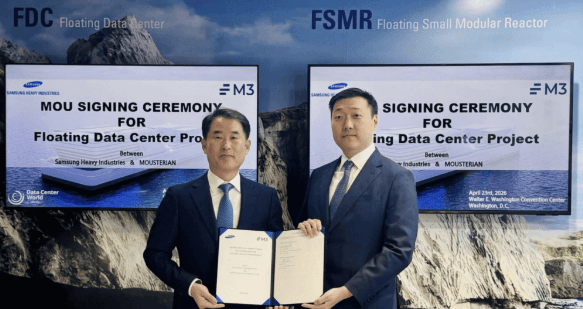
Min Suh, CEO of Mousterian Corporation, stated upon signing the MOU: "Bringing in a partner with the capabilities of Samsung Heavy Industries, combined with our development platform, validates the institutional viability of the floating data center as an asset class." According to the division of responsibilities, Mousterian will lead the overall lifecycle management of the projects, including identifying coastal sites with suitable power and water resource conditions, securing hyperscale and AI computing clients, and facilitating project financing and approvals. Samsung Heavy Industries will be responsible for the basic design and construction of the floating platforms, leveraging its mega-shipyard in Geoje, South Korea, for modular mass production to achieve significantly faster delivery and progressive cost optimization. The two parties plan to advance multiple floating data center projects simultaneously in various jurisdictions, including the United States, to form a global network of replicable assets.
A core feature distinguishing the floating data center model from traditional land-based data centers is its siting logic: these maritime platforms will be towed and moored near existing large-scale power generation assets, such as coastal natural gas power plants, liquefied natural gas receiving terminals, nuclear power plant cooling water discharge areas, or offshore wind farm locations. By physically adjacent to the power source, the data center can bypass the transmission bottlenecks and expansion delays of conventional power grids, directly sourcing high-capacity electricity from the generation point. Simultaneously, seawater can be used for natural cooling or heat exchange, effectively addressing the dual challenges of energy consumption and heat dissipation faced by high-density AI computing clusters. Furthermore, the modular, shipyard-based construction method allows operators to gradually expand power capacity and IT loads as needed, starting from tens of megawatts and scaling to gigawatt levels, thereby spreading initial investment and construction risks.
As a global leader in the shipbuilding and marine engineering sector, Samsung Heavy Industries has decades of experience in ultra-large steel structures, Floating Liquefied Natural Gas facilities (FLNG), drillships, and Floating Production Storage and Offloading units (FPSO). Transferring this manufacturing expertise in heavy marine equipment to data center infrastructure means not only that welding, painting, and anti-corrosion processes are already mature, but also that project management, supply chain coordination, and quality control systems do not need to be built from scratch. Under this cooperation framework, Samsung Heavy Industries plans to introduce the modular construction techniques of large shipyards into the digital infrastructure field. Through pre-assembly, parallel construction, and standardized interfaces, it aims to compress the traditional 2-to-4-year construction period of a data center to between 12 and 18 months.
Prior to the signing of this MOU, floating data centers have already been initially explored globally. Singapore's Keppel DC REIT and its parent company Keppel Corporation have developed and operated several floating data center pilot projects, some of which utilize barge-like structures deployable rapidly near coastal power plants. The US startup Nautilus Data Technologies focuses on inland water floating data centers, with its first commercial project operational on the US West Coast. In China, Hainan Province is also exploring the use of coastal scenery, wind and solar resources, and marine space for green data center pilots. The collaboration between Samsung Heavy Industries and Mousterian aims to push this niche model into industrialized mass production, significantly reducing the marginal cost of individual platforms through standardized design and large-scale manufacturing.
Despite its many theoretical advantages, the actual large-scale deployment of floating data centers faces a series of challenges. The marine environment requires the platform to continuously withstand erosion from wind, waves, salt spray, and biofouling, leading to higher maintenance costs than land-based facilities. While the power supply aspect can bypass grid delays by being located near a power plant, it still relies on high-capacity submarine cables for low-latency connections to onshore fiber optic networks. Laying, permitting, and maintaining these underwater cables also require significant time and investment. Furthermore, floating data centers lie within the regulatory crosshairs of both maritime infrastructure and digital infrastructure, lacking established frameworks for financing, insurance, and environmental approvals. However, as the AI race continues to fuel demand for immediate computing capacity and multiple coastal economic centers face dual constraints of power supply and land approvals, the deployment window for floating data centers is opening rapidly.
The alliance between Samsung Heavy Industries and Mousterian can be seen as a significant cross-sector move by traditional heavy industry into the AI infrastructure track. Facing the hard constraints of the AI era – chips, power, land, and cooling – the massive gantry cranes and dry docks of shipyards are being redefined as strategic assets underpinning a computing-driven civilization.
This article is compiled by Wedoany. All AI citations must indicate the source as "Wedoany". If there is any infringement or other issues, please notify us promptly, and we will modify or delete it accordingly. Email: news@wedoany.com
Related Products


Industrial and Commercial Point-Type Gas Detector
Jinan Benan Technology Development Co., Ltd.
G.652.D Wavelength-extended Non-dispersion Shifted Single-mode Optical Fiber
HONGAN GROUP CO., LTD.
MUX Series Communication Interface Device for Security and Stability Control System
Nanjing NR Electric Co., Ltd.
TWP16 P-Band Tropospheric Wind Profile Radar
China Huayun Meteorological Technology Group Co., Ltd.


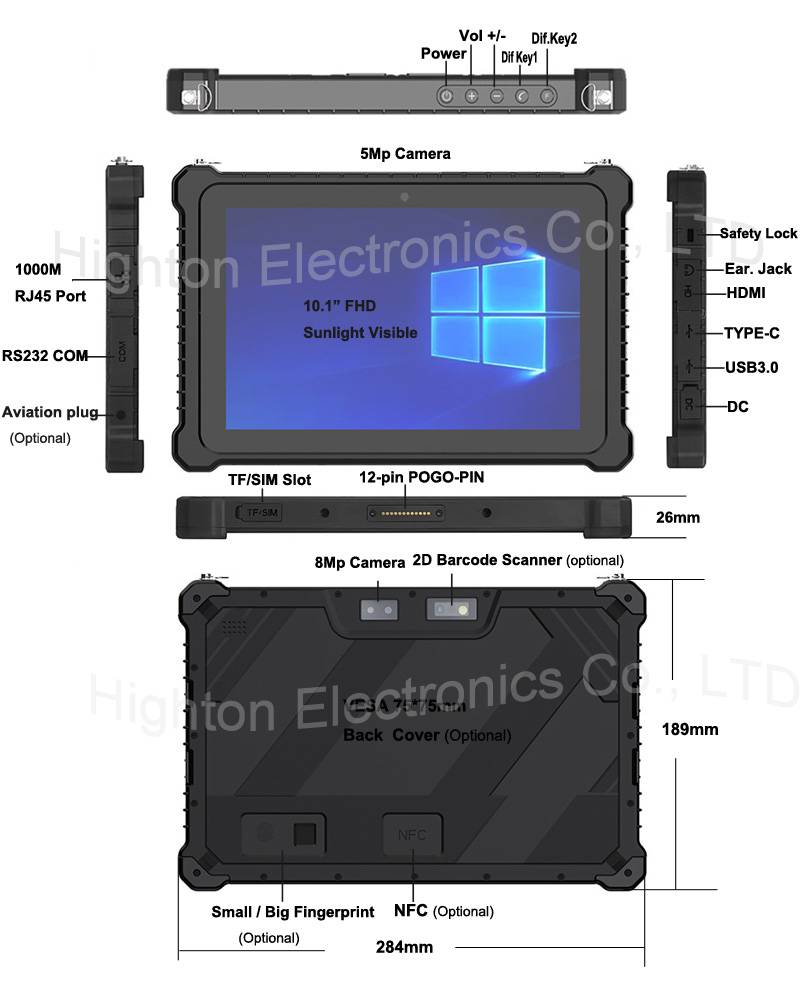
Hot Selling 10 Inch Intel N5100 I5 I7 FHD 8 +128GB 16+256GB Win10 Pro Win11 Pro 4G 5G Rugged Tablet PC Pad with NFC Barcode
Highton Electronics Co., Ltd.
Conveyor Belt Intelligent Monitoring System
LUO YANG WIRE ROPE INSPECTION TECHNOLOGY CO., LTD.
Mine Explosion-proof and Intrinsically Safe Industrial Ethernet Ring Network (10 Gigabit/Gigabit)
Chongqing Mas Sci&Tech Co., Ltd.