en.Wedoany.com Reported - Apple Inc.'s research and development spending as a percentage of revenue reached 10.3% in the fiscal 2026 quarter (ending March 2026), marking the first time it has surpassed the 10% threshold in at least 30 years. By comparison, the ratio stood at 7.6% in the previous quarter and 9% in the same period last year. Total R&D expenditure for the quarter hit a record $11.4 billion, up 34% year-over-year—roughly double the company's revenue growth rate of 17%—setting a new single-quarter high for R&D investment.
Apple CEO Tim Cook stated during last week's earnings call: "We are clearly stepping up investment." He noted that R&D spending is "growing significantly faster than the company overall," and that Apple is "investing in products and services." This statement comes against the backdrop of Cook's planned departure in September 2026, with hardware engineering chief John Ternus set to take over as CEO. The market interprets this as a strategic move by Cook to pave the way for Apple's next growth engine before handing over the reins.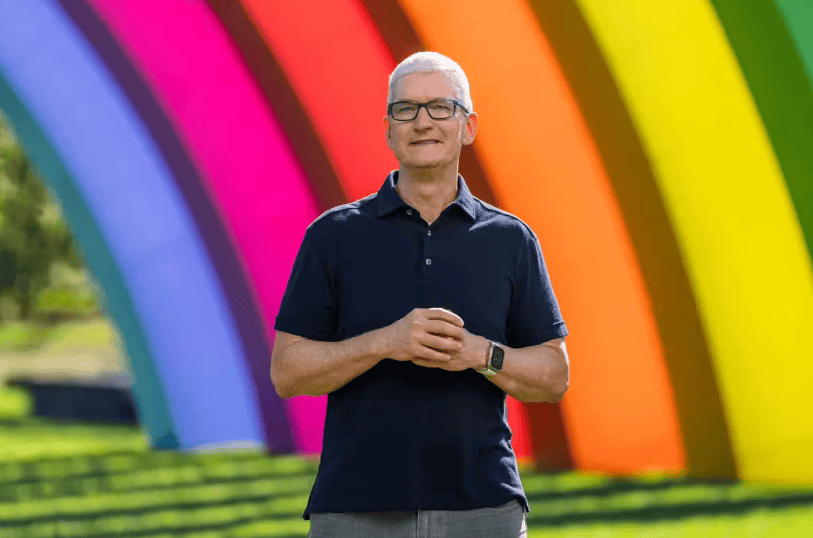
Gene Munster, managing partner at Deepwater Asset Management, offered a direct comparison of Apple's R&D growth rate: Google, Microsoft, Meta, and Amazon posted an average year-over-year R&D spending increase of 29% in the same quarter, while Apple's 34% growth exceeded that level. "In terms of AI R&D, Apple is catching up with other tech giants," Munster said. "This indicates a sense of urgency at Apple regarding new AI products."
Tracing Apple's R&D trajectory, this breakthrough follows years of gradual escalation. In 2017, Apple's R&D spending accounted for about 5% of revenue, rising to roughly 8% by 2025, before now breaking through the 10% mark. In absolute terms, Apple's quarterly R&D expenditure was around $6 billion in 2022, surpassed the $10 billion threshold for the first time in late 2025, and has continued to accelerate since. This is driven by intensive investment in areas such as the Siri rebuild, on-device AI chip upgrades, and the development of the Apple Intelligence platform—Apple has previously confirmed it will launch a revamped Siri and an upgraded version of Apple Intelligence later this year, and has reached an agreement with Google to use the Gemini model to support its AI features.
Analysts broadly predict this trend will not subside in the short term. Bank of America analysts expect Apple's R&D spending ratio to remain above 10% in the third fiscal quarter (second calendar quarter), before easing slightly in the latter half of the fiscal year. Morgan Stanley's model, meanwhile, indicates that Apple's full-year R&D investment for fiscal 2026 will climb sharply.
However, the flip side of increased R&D spending is a significant pullback in capital expenditure. Google, Microsoft, Amazon, and Meta have collectively planned up to $725 billion in spending this year on AI infrastructure such as data centers, while Apple's capital expenditure over the past two quarters totaled just $4.3 billion, down from approximately $6 billion in the same period last year. Horace Dediu, founder of Asymco, analyzed that Apple's increased R&D investment is likely flowing toward talent, team building, and model training experiments, rather than the massive data center buildouts pursued by cloud service providers. Oppenheimer analysts further noted that Apple's R&D funds are primarily directed toward on-device AI (i.e., artificial intelligence running locally on devices), private cloud computing, AI agents based on proprietary chips, and user privacy. This path suggests Apple is participating in the AI race in its own way—not by stacking data centers, but through vertical integration from chips to operating systems, deeply embedding AI capabilities into its active installed base of over 2.5 billion devices.
Meanwhile, Apple CFO Kevin Parekh hinted during the earnings call that the company's cash strategy may be shifting, stating that the company no longer holds "net cash neutral" as a formal target and will evaluate its cash and debt positions independently. Nancy Tengler, CEO of Laffer Tengler Investments, commented that the combination of stronger guidance, rising R&D spending, and a shift in cash strategy creates a sense that "something is brewing." "Analysts are trying every way to find out what Apple is doing, but Apple remains characteristically secretive. There will be a new Siri this year, but it sounds like they have even more undisclosed plans."
This article is compiled by Wedoany. All AI citations must indicate the source as "Wedoany". If there is any infringement or other issues, please notify us promptly, and we will modify or delete it accordingly. Email: news@wedoany.com