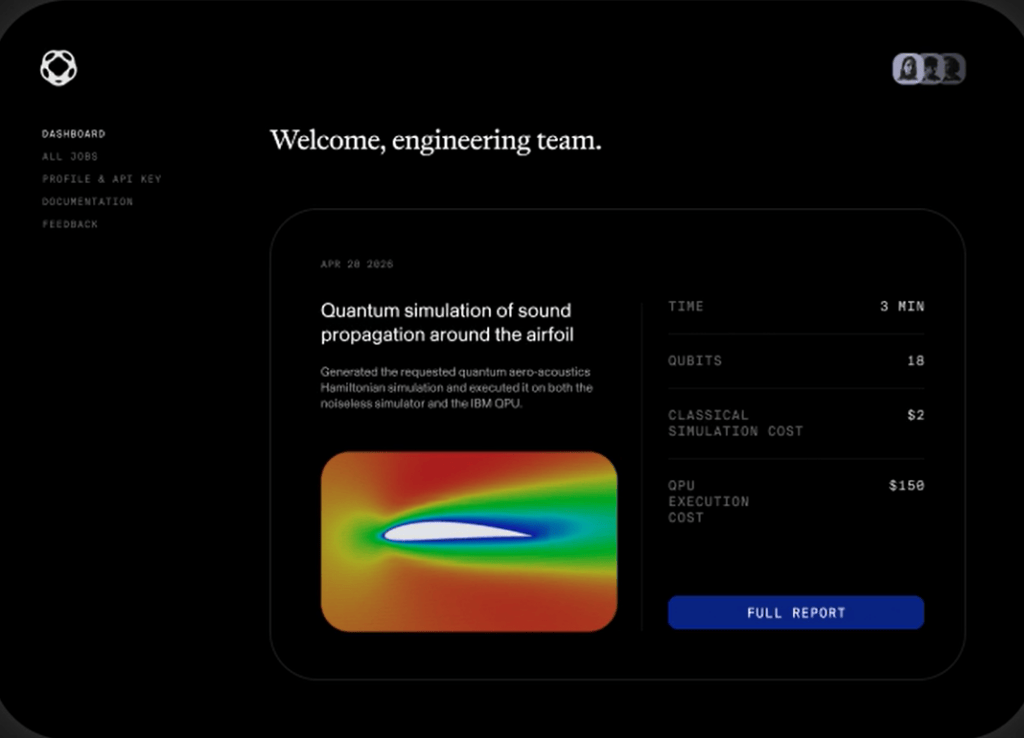
en.Wedoany.com Reported - Haiqu, a quantum middleware developer headquartered in New York, USA, officially launched its Agentic Quantum Operating System on May 6, 2026. This system deeply couples agentic AI with proprietary middleware, automating the entire process from task decomposition and algorithm selection to hardware execution, thereby creating an end-to-end automated pipeline for quantum R&D applications. This addresses the current industry pain point where hardware access is no longer the primary bottleneck; instead, the real challenge lies in rapidly translating scientific problems into credible quantum application prototypes.
Haiqu CEO and co-founder Richard Givhan identified the industry bottleneck in an official press release: "The bottleneck for quantum R&D teams is often not QPU access, but the time and expertise required to find the right problem, organize the work, and deliver a compelling application prototype." The launch of this operating system is precisely aimed at using software automation to heal this time-consuming, labor-intensive, and expert-dependent historical breakpoint.
The system employs a three-layer functional architecture, with each layer directly targeting specific pain points in industrial applications. The top layer, Agentic Intelligence, embeds Haiqu's proprietary knowledge base of quantum theory and algorithms, allowing engineers to use natural language to semi-automate the entire workflow from problem definition and experimental design to application solution planning, starting from business problems or exploratory research ideas. The middle layer, the Haiqu SDK, serves as the core performance engine. Through advanced data loading, algorithm optimization, and error suppression techniques, the company claims it can support computations with circuit sizes up to 100 times larger than conventional methods on current noisy intermediate-scale quantum devices. The bottom layer, Haiqu Runtime, is an orchestration engine responsible for deploying applications to the optimal infrastructure layer and continuously monitoring and reducing the end-to-end time and cost of individual experiments.
Performance benchmark data strongly corroborates the practical value of this architecture. In a recent test, Haiqu used its platform to optimize the execution of a typical molecular dynamics simulation task. Previously, this task required over 9 hours and incurred cloud computing costs of up to $30,000. After optimization with HaiquOS, the successful execution of the same task was compressed to approximately 30 seconds, with costs plummeting to about $25. This thousandfold performance leap, reducing "day"-scale R&D tasks to the "second" scale, signals a fundamental shift in the pace of quantum application exploration.
To demonstrate its effectiveness on real scientific problems, the Haiqu team also used the operating system to build a quantum simulation of the single-impurity Anderson model from scratch. This model is one of the foundational models in condensed matter physics for describing strongly correlated electron systems. Furthermore, the platform successfully established a complete simulation workflow to reproduce the magnetic signatures of neutron scattering experiments on one-dimensional quantum magnets, with the output simulation signals highly consistent with laboratory observations. These results indicate that agentic quantum workflows can not only lower the barrier for physicists to design experiments but have also begun to play a role in cutting-edge materials science problems.
Meanwhile, Haiqu has been continuously accumulating key validations in both industry and academia over the past few months. In April 2026, Quanscient and Haiqu jointly announced the development of a novel quantum algorithm, a simplified Single-Step LBM, specifically designed to accelerate computational fluid dynamics simulations, relying precisely on Haiqu's algorithm runtime environment to minimize circuit depth and enhance error suppression. In May 2026, HSBC collaborated with Haiqu, achieving a breakthrough in processing probability distributions required for risk modeling in financial institutions, demonstrating that current quantum systems are already capable of handling such complex financial statistical tasks.
In terms of ecosystem promotion, the platform has already attracted early adoption from globally renowned consulting firms, including Capgemini and Deloitte, and sparked interest from financial institutions, including the Bank of Montreal's Applied Artificial Intelligence and Quantum Institute. The company, co-founded in 2022 by Stanford-trained engineer Richard Givhan and Mykola Maksymenko, a former quantum researcher at the Max Planck Society and the Weizmann Institute, firmly believes that by implementing "error shielding" and extreme optimization for quantum hardware at the software level, it is possible to realize near-term quantum systems of practical value for commercial applications even before the advent of large-scale fault-tolerant quantum computers.
Haiqu's rapid business expansion is inseparable from its seed funding round completed in January 2026. At that time, the company successfully raised $11 million, led by Primary Venture Partners, with active participation from Qudit Investments, Alumni Ventures, Collaborative Fund, and Toyota Ventures. Investor representative Brian Schechter clearly stated at the time of the deal that "software is the core prerequisite for helping quantum computing achieve the grand goal of commercial advantage."
This article is compiled by Wedoany. All AI citations must indicate the source as "Wedoany". If there is any infringement or other issues, please notify us promptly, and we will modify or delete it accordingly. Email: news@wedoany.com