The National Development and Reform Commission, the Ministry of Industry and Information Technology, the National Energy Administration, and the National Data Administration of China issued the "Action Plan on Promoting Two-Way Empowerment of Artificial Intelligence and Energy"
en.Wedoany.com Reported - To thoroughly implement the major decisions and deployments of the CPC Central Committee and the State Council on the development of artificial intelligence, earnestly fulfill the relevant requirements of the "Opinions of the State Council on Deeply Implementing the 'AI+' Action" (Guo Fa [2025] No. 11), strengthen the fundamental supporting role of energy for AI development, leverage the superimposed and multiplying effect of AI on energy transformation, promote the two-way empowerment of AI and energy development, and accelerate the construction of a new "AI+" energy development pattern that is synergistic and efficient, safe and reliable, green and low-carbon, and open and integrated, this action plan is hereby formulated.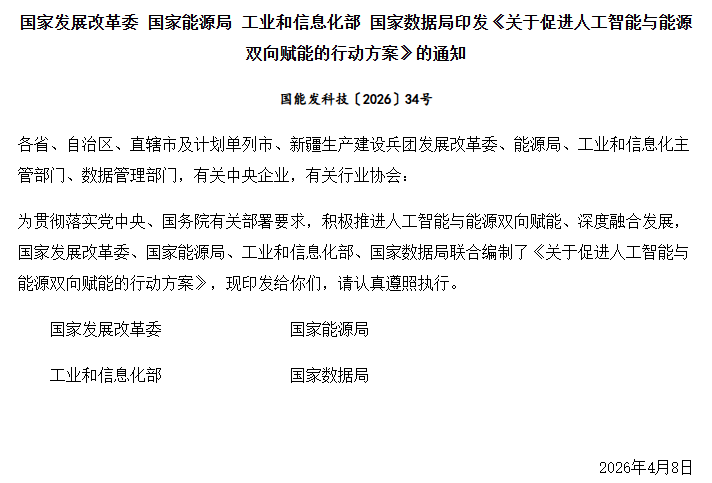
I. General Requirements
Guided by Xi Jinping Thought on Socialism with Chinese Characteristics for a New Era, thoroughly implement the spirit of the 20th CPC National Congress and all plenary sessions of the 20th Central Committee, earnestly carry out the deployments of the Fourth Plenary Session, fully leverage China's advantages in having a complete energy industry system, abundant data resources, and broad application scenarios, promote the efficient synergy of elements such as energy, computing power, scenarios, data, and models, help seize the commanding heights of AI industrial application, and strongly support high-quality energy development.
By 2027, a safe, green, and economical energy support system that underpins AI innovation and development will be preliminarily established, and the interactive capability between clean energy and computing power facilities will be significantly enhanced. High-value scenarios in the energy sector will be gradually opened for application, a long-term management mechanism for the co-construction and sharing of high-quality energy datasets will be preliminarily established, and the utilization efficiency of computing power resources by energy enterprises will be continuously optimized and steadily improved. By 2030, the clean energy supply guarantee capability for AI computing power facilities, as well as the research, development, and application of specialized AI technologies in the energy sector, will reach a world-leading level, and the two-way empowerment of AI and energy will achieve significant results.
II. Ensuring Safe and Reliable Energy Supply for Computing Power Facilities
Coordinate the allocation of energy resources and the construction of computing power facilities, strengthen the supporting role of energy supply for computing power development, ensure the safe and stable operation of computing power facilities, and build a strong barrier for energy security and digital security.
(1) Coordinate and optimize the layout of energy resources and computing power. Coordinate the planning and layout of large-scale new energy bases and national computing power hubs, promote the orderly and reasonable aggregation of computing power facilities and internet backbone direct connection points in areas rich in new energy resources, and facilitate the local and nearby consumption of new energy. Considering regional carrying capacities for energy, water resources, etc., explore the synergistic construction of million-kilowatt-level AI computing power facilities and supporting energy systems, select areas with suitable conditions to carry out pilot projects, and promote the integrated development of computing-power synergy.
(2) Improve the diversified power supply capacity for computing power facilities. Establish and improve standards for the planning and construction of energy supply for computing power facilities based on actual conditions such as the access system scale, grid voltage level, grid new energy penetration rate, power quality requirements, and business types of the computing power facilities. Explore the use of nuclear energy, hydrogen energy, and other energy sources to supply power to computing power facilities through direct connection methods. Encourage computing power facilities to configure grid-forming energy storage to enhance power supply stability and active support capability for the power system.
(3) Enhance the quality of energy supply for computing power facilities. Carry out special actions to improve power supply quality, build a tripartite collaborative governance system involving the government, power grid, and users, guide computing power facilities to reasonably configure power supply reliability and power quality improvement devices, and ensure the power quality for computing power facilities. Strengthen the whole-process monitoring and risk early warning of energy consumption for computing power facilities, and enhance the ability of relevant users to prevent and respond to extreme situations.
III. Promoting the Green and Low-Carbon Transformation of Computing Power Facilities
Solidly promote the statistical accounting of green electricity consumption proportion and carbon emissions for computing power facilities, strengthen policy guidance for direct green electricity connection, continuously improve the energy efficiency and carbon efficiency of computing power facilities, and build a full-chain green and low-carbon development system that coordinates green electricity supply, efficient energy use, and carbon emission control.
(4) Continuously increase the proportion of green electricity used by computing power facilities. Strengthen the layout planning guidance for computing power facility projects, take the proportion of green electricity usage as an important reference indicator, and enhance the level of green computing power supply. Support computing power facilities in increasing the proportion of green electricity consumption by participating in green certificate and green electricity trading. Promote the green and low-carbon transformation of backup power sources for computing power facilities, and encourage the accelerated replacement of traditional fuel generators with clean energy for backup power sources.
(5) Continuously improve the energy efficiency level of computing power facilities. Promote the research, development, and application of technologies such as efficient cooling for computing power facilities, high-performance servers, high-performance power supply architectures, advanced storage, and waste heat resource recovery and utilization. Strengthen the intelligent level of energy consumption management for computing power facilities, improve the energy consumption monitoring and evaluation system for computing power facilities, and encourage enterprises to conduct assessments of computing power performance and energy efficiency/carbon efficiency levels. Explore research and pilot applications of transformative low-power computing chips and system solutions such as brain-like, quantum, and photonic computing.
(6) Strengthen energy conservation and carbon reduction management for computing power facilities. Implement the dual control requirements for total carbon emissions and carbon intensity, and take the renewable energy utilization plan, power usage effectiveness (PUE), green electricity consumption proportion, and waste heat resource recovery and utilization of newly built, renovated, or expanded computing power facilities as important content in the review and evaluation of project energy conservation and carbon reduction. For computing power facilities laid out relying on zero-carbon parks, explore the implementation of a filing system for project energy conservation and carbon reduction review and evaluation. Strengthen the coordinated metering of electricity, computing power, and carbon emissions, encourage carbon footprint accounting and certification services, and guide the green and low-carbon development of computing power facilities.
(7) Improve policies for direct green electricity connection to computing power facilities. Implement classified management of computing power facilities based on the type of computing tasks, and encourage computing power facilities with flexible adjustment capabilities to adopt direct green electricity connections. Study the use of price policies to incentivize computing power facilities to consume a higher proportion of new energy through methods such as direct green electricity connection, continuously improving the green development level of computing power facilities.
IV. Promoting Efficient and Economic Synergy Between Computing Power and Electricity
Fully leverage the scale effect of computing-power synergy, tap into the flexible adjustment potential of computing power facilities, and promote the improvement of comprehensive operational benefits of computing power facilities and the level of energy resource allocation across society through electricity market-based trading.
(8) Strengthen the synergistic operation of computing power and electricity. Promote the establishment of an interaction mechanism between computing power and electricity, use electricity market price signals to guide computing power facilities in optimizing energy management and multi-form computing power scheduling across networks and regions, thereby improving the economic benefits of computing power facilities. Encourage computing power facilities to participate in grid operation as flexible and adjustable resources on the load side, enhancing the regulation capacity of the power system and achieving two-way efficiency improvement for both computing power facilities and the power system.
(9) Strengthen the construction of market mechanisms for computing-power synergy. Encourage newly built computing power facilities to sign multi-year green electricity purchase agreements with renewable energy power generation enterprises, increasing the proportion and supply stability of green electricity consumption, and building an economical, efficient, and green energy supply system for computing power facilities. Support computing power facilities in participating in market transactions such as electric energy, ancillary services, and demand response in various forms. Promote the construction of a green computing power trading system, and facilitate the synergistic optimization of green electricity consumption and computing power resource allocation.
V. Opening High-Value Application Scenarios for AI in the Energy Sector
Drive AI technological innovation with scenario demands, accelerate the deep integration and large-scale development of AI technology across the entire chain of energy production, supply, storage, and sales, and form a virtuous cycle of technological innovation and industrial application.
(10) Identify high-value energy scenarios. Build a demand-driven, dynamically iterative scenario supply system, forming a map of AI energy scenarios that covers major business areas and possesses both industry leadership and international competitiveness. Focusing on key elements such as clear application value, complete data foundation, and large-scale application potential, strengthen the value assessment of AI-empowered energy scenarios, establish a mechanism for selecting and publishing high-value scenarios, and provide practical guidance for the application of AI technology in the energy sector.
(11) Promote the opening of high-value energy scenarios. Build an open sharing platform for energy sector scenarios, establish standard specifications and an evaluation system for opening energy scenarios, encourage energy enterprises to open benchmark scenarios, and drive collaborative innovation across the entire industry chain through point-to-area demonstration. Under the premise of effectively safeguarding national energy security, network security, and commercial secrets, promote the opening and circulation of elements such as technology, data, and software/hardware infrastructure.
(12) Build a closed-loop management mechanism for high-value energy scenarios. Construct a testing and verification platform for open energy scenarios, promote AI technology adaptation verification and scenario application performance evaluation, and continuously standardize the access conditions for AI technology application in the energy sector. Establish a full-lifecycle closed-loop management mechanism covering scenario release, research and development tackling, testing and verification, engineering implementation, and effectiveness evaluation, ensuring that the implementation of AI technology in the energy sector is verifiable, traceable, iterable, and scalable for promotion.
(13) Promote the large-scale application of high-value energy scenarios. Organize and carry out pilot projects for the integration of AI applications in the energy sector, continuously select benchmarks for high-value scenario applications that deeply integrate the needs of the AI and energy industries, accelerate the implementation and application of AI in full-chain scenarios such as energy planning and design, exploration and development, production operation, equipment operation and maintenance, operations, and safety management, and accelerate the improvement of the clean, low-carbon, safe, efficient, flexible, and intelligent level of the energy system.
VI. Unlocking the Value of Data in the Energy Sector
Establish a high-quality energy data development model integrating governance, security, and circulation, fully leverage the value of data as a factor of production, and promote the transformation of energy data from a resource to an asset.
(14) Promote the construction of high-quality datasets in the energy sector. Formulate standards for the construction of high-quality datasets in the energy sector, standardizing the full-lifecycle management and technical requirements for data demand, data architecture, data collection, data preprocessing, data annotation, and quality verification. Driven by business scenarios, accelerate the construction of high-quality datasets for core energy scenarios. Utilize data infrastructure such as trusted data spaces to build a sharing platform for high-quality datasets, establish a dynamic update and long-term operation mechanism, and promote the release of value from high-quality data in the energy sector.
(15) Build a strong barrier for energy data security and privacy protection. Formulate standards and specifications for data classification and grading in the energy industry, and strengthen the protection of energy critical information infrastructure and data. Build a security protection system covering the entire data lifecycle, and regularly conduct security audits and risk assessments. Promote the deep integration of cutting-edge security technologies such as privacy computing and cryptographic computing with energy business scenarios, and accelerate the research, development, application, and promotion of trusted circulation technologies.
(16) Activate the vitality of the energy data factor market. Establish and improve market-oriented rules, mechanisms, and standard specifications suitable for the needs of the energy industry, such as data value assessment and revenue distribution, to open up data circulation paths. Deepen the pilot construction and interconnection of trusted data spaces in the energy sector, promoting the sharing and efficient connection of data resources. Encourage relying on national data infrastructure to explore the cultivation of energy data operation entities and innovate data operation models.
VII. Strengthening AI Model Innovation in the Energy Sector
Strengthen the tackling and innovation of specialized models, deepen the in-depth application of autonomous and controllable hardware in the energy sector, achieve deep coupling between AI technology and the energy industry, and solidify the foundation for AI innovation in the energy sector.
(17) Accelerate technological breakthroughs in specialized energy models. Focusing on areas such as power grids, power generation, coal, oil and gas, and integrated energy, enhance the basic capabilities of large energy models, including generalization and transfer, multi-agent frameworks, collaboration between large and small models, multimodal understanding and generation, and long-sequence reasoning. Encourage specialized energy models to be preferentially opened and shared in national-level AI open-source communities, accelerating the transformation and implementation of model application achievements. Promote the in-depth application of more than five specialized large models in industries such as power grids, power generation, coal, and oil and gas, and promote the aggregation and integration of industry data into specialized large models.
(18) Strengthen the research, development, and application of cutting-edge AI technologies in the energy sector. Promote the research and development of technologies such as intelligent terminals, intelligent agents, embodied intelligence, and AI-native architectures adapted to the energy sector. Improve the testing infrastructure for AI applications in the energy sector, and promote the verification and pilot testing of intelligent equipment and agents. Accelerate the inclusive application of AI technology and industrial intelligent upgrading in the energy sector, promoting industry-wide large-scale promotion and value release. Encourage the development of new business formats such as Model-as-a-Service based on cloud computing, and support the cultivation of a batch of high-quality AI technology service providers.
(19) Promote the in-depth application of autonomous and controllable AI software and hardware in the energy sector. Accelerate the adaptation and optimization of autonomous intelligent computing chips and domestic deep learning frameworks, promote the collaborative operation of multiple frameworks, and advance the application of efficient migration technologies for large energy models in typical scenarios. Continuously promote the iterative upgrading of AI software and hardware technologies in the energy sector, and enhance the intelligence level of energy sector infrastructure.
VIII. Building an Ecosystem for the Synergistic Development of AI and Energy
Based on the full-process needs of AI technology research, development, and application in the energy sector, optimize the allocation of various elements, and build a virtuous ecosystem of two-way empowerment and deep integration between AI and energy development.
(20) Carry out the "AI+" Energy Standardization Enhancement Action. Strengthen the top-level design of "AI+" energy standardization, and establish and improve a standards system for the two-way empowerment of AI and energy. Improve the standardization management mechanism, and, following the principle of urgent use first, promptly develop key technology standards such as AI application capability assessment in the energy sector, green and low-carbon level assessment of computing power facilities, technical requirements for computing-power synergy, and planning and construction of large-load computing power facilities. Vigorously promote the internationalization of "AI+" energy standards, and further advance technical standard exchange and cooperation and mutual recognition of Chinese and foreign standards.
(21) Explore the establishment of an "AI+" Energy Security Governance System. Carry out top-level design for AI security governance, and explore the establishment of basic safety principles for AI research, development, and application in the energy sector. Promote the formulation of standards for dividing safety responsibilities for AI applications in the energy sector, and build a closed-loop control mechanism and risk isolation measures for security governance covering data, models, and applications.
(22) Promote diverse and integrated international exchanges and cooperation. Actively participate in the construction of the global governance rule system for the integrated development of AI and energy, and support the construction of a fair, just, inclusive, and equitable international landscape for the integrated development of AI and energy. Fully leverage the role of intergovernmental bilateral and multilateral energy cooperation mechanisms, deepen exchanges and cooperation with relevant countries, international energy organizations, and professional institutions, make good and flexible use of non-governmental science and technology exchange platforms and international science and technology organizations, and promote technical exchanges and information sharing in the field of AI in energy. Fully leverage China's experience in the construction of energy and computing power facilities, promote the coordinated overseas expansion of AI and energy projects, guide domestic enterprises' advanced experience and technical equipment to "go global," and help the intelligent transformation and upgrading of the global energy industry chain and supply chain.
(23) Build a compound talent training system. Strengthen the construction of disciplines integrating AI and energy, rely on high-level universities and leading technology enterprises to create industry-education integration discipline clusters, and cultivate a batch of compound, innovative, and practical talents. Encourage enterprises, universities, research institutions, and other innovation entities to establish talent training and exchange interaction mechanisms. Encourage the establishment of AI open-source communities in the energy sector, guiding more developers who understand both AI and energy to efficiently solve the innovation and development challenges of energy enterprises through open-source sharing.
IX. Policy Support
Based on the characteristics of "AI+" energy development, establish and improve policy support mechanisms to enhance the momentum for synergistic development of upstream and downstream sectors.
(24) Strengthen scientific and technological innovation. Relying on major national science and technology projects in fields such as energy and AI, increase investment in basic research hotspots, industrial technology pain points, and future development priorities in the field of AI and energy integration. Encourage enterprises to jointly build industry-university-research-application innovation consortia with scientific research institutions, universities, social service organizations, etc., to carry out collaborative research and resource sharing, promoting the deep integration of the innovation chain and the industrial chain.
(25) Promote the transformation of achievements. Promote the priority inclusion of technical equipment related to AI applications in the energy sector into the support scope of the first (set of) major technical equipment in the energy sector, and create an innovation environment for AI applications in the energy sector that allows for trial and error and tolerates failure. Establish and improve mechanisms for quantifying and evaluating the application value of AI in the energy sector, incorporating technology maturity, scenario adaptability, economic benefits, social impact, safety and controllability level, and user evaluation into the evaluation indicator system, guiding the large-scale implementation of AI technologies with significant application effects in the energy sector.
(26) Strengthen financial support. Encourage computing power facilities to apply for Real Estate Investment Trusts (REITs) in the infrastructure sector. Encourage financial institutions to provide financial support for computing power infrastructure projects that meet the requirements of the "Green Finance Supported Project Catalogue (2025 Edition)," and support eligible enterprises in issuing green bonds. Explore providing support for eligible AI and energy integration projects through funding channels such as "Two Major Projects" and "Two New Actions." Guide enterprises to increase investment in AI and energy integration projects, and attract various types of social capital to invest in the field of AI and energy integrated development. Support financial institutions in launching financial products suitable for the characteristics of the AI and energy integration field, and increase financial support under the premise of legal compliance, controllable risks, and commercial sustainability.
X. Organization and Implementation
Strengthen overall coordination, consolidate the responsibilities of all parties, and ensure that all tasks of the action plan are implemented effectively.
(27) Strengthen organization and implementation. Establish and improve a coordinated promotion working mechanism with overall coordination by the National Energy Commission, guidance by the National Development and Reform Commission, organization and implementation led by the National Energy Administration in conjunction with relevant departments, and detailed implementation by provincial governments and key enterprises, forming a work pattern of linkage between upper and lower levels, layer-by-layer implementation, and safe development. All regions should ensure the provision of various elements for the two-way empowerment of AI and energy, and coordinate the promotion of the integrated development of AI and energy. Energy and AI-related enterprises, as the implementation subjects of this action plan, should effectively play the role of innovation entities, accelerate technological research and development, demonstration trials, construction and application, and regularly summarize experiences.
(28) Establish a regular monitoring and evaluation mechanism. Carry out dynamic monitoring of the implementation of the action plan, conduct continuous data and information collection and analysis on the overall situation of the integrated development of AI and energy, and use the monitoring results as an important basis for optimizing resource allocation. Based on monitoring and evaluation, timely and dynamically adjust the goals and key tasks of the action plan according to changes in domestic and international situations.
(29) Strengthen publicity and guidance. Strengthen policy interpretation, enhance public opinion guidance, widely build social consensus, and create an atmosphere for the two-way empowerment development of AI and energy that encourages innovation, deepens application, and is standardized and orderly. Encourage all localities and enterprises to actively explore and innovate, and select typical cases for industry-wide publicity and promotion.
This article is compiled by Wedoany. All AI citations must indicate the source as "Wedoany". If there is any infringement or other issues, please notify us promptly, and we will modify or delete it accordingly. Email: news@wedoany.com
Related Products



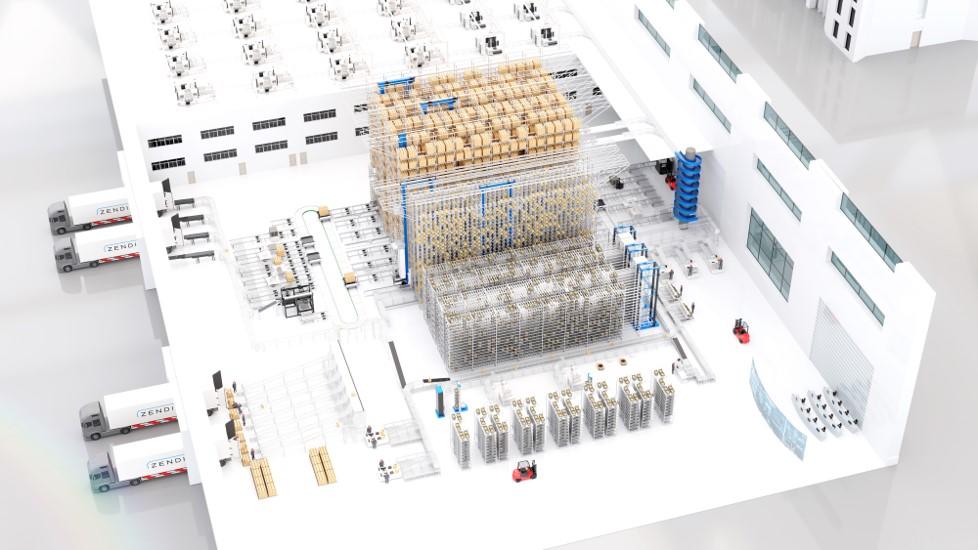
One-Stop Steward Service for the Entire Logistics System Integration Chain
Zhongding Intelligent (Wuxi) Technology Co., Ltd.
G.652.D Wavelength-extended Non-dispersion Shifted Single-mode Optical Fiber
HONGAN GROUP CO., LTD.
MUX Series Communication Interface Device for Security and Stability Control System
Nanjing NR Electric Co., Ltd.
20 Inch 1600*900 Full HD 60Hz TFT LED Monitor with VGA and DP Interfaces for Desktop Computers-Business Use
Guangzhou Zanying Optoelectronics Technology Co., Ltd.


TWP16 P-Band Tropospheric Wind Profile Radar
China Huayun Meteorological Technology Group Co., Ltd.