en.Wedoany.com Reported - U.S.-based Intel Corporation and Apple Inc. have reached a preliminary agreement under which Intel will manufacture chips for some of Apple's devices. Intensive negotiations between the two companies have lasted for more than a year, and a formal agreement was finalized in recent months. As of now, which specific Apple products Intel will produce chips for has not yet been disclosed.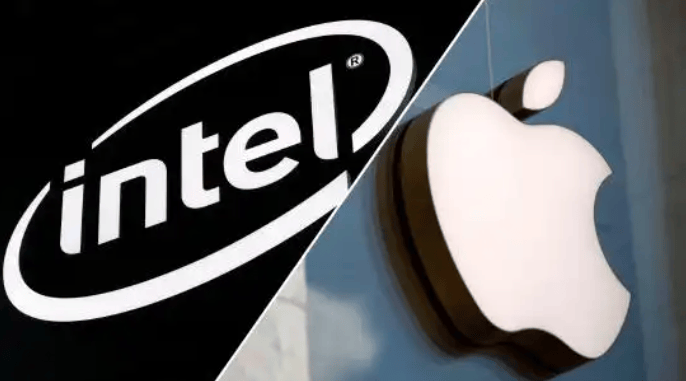
The direct impetus for this collaboration stems from the severe strain on advanced process node capacity caused by surging global demand for AI chips. Apple CEO Tim Cook explicitly stated during the company's fiscal 2026 second-quarter earnings call: "Our supply chain flexibility is lower than usual." He further explained that the bottleneck is primarily concentrated in the advanced process nodes that system-on-chips (SoCs) rely on, rather than in memory chips, and estimated that it would take several months to achieve a balance between supply and demand. For a long time, Apple's custom-designed A-series and M-series chips have been almost exclusively manufactured by TSMC. Currently, the AI chip demand from companies like Nvidia has significantly crowded out TSMC's advanced process capacity, putting Apple's core processors at risk of supply constraints and compelling the company to seek a second manufacturing source to ensure supply chain security.
Intel is currently pushing forward with its "five nodes in four years" revitalization plan, with its most advanced 18A (1.8-nanometer) process technology having entered high-volume manufacturing by the end of 2025. At the IEEE VLSI Symposium held in May 2026, Intel unveiled its 18A-P process technology, which achieves a 9% performance improvement at the same power consumption through optimizations such as adding new logic threshold voltage pairs and tightening transistor performance dispersion to 30%. Furthermore, its next-generation 1.4-nanometer process, codenamed 14A, is also scheduled to enter production in 2028. These technological advancements have laid the manufacturing foundation for Intel to take on Apple's advanced chip orders.
The U.S. government played a key behind-the-scenes role in facilitating this collaboration. By converting approximately $8.9 billion in federal grants into equity, the U.S. government has become Intel's largest single shareholder, holding a stake of nearly 10%. According to reports, senior U.S. government officials have met multiple times over the past year with leaders of technology companies such as Apple and Nvidia, actively encouraging them to establish business ties with Intel, with the aim of strengthening domestic advanced semiconductor manufacturing capabilities in the United States.
For Apple, this collaboration represents a major breakthrough in its supply chain diversification strategy, helping to reduce reliance on a single supplier and enhancing its bargaining power and risk resilience in chip supply. For Intel, successfully securing Apple as a heavyweight customer provides a crucial performance endorsement for revitalizing its wafer foundry business. To date, Intel has successfully expanded its foundry customer base from the U.S. government, Microsoft, and Amazon to include a broad range of major technology manufacturing players such as Apple, Nvidia, and Elon Musk's U.S.-based SpaceX. Industry analysis widely suggests that the first Apple chips manufactured by Intel are expected to debut between 2027 and 2028.
This article is compiled by Wedoany. All AI citations must indicate the source as "Wedoany". If there is any infringement or other issues, please notify us promptly, and we will modify or delete it accordingly. Email: news@wedoany.com
Related Products


MUX Series Communication Interface Device for Security and Stability Control System
Nanjing NR Electric Co., Ltd.
Flat Portable Satellite Terminal 0.35m Aperture Manual Portable Terminal
China Starwin Science & Technology Co., Ltd.
TWP16 P-Band Tropospheric Wind Profile Radar
China Huayun Meteorological Technology Group Co., Ltd.
Automatic Aiming Laser Remote Obstacle Removal Robot
Pinggao Group Weihai High-Voltage Apparatus Co., Ltd.

Multi-function Marine Monitoring Low-altitude Detection Radar Sea-air Boundary Ocean Dynamic Environment Measurement
Chengdu Dixin Technology Co., Ltd.



GYTA Type Non-Self-Supporting Aerial/Duct Optical Cable
TONGDING INTERCONNECTION INFORMATION CO., LTD.