en.Wedoany.com Reported - Lonestar Data Holdings Inc., a space data infrastructure company headquartered in St. Petersburg, Florida, announced on May 11, 2026, that it has signed a Space Act Agreement with NASA's Ames Research Center. The two parties will engage in technical collaboration and operational exploration focused on lunar data storage, resilient extraterrestrial computing infrastructure, and next-generation space communication architectures. Under the framework of this non-reimbursable agreement, initial activities will focus on technical assessment and feasibility validation of the "Lunar Edge" data infrastructure concept, supporting the data needs of future commercial, civil, and scientific space missions.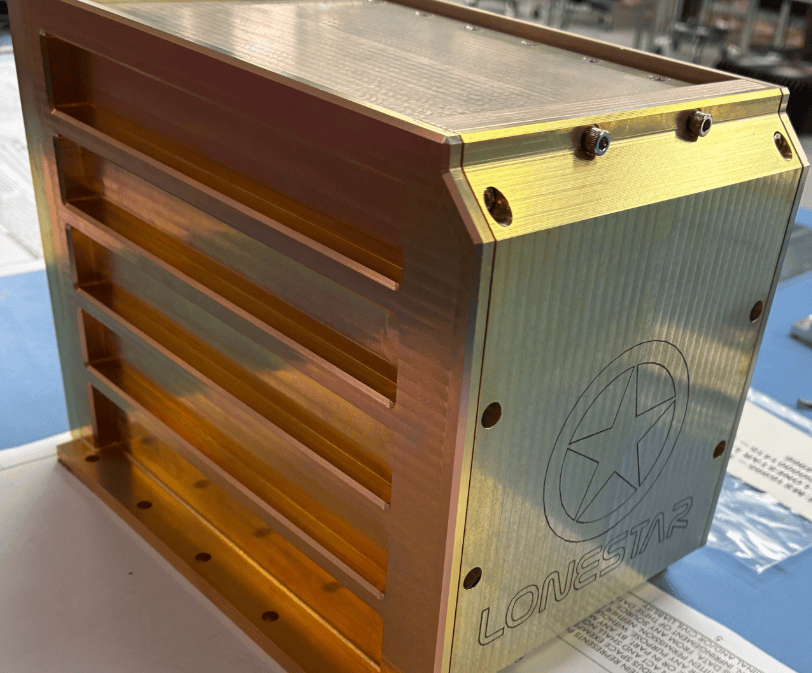
Lonestar CEO Steve Eisele explicitly stated in the signing documents that as humanity expands beyond Earth, trusted data resilience and secure digital infrastructure will become critical elements as important as power and communications. The company is honored to collaborate with NASA Ames to advance technologies supporting the next phase of lunar and cislunar space operations. NASA's Ames Research Center has long served as a core hub for advancing space technology, autonomous systems, and exploration capabilities, supporting NASA's mission portfolio and commercial space partners. This agreement can be seen as a key deployment by NASA to integrate digital infrastructure into its deep space strategy.
The signing of the agreement marks Lonestar's continued push to bring the US national strategy of "space data sovereignty" into industrial implementation. The company articulates its vision as establishing the Moon as the ultimate secure location for Earth's most critical data, enabling governments, enterprises, and mission-critical applications to access independently recoverable disaster recovery capabilities. Unlike traditional government-funded R&D contracts, a Space Act Agreement is a flexible legal instrument for collaboration, allowing NASA and external entities to pursue technology advancement projects aligned with mutual mission objectives under a structure where each party bears its own costs. The existence of such arrangements enables NASA to leverage the commercial sector's role in space infrastructure without directly committing to large-scale fiscal appropriations.
Lonestar completed a $6.6 million Seed+ funding round in January 2026, co-led by Atypical Ventures and California-based The Veteran Fund, coinciding with a leadership transition. Prior to this, the company had completed an oversubscribed $825,000 Pre-A round and a $5 million Seed round at earlier stages. This continuous fundraising tempo reflects the market's attention to the commercial narrative of "Space Infrastructure as a Service."
Lonestar focuses on integrating radiation-hardened hardware, specialized processors, and solutions suitable for vacuum heat dissipation into lightweight, miniaturized integrated data modules. A micro-data center utilizing the Microchip PolaFire SoC FPGA architecture has already achieved flight-proven validation regarding power consumption and environmental adaptability. In 2025, the company delivered an 8TB payload codenamed "Freedom" to the lunar south pole region aboard a SpaceX Falcon 9 rocket and Intuitive Machines' IM-2 "Athena" lunar lander. Earlier that same year, it also completed the space validation of its first software-defined data center, "Independence," using the IM-1 mission, successfully achieving data storage, downlink transmission, and remote access interoperability while the lander was in a tilted state. To date, Lonestar has sent four proof-of-concept data centers into space, including two lunar missions, forming an initial empirical foundation for extraterrestrial data infrastructure.
Building on these validation achievements, Lonestar launched its first commercial space-based data storage service brand, StarVault, in April 2026, and signed orders for two orbital payloads with satellite manufacturer Sidus Space. The first StarVault payload is expected to be launched into orbit aboard Sidus Space's LizzieSat-4 satellite in the fall of 2026, with the second batch order added to meet demand, targeting a 2027 launch. The company also concurrently reached a preliminary agreement with Sidus Space for a lunar orbit data storage satellite valued at a total of $120 million. This orbital information infrastructure, synergizing with the lunar surface data storage under the new NASA agreement, constitutes a three-dimensional Earth-Moon data assurance system, integrating orbital relay links, surface disaster recovery capabilities, and edge computing into a unified architecture.
Lonestar Founder and Chairman Chris Stott has publicly stated that moving data to the Moon can fully leverage three key advantages: the naturally constant-temperature geological structures of the lunar surface, the inherent capability for vacuum heat dissipation, and the security redundancy provided by the physical distance between Earth and the Moon. The company plans to deploy a complete data center system in lunar orbit around 2028 and achieve full-scale deployment on the lunar surface by the early 2030s. This newly signed agreement with NASA not only deepens the technical feasibility basis for these plans but also provides the startup with crucial credentials connecting it to the space technology assurance needs of the US public sector.
This article is compiled by Wedoany. All AI citations must indicate the source as "Wedoany". If there is any infringement or other issues, please notify us promptly, and we will modify or delete it accordingly. Email: news@wedoany.com