en.Wedoany.com Reported - The ultra-wideband photonic chip independently developed by the National Optoelectronics Innovation Center has pushed the electro-optic modulation bandwidth to 250 gigahertz (GHz), setting a new global performance record for similar devices. This chip is vividly likened to a "super-large truck" on the communication network, providing key hardware support to bridge the "bandwidth gap" between current optical fiber and wireless communications.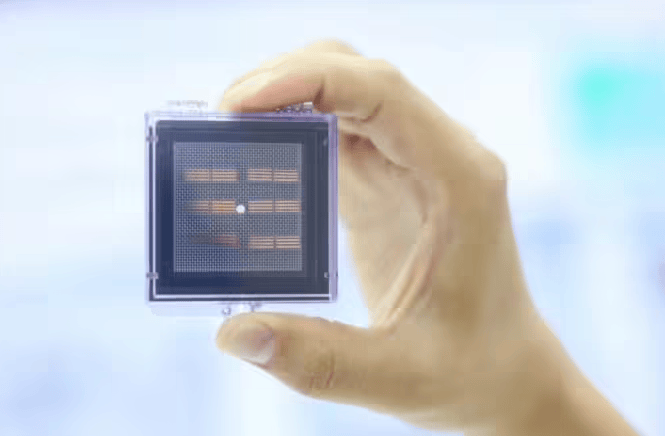
The National Optoelectronics Innovation Center is located in the "Optics Valley of China" in Wuhan, Hubei Province, China. It is a national-level manufacturing innovation platform established to address the "chip shortage" dilemma in the field of information optoelectronics. The center is led by Accelink Technologies Co., Ltd., jointly established with 11 leading industry enterprises including FiberHome Telecommunication Technologies and Hengtong Optic-Electric, adopting an operation model of "company + alliance," and gathering over 60% of the innovation resources in China's information optoelectronics field. Since its official operation in 2018, the center has been committed to achieving self-reliance and controllability in high-end optoelectronic chips and devices.
The core breakthrough of this chip lies in its unprecedented large bandwidth characteristics. Zhang Hongguang, manager of the center's Future Technology Department, introduced that based on this ultra-wideband photonic chip, the center has successfully developed the world's first 170 GHz intensity modulator and has already applied it in domestically produced optoelectronic measurement equipment. This progress not only fills a domestic gap in the field of ultra-high bandwidth optoelectronic conversion devices but also provides core components for building a complete autonomous optoelectronic measurement and testing ecosystem in China.
From an application perspective, the strategic value of this chip lies in its foundational supporting role for 6G communications. The 6G era will build an "integrated space-air-ground" communication network, requiring seamless integration of fiber optic backbone networks and terahertz wireless access networks. With its ultra-large bandwidth, this chip is precisely the core hub for achieving high-speed, low-latency interconnection in such heterogeneous networks. Furthermore, this technology is expected to be extended to satellite-borne communications, promoting technological iteration and performance enhancement of domestically produced satellite communication equipment.
This latest achievement represents another acceleration by the National Optoelectronics Innovation Center on its trajectory of breakthrough technologies. Previously, the center had participated as a core collaborative unit in the major "Fiber-Wireless Integrated Communication" project led by a team from Peking University. The related research results were published on February 18, 2026, in the top international journal Nature, proposing and verifying the integrated "fiber-wireless fusion communication" concept for the first time internationally. This achievement utilized similar ultra-wideband devices developed by the center to achieve a single-channel fiber optic communication transmission rate of 512 Gbps and a terahertz wireless communication transmission rate of 400 Gbps, while supporting the wireless transmission of 86 channels of 8K ultra-high-definition video. The successive breakthroughs indicate that the center is continuously transforming cutting-edge laboratory explorations into usable engineered products.
The successful development of this chip and modulator demonstrates the capability to transform core optoelectronic devices from "samples" to "products." The R&D team relied on a fully domestically produced process platform, circumventing dependence on specific advanced semiconductor manufacturing processes, and explored an independent and innovative technological path. In the future, with deepening research and advancing industrialization, this ultra-wideband chip is expected to play a key role in core scenarios such as 6G base stations, large-scale AI computing center interconnections, and next-generation satellite communication payloads, providing a strong technological foundation for China to seize strategic high ground in the next generation of global information technology competition.
This article is compiled by Wedoany. All AI citations must indicate the source as "Wedoany". If there is any infringement or other issues, please notify us promptly, and we will modify or delete it accordingly. Email: news@wedoany.com