Global Container Ship Orderbook Hits Record High, Chinese Shipyards Command Nearly 80% Market Share
en.Wedoany.com Reported - The container ship orderbook has once again shattered historical records, and among the top ten shipyards by orderbook, as many as eight are from China, highlighting the absolute dominance of "Made in China" in this wave of ordering. However, with a large number of new vessels scheduled for concentrated delivery in the coming years, a severe overcapacity crisis seems almost inevitable.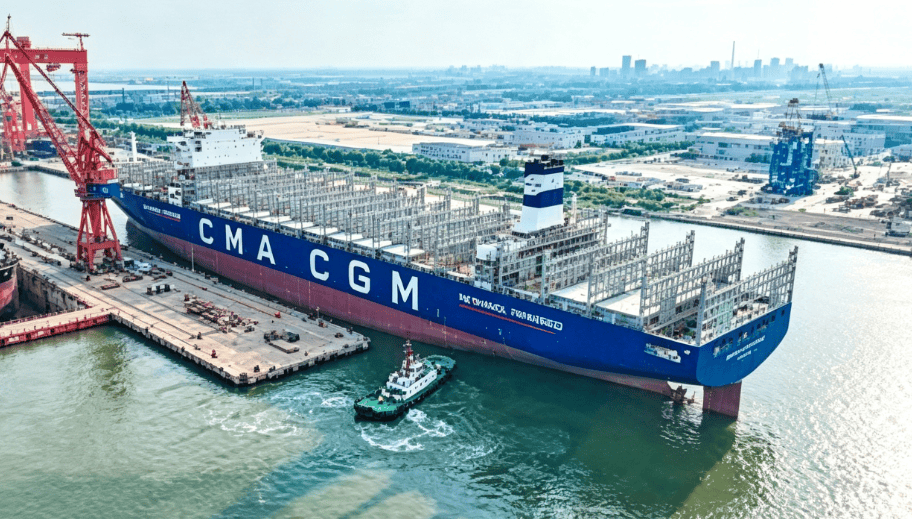
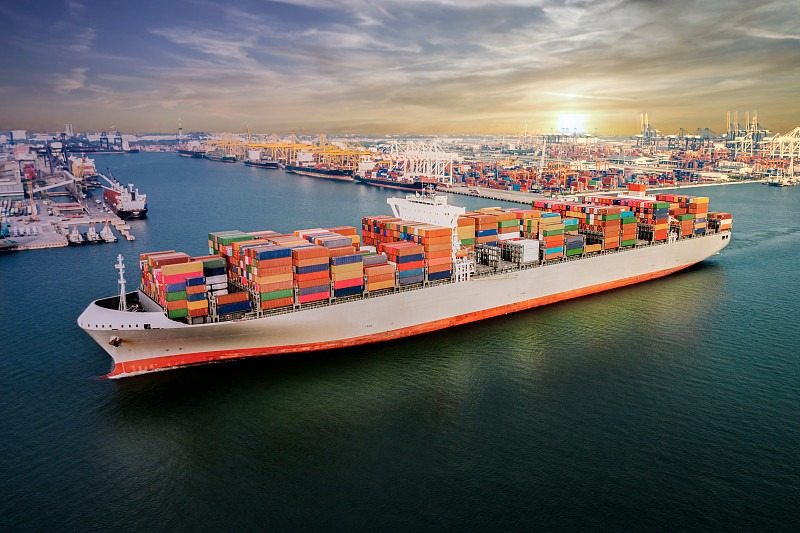
Shipping consultancy Linerlytica stated that driven by the surging "order wave" for container ships, the global container ship orderbook has now climbed to 13 million TEU, a record high. The orderbook-to-fleet ratio has reached 38.3%, the highest level in nearly 20 years since the financial crisis. The total capacity of container ships currently under construction has already surpassed the combined existing fleet capacity of Maersk, CMA CGM, and COSCO Shipping, the three shipping giants ranked second to fourth globally by capacity.
In the first four months of this year, global new container ship orders exceeded 1.9 million TEU. Linerlytica expects that new orders for the full year could surpass the annual record of 5.1 million TEU set in 2025. Most of the additional capacity is scheduled for delivery in 2028, with the total confirmed delivery capacity for 2028 currently standing at 5.2 million TEU.
As available berth resources at shipyards are already very limited, with remaining capacity being filled, container ship deliveries in 2028 are expected to exceed 5.5 million TEU.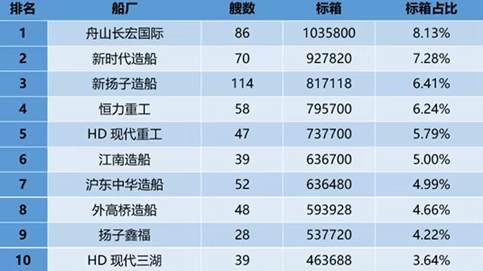
The vast majority of the current container ship orderbook is being built by Chinese shipyards. According to data from Clarksons, Chinese shipyards currently hold orders for 1,282 container ships totaling 10.03 million TEU, representing a market share of about 79% by TEU; in addition, South Korean shipyards hold orders for 199 container ships totaling 2.28 million TEU, with a market share of about 18%.
Among the top ten individual shipyards globally by container ship orderbook, eight are from China. These include the top four: Zhoushan Changhong International (86 ships, approx. 1.04 million TEU), New Times Shipbuilding (70 ships, approx. 930,000 TEU), New Yangzi Shipbuilding (114 ships, approx. 820,000 TEU), and Hengli Heavy Industry (58 ships, approx. 800,000 TEU); and those ranked sixth to ninth: Jiangnan Shipyard (39 ships, approx. 640,000 TEU), Hudong-Zhonghua Shipbuilding (52 ships, approx. 640,000 TEU), Shanghai Waigaoqiao Shipbuilding (48 ships, approx. 590,000 TEU), and Yangzi Xinfu Shipbuilding (28 ships, approx. 540,000 TEU).
On the other hand, only two South Korean shipyards made the top ten list: HD Hyundai Heavy Industries, ranked fifth (47 ships, approx. 740,000 TEU), and HD Hyundai Samho, ranked tenth (39 ships, approx. 460,000 TEU).
The persistently high order volume has sparked market concerns about future overcapacity. Linerlytica bluntly stated that container shipping lines remain mired in an "endless battle for market share," describing the current order wave as "unrestrained," and predicted that an overcapacity crisis is looming.
Currently, as global trade routes remain disrupted and high-risk due to geopolitical tensions, container freight rates and charter rates remain elevated. However, analysts point out that this strong momentum may only be temporary.
Jonathan Roach, an analyst at shipbroker Braemar, said the current prosperity in the container shipping market is largely "borrowed." Due to vessel diversions around the Red Sea and the Suez Canal, voyages have been forcibly extended, thereby absorbing significant capacity and artificially tightening market supply.
Roach noted that while this has indeed supported the market, it is not a permanent solution, and supply growth is the core factor determining the future trajectory of the container shipping market. Although the market is expected to remain relatively firm in 2026 under the influence of route disruptions and operational inefficiencies, starting from 2027, with the massive delivery of new ships and intensifying cascading effects, the small and medium-sized vessel market will face greater pressure.
He predicts that by 2028, overcapacity will become a reality, at which point freight rates will face downward pressure, idle capacity will increase, and ship demolition activity will eventually pick up significantly. Although market demand is still expected to grow by about 2% to 4% annually, roughly in line with global GDP growth, this is far from sufficient to absorb the massive influx of new capacity about to enter the market.
Clarksons Research noted that the benefits derived from shipping disruptions, along with the further delay in the full resumption of Red Sea routes, have strengthened the short-term market outlook heading into this summer. However, the underlying supply-demand fundamentals still point to a weakening market ahead, while macroeconomic risks also require close attention.
This article is compiled by Wedoany. All AI citations must indicate the source as "Wedoany". If there is any infringement or other issues, please notify us promptly, and we will modify or delete it accordingly. Email: news@wedoany.com