en.Wedoany.com Reported - On May 20, as the final steel pylon section was precisely positioned, the main pylon of the Jiangjunzhou Bridge on the Nanchang Poyang Lake Tourist Highway was successfully topped out. The project is under the construction management of Nanchang Transportation Investment Group Co., Ltd., designed by Shanghai Urban Construction Design & Research Institute, and constructed by China Railway Major Bridge Engineering Group. This achievement set a new record for the "World's Tallest Composite Structure Inclined Pylon," marking the completion of all main bridge works, with construction now fully transitioning to ancillary works.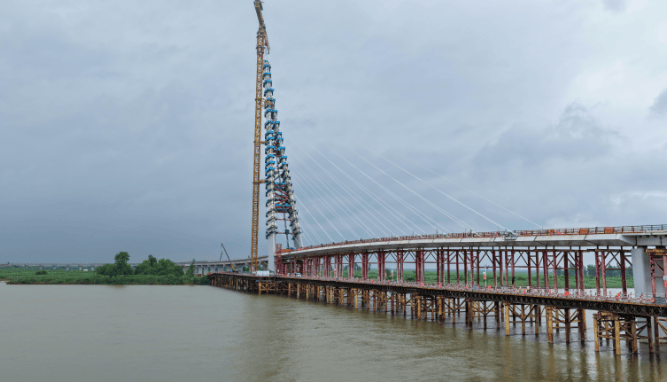
The Jiangjunzhou Bridge has a total length of 1,827 meters with a main span of 225 meters. It features a cable-stayed design without backstays and a deck width of 10 to 14 meters. Built to two-lane, two-way standards, upon completion it will set two world records: the longest-span cable-stayed bridge without backstays and the tallest composite structure inclined pylon.
"The main pylon of the bridge is not a traditional straight pylon or a single inclined straight pylon, but a structure that inclines in two directions spatially, making it a true three-dimensional irregular structure," introduced Wei Wentao, Director of the Poyang Lake Tourist Highway Bridge Project Office. Unlike conventional cable-stayed bridges, the Jiangjunzhou Bridge is a cable-stayed bridge without backstays. Its main pylon adopts an A-shaped composite structure with a total height of 158 meters, a height of 133 meters above the bridge deck, and a total pylon shaft length of 173 meters along its axis. A backstay-free structure of such height and volume is unprecedented globally. Precisely controlling the balance between the main pylon and the main girder was the core difficulty of the entire construction process. Facing these construction challenges, the project team summarized and implemented six major innovative measures, including the "girder before pylon" construction technique, enhanced pre-construction force calculation analysis, refined concrete pouring control, and the establishment of a full-process monitoring and tracking mechanism, systematically overcoming the force balance and stability challenges of the pylon-girder-cable system.
To address the longitudinal displacement challenge during the main pylon construction, multiple displacement monitoring points were set up at different heights and key locations on the tall pylon. High-precision total stations, leveling instruments, and other equipment were used to monitor the pylon's displacement and inclination in real-time. Furthermore, a multi-point girder lifting system and adjustable slings were designed, calculating the forces at lifting points to achieve fine attitude adjustments. This enabled the high-quality, precise installation of 39 steel pylon sections, with all indicators for the main pylon topping out exceeding design requirements.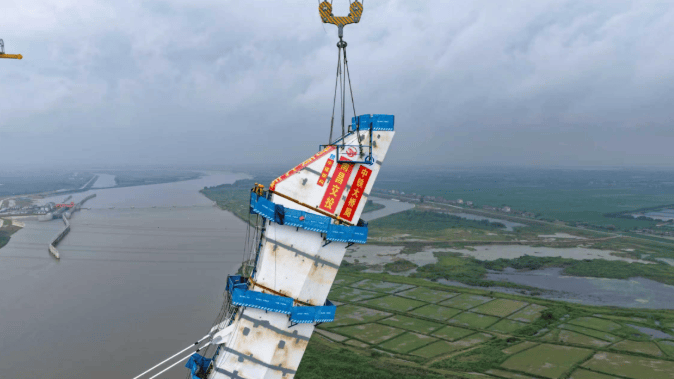
Next, the project will fully commence the remaining ancillary works, including bridge deck paving, guardrail installation, traffic safety facilities, and landscape lighting. According to the plan, the bridge is expected to meet conditions for traffic by June. The Jiangjunzhou Bridge is a key project of the second phase of the Nanchang Poyang Lake Tourist Highway Bridge Project, located between the Hongqi Levee and Jiangxiang Levee. Once completed, the project will further improve the transportation network around the Poyang Lake region, enhance travel efficiency on both sides of the Gan River, and play a significant role in strengthening flood control safety, promoting ecological protection, and driving economic development.
This article is compiled by Wedoany. All AI citations must indicate the source as "Wedoany". If there is any infringement or other issues, please notify us promptly, and we will modify or delete it accordingly. Email: news@wedoany.com