US-based Muon Space Unveils Condor-Ultra Platform for Orbital Data Centers
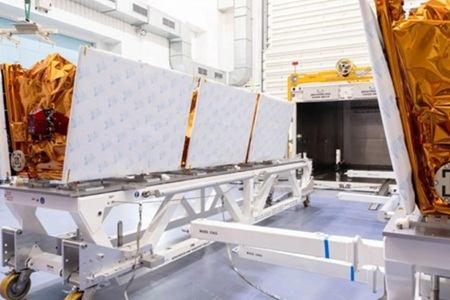
en.Wedoany.com Reported - On June 3, US satellite platform company Muon Space unveiled the Condor-Ultra, a Starship-class satellite platform. Designed for missions such as orbital data centers, communications, remote sensing, and orbital computing, the first Condor-Ultra pathfinder is scheduled for delivery in 2028, with subsequent launch cadence depending on customer orders and mission schedules.
The launch of Condor-Ultra reflects that orbital data centers are moving from conceptual discussions to satellite platform pre-research and engineering product stages. As demand rises for AI model inference, remote sensing data processing, space communication networks, and on-orbit edge computing, traditional small satellite platforms face higher requirements in power, heat dissipation, payload area, network connectivity, and batch deployment efficiency. Muon Space defines Condor-Ultra as a "Starship-class" platform, primarily because it is optimized for large-scale stacked launches on SpaceX's Starship, supporting the deployment of constellations comprising hundreds to thousands of satellites, while also being adaptable to medium-lift launch vehicles such as Falcon 9 and Rocket Lab Neutron. For orbital data centers, whether the platform can provide stable power, high-bandwidth interconnection, autonomous operation capabilities, and scalable manufacturing determines if on-orbit computing can transition from single-point experiments to constellation-level infrastructure.
Muon Space disclosed that the base version of Condor-Ultra has a power capacity of 20 kilowatts, with future high-power models scalable to 100 kilowatts; the platform offers over 18 square meters of Earth-facing payload area and supports continuous 25Gbps Starlink connectivity and 100Gbps inter-satellite optical mesh communication.
These specifications position Condor-Ultra closer to an "on-orbit computing node" rather than a typical remote sensing satellite platform. Operating an orbital data center involves not just sending servers into space, but also complex engineering challenges such as power acquisition, thermal management, network backhaul, inter-satellite coordination, equipment autonomy, task scheduling, and fault recovery. In its press release, Muon Space stated that the platform architecture is designed from the power, thermal control, and network perspectives to meet the needs of orbital data centers, and can integrate next-generation AI inference hardware, including the NVIDIA Space-1 Vera Rubin Module. This means Condor-Ultra aims to combine a high-power satellite platform, AI inference modules, and space internet connectivity, providing a unified foundation for future communications, remote sensing, distributed computing, and data center-level missions. As ground-based data centers face constraints in power, land, cooling, and computing deployment cycles, some enterprises are beginning to evaluate the long-term potential of on-orbit computing, and satellite platform manufacturers are also positioning themselves early in this emerging space infrastructure market.
Key variables going forward include customer signings, the delivery schedule of the first pathfinder, conditions for Starship batch launches, on-orbit thermal management validation, space adaptation of AI inference hardware, and whether the orbital data center business model can be established. If Condor-Ultra proceeds to mission verification as planned, it will serve as an important benchmark for observing the transition of large-scale on-orbit computing from vision to engineering deployment, and will also drive satellite platform competition from "smaller and lower-cost" to a new phase of "higher power, stronger networking, and better suitability for batch computing tasks."
This article is compiled by Wedoany. All AI citations must indicate the source as "Wedoany". If there is any infringement or other issues, please notify us promptly, and we will modify or delete it accordingly. Email: news@wedoany.com
Related Products

KJD127(A) Mining Explosion-Proof and Intrinsically Safe Computer
Taiyuan Xiangming Intelligent Control Technology Co., Ltd.
Automatic Aiming Laser Remote Obstacle Removal Robot
Pinggao Group Weihai High-Voltage Apparatus Co., Ltd.

G.652.D Wavelength-extended Non-dispersion Shifted Single-mode Optical Fiber
HONGAN GROUP CO., LTD.

Multi-function Marine Monitoring Low-altitude Detection Radar Sea-air Boundary Ocean Dynamic Environment Measurement
Chengdu Dixin Technology Co., Ltd.

Industrial and Commercial Point-Type Gas Detector
Jinan Benan Technology Development Co., Ltd.

Conveyor Belt Intelligent Monitoring System
LUO YANG WIRE ROPE INSPECTION TECHNOLOGY CO., LTD.