China's Guangxiang Technology Launches Industrial-Grade Embodied Intelligent Robot Phi-Bot X1
en.Wedoany.com Reported - Recently, China's embodied intelligence company Guangxiang Technology released the industrial-grade self-evolving embodied intelligent robot Phi-Bot X1. Designed for high-precision, multi-station, high-takt industrial production lines, this product features an industrial-grade body design, is equipped with a self-developed physical native intelligence model, and supports large-scale deployment through the Phi-Arch physical intelligence development platform. Its goal is to achieve autonomous perception, decision-making, operation, and continuous learning in real factory environments.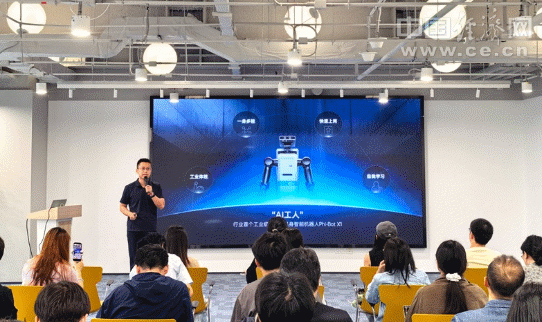
The requirements for embodied intelligent robots in industrial scenarios differ from those for ordinary demonstration robots. Production line tasks often involve complex processes such as positioning, handling, assembly, loading/unloading, inspection, collaborative avoidance, and takt matching. Robots must not only perform single actions but also adapt to station changes, material variations, and on-site disturbances. Phi-Bot X1 emphasizes "multi-functionality, rapid deployment, and self-learning," with the core aim of reducing the time costs associated with line changeovers, debugging, and process migration in traditional automation equipment. For automotive manufacturing, precision electronics, component assembly, and flexible production lines, if such robots can stably adapt to multiple tasks, they will help improve equipment utilization rates and reduce the customization pressure on individual production lines.
The key support for Phi-Bot X1 comes from the physical native intelligence model and the Phi-Arch development platform. The former enhances the robot's understanding of the real physical environment, enabling it to handle workpiece posture, spatial constraints, and dynamic changes during grasping, alignment, movement, and operation. The latter is more akin to a development foundation for industrial deployment, integrating task development, scenario adaptation, model iteration, and production line collaboration into a unified process. Once embodied intelligence enters the factory, the capability of a single robot is just the foundation; the speed of commercialization depends on whether it can be replicated in batches across different stations, equipment, and process flows.
This release also reflects that competition in industrial robots is shifting from "mechanical execution" to "intelligent operation systems." In the past, industrial automation relied more on fixed tooling, teach programming, and highly standardized production lines, offering stability but lacking flexibility. As manufacturing enterprises face demands for small batches, diverse product types, rapid changeovers, and high-quality inspection, robots need stronger environmental perception, task planning, and adaptive operation capabilities. If the self-evolving ability can continuously accumulate data and optimize action strategies on real production lines, robots will gradually transform from one-time delivery devices into continuously upgradable industrial intelligent agents.
For the industrial chain, Phi-Bot X1 will drive demand in areas such as machine vision, force control actuators, robot controllers, industrial sensors, edge computing, physical simulation, production line data interfaces, and industrial software. For embodied intelligent robots to truly enter factories, they also need to coordinate with MES, WMS, PLC, tooling fixtures, and safety systems to ensure production takt, quality traceability, and personnel safety. Subsequent focus points include the initial production line deployment of Phi-Bot X1, its stable operation performance in different industrial scenarios, the support capability of the Phi-Arch platform for large-scale replication, and its actual efficiency improvements in scenarios such as automotive manufacturing and precision assembly. If application results are continuously validated, Guangxiang Technology is expected to drive embodied intelligence from laboratory demonstrations further into the mainstream process of industrial production.
This article is compiled by Wedoany. All AI citations must indicate the source as "Wedoany". If there is any infringement or other issues, please notify us promptly, and we will modify or delete it accordingly. Email: news@wedoany.com
Related Products






Industrial and Commercial Point-Type Gas Detector
Jinan Benan Technology Development Co., Ltd.

MUX Series Communication Interface Device for Security and Stability Control System
Nanjing NR Electric Co., Ltd.
One-Stop Steward Service for the Entire Logistics System Integration Chain
Zhongding Intelligent (Wuxi) Technology Co., Ltd.

TWP16 P-Band Tropospheric Wind Profile Radar
China Huayun Meteorological Technology Group Co., Ltd.