American Chemistry Council Forecasts Only 0.5% Growth in Chemical Production in 2026
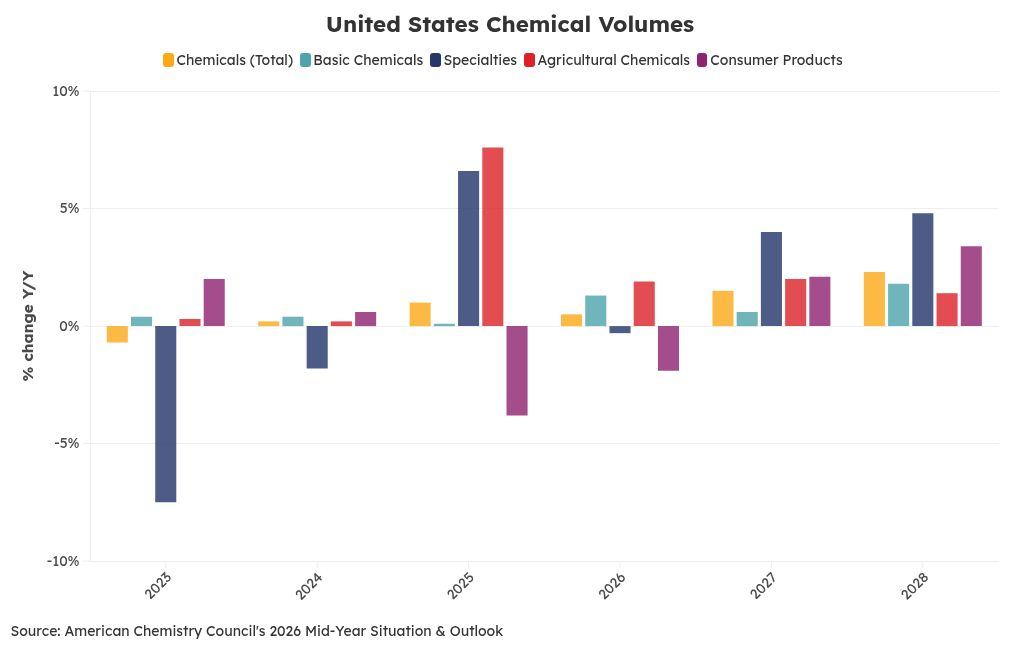
en.Wedoany.com Reported - The American Chemistry Council (ACC) recently released its latest economic outlook, forecasting that U.S. chemical production will grow by only 0.5% in 2026, with growth in basic chemicals and agricultural chemicals offset by declines in consumer and specialty chemicals. The report notes that geopolitical conflicts, inflationary pressures, and high interest rates are creating significant uncertainty for the chemical industry and related manufacturing sectors.
The report projects that U.S. gross domestic product (GDP) will grow by 2.1% in 2026, unchanged from 2025. Inflationary pressures are intensifying, primarily due to rising oil prices, with consumer prices expected to accelerate by 3.5% for the full year. If the Middle East situation is resolved, a deflationary trend is expected to resume in 2027, with consumer price growth at 2.4%. The unemployment rate is projected to remain largely stable in 2026 and 2027, at 4.4% and 4.5%, respectively. Consumer spending growth is expected to slow to 1.9% in 2026 and 1.8% in 2027, compared to 2.6% in 2025. Business investment is showing a "two-track" pattern, with data center construction related to artificial intelligence continuing to exceed expectations, driving demand for semiconductors, computers, electrical equipment, and advanced cooling materials, but investment outside of AI and electricity remains weak.
The American Chemistry Council points out that chemistry is the foundation of manufacturing, with over 80% of basic and specialty chemicals purchased directly by the industrial sector. Affected by the Middle East conflict, precautionary inventory accumulation has boosted manufacturing activity in some industries, while others have benefited from the data center supply chain. Overall industrial production is expected to grow by 1.3% in 2026, but growth is uneven, with only 12 of the 20 key chemical-consuming end-use industries expected to expand. Industries related to data center investment, aircraft, oil and gas, and pharmaceuticals are growing, while those tied to residential construction remain weak.
Housing and automobiles are important end markets for chemical products. The report shows that an average single-family home built in the U.S. contains over 33,000 pounds of chemical products. With mortgage rates still well above 6%, affordability continues to constrain the housing market, and housing starts are expected to stabilize at 1.36 million units in 2026. In automotive manufacturing, an average car made in North America contains $4,400 worth of chemical products. Due to affordability constraints, auto sales are expected to be limited to 15.7 million units in 2026, down from 16.2 million in 2025.
In chemical trade, despite competitive advantages based on natural gas, supply chain disruptions pose challenges. U.S. chemical exports fell by 3.4% in 2025 and are expected to grow by 4.0% in 2026. U.S. chemical imports fell by 9.8% in 2025 and are expected to decline by another 1.0% in 2026. Capital expenditures for equipment and structures in the chemical industry grew by 1.3% in 2025, and growth is expected to remain sluggish at 0.9% in 2026. Employment in the chemical industry continued to slow in 2025 and is expected to remain largely flat in 2026 and 2027, with the average compensation for the industry's 545,000 workers at $108,000, well above the manufacturing average.
This article is compiled by Wedoany. All AI citations must indicate the source as "Wedoany". If there is any infringement or other issues, please notify us promptly, and we will modify or delete it accordingly. Email: news@wedoany.com
Related Products


Industrial and Commercial Point-Type Gas Detector
Jinan Benan Technology Development Co., Ltd.

Steel Pipes for Refining and Coal Chemical Industries
YANGZHOU LONTRIN ENERGY EQUIPMENT CO.,LTD.

High Thermal Conductivity Encapsulating Resin
Nantong BESALL Sealing Technology Company.,Limited