en.Wedoany.com Reported - Every year, carbon dioxide emissions from the operational phase of global shipping exceed 1 billion tons, posing a significant obstacle to the global energy transition. In recent years, electric ships have gradually seen applications in certain scenarios, but due to range limitations, they have yet to become a mainstream form of propulsion.
However, with the emergence of a new research project, a novel concept has been born—the Electric Shipping Highway.
Stillstrom, a Maersk subsidiary specializing in offshore power and charging solutions, has launched a study titled "Energy Island Bornholm Powering Maritime Electrification," aimed at exploring how to integrate offshore wind power with port infrastructure and offshore charging concepts to help ferries, cargo ships, and service operation vessels (SOVs) transition away from fossil fuels.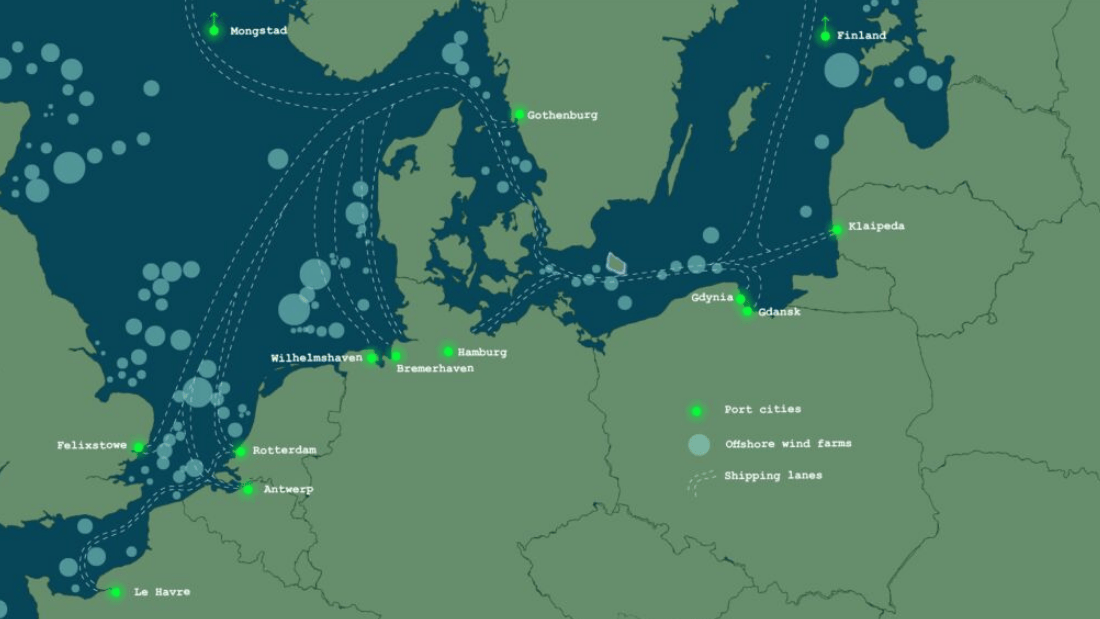
This study focuses on deploying electric ship charging facilities and other supporting infrastructure at major energy islands and key ports. However, these facilities alone cannot guarantee the range of electric ships. On one hand, energy islands are costly to build and limited in number; on the other hand, as offshore wind farms are increasingly located farther from shore, returning to port for charging each time is impractical.
Consequently, industry experts have proposed a plan to build charging facilities based on offshore wind farms. The North Sea is dotted with numerous offshore wind farms of various sizes. By constructing charging stations near shipping lanes adjacent to these wind farms, convenient charging conditions can be provided for passing vessels of all sizes, while also increasing the local consumption ratio of offshore wind power and reducing transmission losses.
According to statistics, approximately 37,000 ships pass through the waters near the Bornholm Energy Island each year, consuming about 3 million tons of marine fuel and emitting roughly 10 million tons of carbon dioxide annually. If this segment were fully electrified, it could consume 17 TWh of electricity per year, replacing approximately €2 billion worth of fossil fuel imports.
If all offshore wind farms in the North Sea were utilized and charging facilities were built near shipping lanes, the entire North Sea could become the world's first fully electrified waterway, significantly reducing carbon dioxide emissions.
This article is compiled by Wedoany. All AI citations must indicate the source as "Wedoany". If there is any infringement or other issues, please notify us promptly, and we will modify or delete it accordingly. Email: news@wedoany.com