China's Lovol Heavy Industry Enhances Batch Delivery Capability of Construction Machinery through Intelligent Manufacturing
en.Wedoany.com Reported - Recently, Lovol Heavy Industry's intelligent manufacturing upgrade has attracted attention. Inside its intelligent manufacturing workshop, automated welding robots, AGV unmanned transport vehicles, an intelligent warehousing system, and production data dashboards together form a digital production site. Public information shows that a medium-sized excavator can roll off the production line every 15 minutes at Lovol Heavy Industry. The intelligent transformation is reshaping the construction machinery manufacturing process across stages including welding, painting, assembly, logistics, and quality traceability.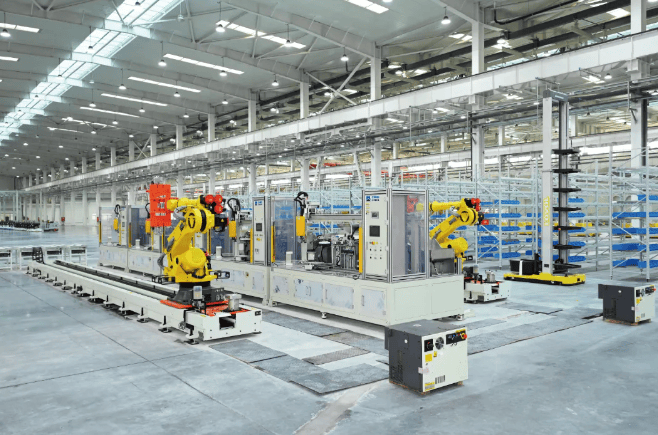
Lovol Heavy Industry has established an intelligent manufacturing layout covering "two locations and three factories," connecting the entire chain from core component precision machining, structural part forming, and complete machine assembly to factory testing. This layout supports batch manufacturing of products including 1.5-ton to 200-ton excavators, 2-ton to 12-ton loaders, 70-ton to 160-ton mining dump trucks, and backhoe loaders. For construction machinery enterprises, the value of such a layout lies not only in expanding production capacity but also in integrating multi-category, multi-tonnage, and multi-condition products into a unified manufacturing system, thereby improving order response and quality consistency.
In the component production stage, nearly one hundred automated welding robots handle the welding of core structural parts. Structural parts are crucial for the strength, reliability, and service life of excavators, loaders, and mining vehicles, and weld quality directly affects the durability of the complete machine. Lovol Heavy Industry's intelligent production line controls welding errors within the millimeter range, with the first-pass yield rate for key welds consistently above 99%. A welding automation rate of 90% means that key processes have shifted from being driven by manual experience to being jointly controlled by process parameters, robot trajectories, and digital inspection.
The painting stage is also a critical part of quality control in construction machinery. Construction machinery is often exposed to high temperatures, high humidity, high salt spray, mud, mine dust, and outdoor construction environments. The anti-corrosion, weather resistance, and adhesion properties of the paint finish are related to the equipment's appearance retention and structural protection. Lovol Heavy Industry's painting workshop uses a closed-loop automated spray painting production line, employing materials such as water-based paint and two-component epoxy solvent primer, achieving a painting automation rate of 95%. In the context of global sales, painting quality also determines whether products can adapt to different regional working conditions.
In the material flow stage, AGV unmanned transport vehicles and the intelligent warehousing system work in tandem, automatically completing delivery and flexible transfer based on production tasks. The assembly of complete construction machinery involves a large number of components with complex specifications and significant batch variations. Traditional material management can easily lead to waiting, mismatches, and inventory backlogs. By integrating the intelligent warehousing and AGV system with the production plan, material delivery can be matched with the assembly rhythm, reducing production waiting time and minimizing the risk of errors and omissions caused by manual transport.
Quality traceability is a core link in Lovol Heavy Industry's intelligent manufacturing system. Relying on the MOM (Manufacturing Operations Management) execution system, the company establishes a full lifecycle quality file for each piece of equipment. A unique identity identifier is created from the moment components enter the factory, and data from processing, assembly, and inspection are all recorded by the system. Digital terminals are installed at each stage of the production line, allowing operators to view work instructions and production tasks in real time, while the system automatically verifies component models and assembly processes. In the event of a quality anomaly, the system can issue an alert and trace back to the specific component batch and processing records.
This full-chain digital control addresses the issue of consistency in construction machinery manufacturing. Construction machinery products often serve different scenarios such as mines, earthworks, municipal projects, ports, and overseas infrastructure. Customers demand not only reliable equipment but also delivery speed and customization capabilities. Relying solely on final inspection makes it difficult to prevent quality fluctuations at the source. By moving data collection, process control, anomaly alerts, and batch traceability forward into the production process, problems can be prevented from flowing into subsequent stages.
After the new factory commenced operations, Lovol Heavy Industry shortened the mass production cycle for new products by approximately 30%, reduced the production hours per unit, and enabled faster response to order demands from different regions and working conditions. Its products are now sold to over 100 countries and regions worldwide. Overseas markets impose higher requirements on batch delivery, spare parts compatibility, quality stability, and service response. The intelligent manufacturing system provides manufacturing support for Lovol Heavy Industry to compete in the international construction machinery market.
The construction machinery industry is shifting from pure capacity competition to competition in quality, delivery, green manufacturing, and digital operational capabilities. The true value of intelligent manufacturing is not just making the workshop look more automated, but integrating product consistency, production rhythm, material efficiency, quality traceability, and global delivery into a single system. Lovol Heavy Industry's practice shows that for construction machinery enterprises to enter higher-end markets, the manufacturing system itself must possess verifiable, traceable, and replicable capabilities.
This article is compiled by Wedoany. All AI citations must indicate the source as "Wedoany". If there is any infringement or other issues, please notify us promptly, and we will modify or delete it accordingly. Email: news@wedoany.com
Related Products





Flat Portable Satellite Terminal 0.35m Aperture Manual Portable Terminal
China Starwin Science & Technology Co., Ltd.
G.652.D Wavelength-extended Non-dispersion Shifted Single-mode Optical Fiber
HONGAN GROUP CO., LTD.

Conveyor Belt Intelligent Monitoring System
LUO YANG WIRE ROPE INSPECTION TECHNOLOGY CO., LTD.

MUX Series Communication Interface Device for Security and Stability Control System
Nanjing NR Electric Co., Ltd.
One-Stop Steward Service for the Entire Logistics System Integration Chain
Zhongding Intelligent (Wuxi) Technology Co., Ltd.