en.Wedoany.com Reported - Exactmer, a spin-out from Imperial College London, has developed a pilot-scale membrane capable of separating crude oil fractions without heat, a breakthrough that could significantly reduce energy consumption in refining.
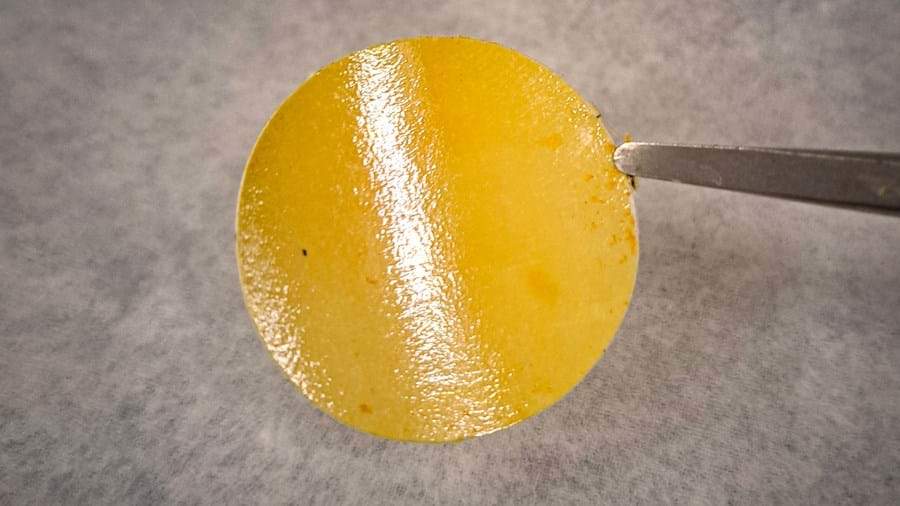
In a paper published today in Science, a team of researchers from the UK, China, Saudi Arabia, and Singapore describes a 1-meter-wide membrane manufactured using a roll-to-roll process. Andrew Livingston, CEO and principal investigator at Exactmer, believes the research shows membrane fractionation technology is now "ready" for commercial application.
Traditional thermal distillation accounts for approximately 1% of global energy consumption. Membrane technology has long been viewed as a low-energy alternative, with estimates suggesting energy savings of up to 90%. However, the trade-off between separation speed and selectivity has been a persistent barrier to commercialization. The researchers say they have overcome this hurdle, with their membrane achieving permeability roughly 10 times higher than current state-of-the-art membranes while maintaining equally high selectivity.
This progress stems from a novel polymer structure whose microscopic pores remain stable when exposed to hydrocarbons. By introducing cross-linking during manufacturing, the team prevented swelling, a phenomenon that typically degrades membrane performance. Zhiwei Jiang, head of membrane development at Exactmer, stated: "This preserves the tiny pores needed for molecular separation while still allowing hydrocarbons to flow rapidly."
Independent experts have acknowledged the work. Ryan Lively, a professor of chemical and biomolecular engineering at the Georgia Institute of Technology, called it "a remarkable achievement." He added that while cross-linking had been considered before, the researchers found "the optimal balance point for membrane performance."
In tests on Arab extra-light crude oil, the team's membrane extracted nearly 100% of heavy hydrocarbons with carbon numbers greater than 15 and removed over 90% of sulfur-containing compounds. The researchers say this could reduce the need for downstream desulfurization, thereby simplifying the refining process. When processing real crude oil, the membrane maintained stable performance over 30 days of continuous operation, albeit at lower flow rates than with synthetic mixtures. Additionally, it has been integrated into standard spiral-wound modules widely used in industry, demonstrating its potential for commercial deployment.
Lively noted that the successful scale-up from a laboratory sample to a full-size membrane module is particularly encouraging. He said: "Moving from stamp-sized tests to full-size membrane modules in such a short time shows a bright future for membrane-based refining." The team is currently exploring green alternatives to chloroform, the solvent used to manufacture the membrane. Exactmer also plans to develop similar technology for pharmaceutical separations.
This article is compiled by Wedoany. All AI citations must indicate the source as "Wedoany". If there is any infringement or other issues, please notify us promptly, and we will modify or delete it accordingly. Email: news@wedoany.com