U.S. Startup Panthalassa Plans to Deploy Oceanic Floating Data Centers by 2027
en.Wedoany.com Reported - SpaceX is pitching investors on a plan to launch data centers into space, with Elon Musk envisioning a solar-powered satellite network processing information in orbit before transmitting it back to Earth. Ground-based data centers have sparked community opposition in many areas, driving up electricity prices, generating noise, and causing pollution. SpaceX aims to begin launching orbital data centers in 2028, but its initial public offering documents include a warning: the plan involves immense technical complexity, unverified or nonexistent technologies, and risks to commercial viability.

Another option for moving data centers off land and reducing operating costs is the ocean. Panthalassa (Greek for "the entire ocean"), a startup based in Portland, Oregon, backed by Peter Thiel and Silicon Valley venture capital firms, has spent the past decade developing floating data centers that generate their own electricity from open ocean waves and use frigid seawater for cooling. The company expects its commercial units to be operational by 2027, a year earlier than SpaceX's claimed potential launch of computing satellites.
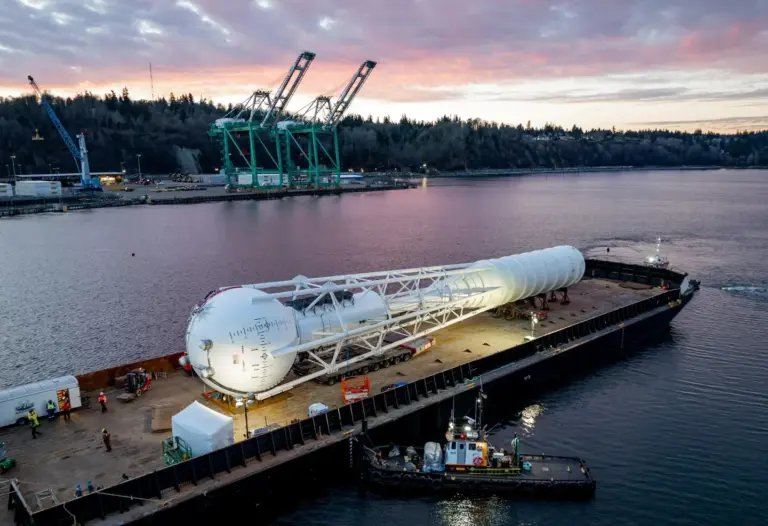
"What we're doing is absolutely crazy," co-founder and CEO Garth Sheldon-Coulson told Forbes. "We are the first company to actually go out into the middle of the ocean to do this." Since last year, Panthalassa has been testing its prototype node, Ocean-2, off the coast of Washington state, using a 70-meter-long steel tower that pumps water by bobbing up and down with waves to generate up to 1 megawatt of continuous power. Units planned for deployment next year will house chips and computing hardware to perform AI learning operations and transmit data via satellite. "This will be the lowest-cost way to perform large-scale AI computing, inference, and reinforcement learning, with zero emissions," Sheldon-Coulson said.
Ocean energy has captivated scientists for over a century. Estimates from the International Energy Agency (IEA) suggest wave energy could generate thousands of terawatt-hours of electricity annually. Panthalassa is not the first to attempt the ocean data center concept. Microsoft tested a subsea unit connected to land-based power off the coast of Scotland but ended the research in 2024. China is also experimenting with wind turbine-powered subsea data centers. Panthalassa emphasizes operating in deep waters where wave energy is more abundant, with nodes capable of autonomously repositioning and no connections to the seabed.
The company was co-founded in 2016 by Sheldon-Coulson (a MIT master's graduate and Harvard Law degree holder) and engineer Brian Moffatt. Chief engineer Daniel Place hails from SpaceX, and other engineering team members come from Google, Blue Origin, Apple, Boeing, Amazon, and Tesla. In May, Panthalassa raised $140 million in a Series B funding round for its first commercial deployment, with backers including Thiel, John Doerr, Marc Benioff's TIME Ventures, Max Levchin's SciFi Ventures, and tech funds including Gigascale Capital, founded by former Meta CTO Mike Schroepfer.
"We will tap into the 10 terawatts of untapped wave energy in the ocean, where there is no commercial shipping—nothing," Schroepfer said. He noted the vast cost difference between sending hardware into the ocean versus space. "If you compare the cost of sending a ton of cargo into the ocean versus into space, the answer is that sending it into space is 100 times more expensive. So we have a 100x cost advantage. Even if we're off by an order of magnitude, there's still a 10x gap." SpaceX charges up to $90 million per launch.
Panthalassa plans to deploy hundreds—and eventually thousands—of floating data center buoys in waters between Antarctica, South America, and Africa, where waves are most consistently powerful and shipping routes are sparse. The energy generated is used locally, as transmitting power back to shore would be too costly. The next goal, starting in the early 2030s, is to use floating power nodes to produce carbon-free fuels like hydrogen or ammonia by splitting water molecules through desalination and electrolysis. "We'll ship these fuels to land where they're needed," Sheldon-Coulson said. He claims this method produces green hydrogen at a fraction of the cost of solar-based hydrogen, with zero carbon emissions.
"Our energy costs are extremely low, around 2 cents per kilowatt-hour for electrons, and with a very high capacity factor—meaning we operate nearly around the clock, with a capacity factor above 90%," Sheldon-Coulson said. The nodes are built with thick steel and coated with zinc or aluminum, designed to last at least 15 years, with computing payloads planned for replacement every five years. The regional average temperature is about 10°C (50°F), eliminating the need for chillers, cooling towers, or potable water. "It's more efficient, cheaper, consumes fewer resources, and provides a better environment for chips, thereby extending their lifespan."
Cooling issues are increasingly prominent for ground-based data centers and pose challenges in space: orbital satellites operate in environments with temperatures swinging violently from -170°C to 120°C, and the vacuum prevents air cooling, requiring complex thermal control systems. Sheldon-Coulson declined a direct cost comparison with Musk's orbital concept but said his costs would be significantly lower than ground-based data centers and, for the foreseeable future, superior to the orbital concept.
Panthalassa's plan still carries risks of failure. History shows that wave energy often damages delicate machinery, and the Southern Ocean could prove a hostile testing ground. But the potential rewards are enormous. As Schroepfer put it: "It's a huge bet, but it's also a place where you can put a lot of computing without anyone worrying about it."
This article is compiled by Wedoany. All AI citations must indicate the source as "Wedoany". If there is any infringement or other issues, please notify us promptly, and we will modify or delete it accordingly. Email: news@wedoany.com
Related Products



MUX Series Communication Interface Device for Security and Stability Control System
Nanjing NR Electric Co., Ltd.
Comprehensive Mining Automation Control System
Beijing Tianma Intelligent Control Technology Co., Ltd.


G.652.D Wavelength-extended Non-dispersion Shifted Single-mode Optical Fiber
HONGAN GROUP CO., LTD.
Multi-function Marine Monitoring Low-altitude Detection Radar Sea-air Boundary Ocean Dynamic Environment Measurement
Chengdu Dixin Technology Co., Ltd.

20 Inch 1600*900 Full HD 60Hz TFT LED Monitor with VGA and DP Interfaces for Desktop Computers-Business Use
Guangzhou Zanying Optoelectronics Technology Co., Ltd.
TWP16 P-Band Tropospheric Wind Profile Radar
China Huayun Meteorological Technology Group Co., Ltd.
GYTA Type Non-Self-Supporting Aerial/Duct Optical Cable
TONGDING INTERCONNECTION INFORMATION CO., LTD.