en.Wedoany.com Reported - A joint team from the Institute of Process Engineering (IPE) of the Chinese Academy of Sciences and Shenzhen University has proposed a polymer "locking" mechanism that weaves nanoparticles into a three-dimensional photothermal evaporation material, significantly enhancing the solar seawater evaporation rate. Through outdoor experimental devices, the team has achieved preliminary exploration from seawater desalination to agricultural irrigation. The relevant research findings have been published in the international academic journal Advanced Materials.
Water scarcity has become a global challenge, with approximately one-quarter of the world's population facing freshwater shortages. Solar interfacial evaporation is considered a green water extraction method, but the core bottleneck lies in the fact that when high-performance nano-photothermal powders are fabricated into macroscopic devices, the particles tend to agglomerate, the three-dimensional structural strength is poor, and light exposure gradually degrades the organic framework, leading to material aging and failure. How to achieve stable aggregation of nanoparticles while maintaining long-term performance is a critical issue that urgently needs to be addressed.
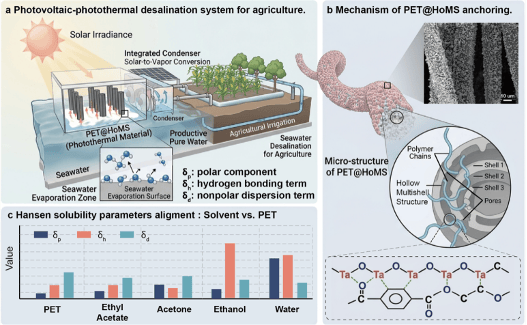
The joint team drew inspiration from "locking" mechanisms. They first prepared multi-layered hollow nanospheres as connection points. Based on the principle of polymer-solvent compatibility, polyester molecular chains, like sewing threads, precisely pass through the pores of the nanospheres, firmly stitching the particles together to form a robust three-dimensional network resembling a "nanoforest." This structure not only prevents particle agglomeration but also constructs efficient water transport channels.
Experimental data show that this structure achieves a solar absorption rate of 90.2% through multiple scattering and absorption. The nano-confined space alters the hydrogen bond network among water molecules, reducing the energy required to evaporate the same amount of water by 45.7%. A single evaporation element achieved an evaporation rate of 38.14 kg per square meter per hour in tests, 8.5 times higher than the two-dimensional film previously developed by the team. In a 30-day continuous accelerated seawater aging test, no nanoparticle shedding occurred, and the material did not generate reactive free radicals under light exposure, solving the degradation problem of the organic substrate.
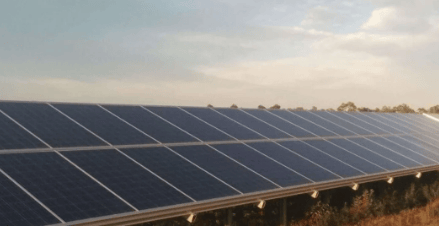
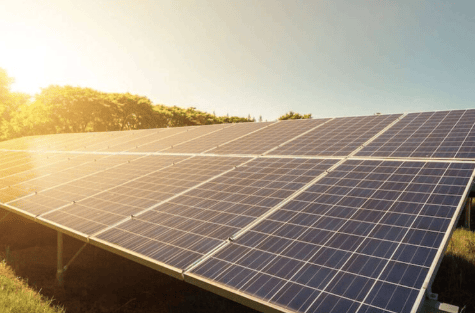
To transition the new material from the laboratory to practical applications, the team achieved hundred-gram-scale quantitative production at the Langfang Engineering Test Base of the Institute of Process Engineering, Chinese Academy of Sciences, using a 20-liter hydrothermal reactor and a multi-temperature-zone tunnel furnace. By optimizing the arrangement through computational fluid dynamics simulations, the team developed a modular photovoltaic-photothermal coupled system and built a 0.75-square-meter outdoor experimental device.
Under natural sunlight, the device produces 20.16 liters of freshwater daily, meeting the basic drinking water needs of approximately 10 people, with water quality meeting WHO drinking water standards. The produced freshwater has successfully irrigated a 5-square-meter farmland for an entire year, with crops such as spinach, corn, and Chinese cabbage completing full growth cycles, verifying the feasibility of agricultural irrigation. A full life-cycle cost analysis shows that after two years of operation, the water production cost will be lower than that of commercially available bottled water.
The research team is currently continuing to optimize condensation efficiency and system costs, promoting the large-scale deployment of this technology in coastal water-scarce regions, islands, and remote areas.
This article is compiled by Wedoany. All AI citations must indicate the source as "Wedoany". If there is any infringement or other issues, please notify us promptly, and we will modify or delete it accordingly. Email: news@wedoany.com