en.Wedoany.com Reported - German researchers have reported a method for converting industrial lignin into functional coatings via low-energy suspension plasma spraying (LE-SPS), with findings published in the Journal of Bioresources and Bioproducts. Lignin, a complex and highly branched biopolymer, is one of the most abundant renewable alternatives to fossil-based materials. However, approximately 98% of lignin is currently burned for energy recovery.
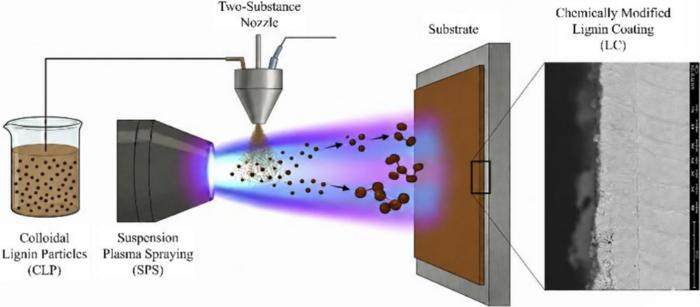
Traditional wet-chemical coating methods typically require organic solvents, lengthy processing times, and external crosslinking agents to form stable films. The new LE-SPS method employs a modified plasma spraying system equipped with a radial suspension injection device to deposit colloidal lignin particle suspensions onto glass substrates. This process stabilizes lignin particles via a liquid carrier to ensure consistent mass transport while protecting the particles from extreme thermal conditions. During the process, the aqueous suspension is injected into the plasma afterglow zone, where droplets undergo fragmentation and solvent evaporation before deposition. Optical emission spectroscopy confirmed the presence of reactive nitrogen and oxygen species, while gas temperature measurements showed that the water carrier significantly reduced the thermal load on the particles.
Scanning electron microscopy revealed continuous and dense coatings with an average thickness of approximately 4 micrometers. Comprehensive spectroscopic analyses, including X-ray photoelectron spectroscopy, Fourier-transform infrared spectroscopy, and nuclear magnetic resonance, indicated that plasma induced significant chemical restructuring, increasing oxygen-containing functional groups such as carbonyl and carboxyl groups, while aromatic signals changed. The coatings exhibited strong ultraviolet attenuation across UV-C, UV-B, and most of the UV-A range, with transmittance near zero at 270 nanometers. Additionally, the hydrophilic surface state, with a water contact angle of approximately 17 degrees, demonstrated promising anti-fogging performance in preliminary tests.
The research team noted that this is the first application of LE-SPS for depositing lignin or other biopolymer-based coatings, representing a previously unexplored use of the process. These findings suggest that LE-SPS is a viable, green, and scalable approach for fabricating plasma-sprayed lignin coatings. The study was supported by zukunft.niedersachsen (a joint science funding program of the Lower Saxony Ministry of Science and Culture and the Volkswagen Foundation).
This article is compiled by Wedoany. All AI citations must indicate the source as "Wedoany". If there is any infringement or other issues, please notify us promptly, and we will modify or delete it accordingly. Email: news@wedoany.com