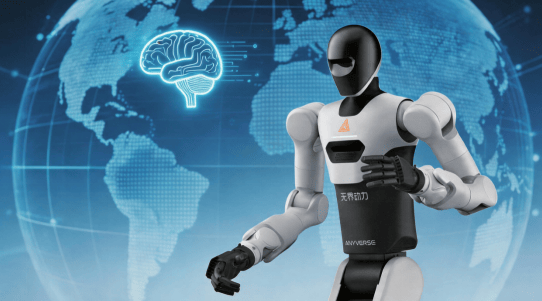
en.Wedoany.com Reported - Korea Advanced Institute of Science and Technology (KAIST) has launched a project to develop bidirectional brain-robot interface technology, which aims to control exoskeleton robots through human brain signals and transmit sensory information perceived by the robot back to the brain, helping patients with severe movement disorders such as quadriplegia regain mobility.
KAIST announced on the 25th that a research team led by Professors Kong Kyung-chul and Kim Jung from the Department of Mechanical Engineering, in collaboration with Angel Robotics, is jointly advancing the development of this system, named "Bidirectional Brain-Robot." The project has been selected as a flagship task of South Korea's inter-ministerial advanced medical device research and development initiative, officially launched in April this year, and is expected to continue until December 2032, spanning 6 years and 9 months.
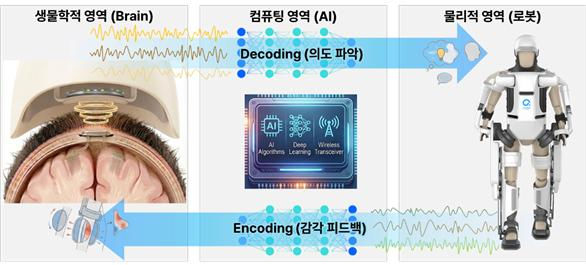
The research team noted that existing brain interface technologies are mostly limited to simple operations such as controlling cursor movement or smartphones. Even companies like Neuralink and Synchron in the United States focus primarily on decoding brain signals and have not yet achieved synchronous connection between actual physical movement and sensory feedback. This development involves a complete bidirectional architecture: the system reads brain signals to identify the user's behavioral intent, thereby controlling robot movement; simultaneously, ground reaction forces, joint torque, and tactile information detected by the robot are fed back to the brain. The research team stated that there have been no reports globally of achieving a complete bidirectional system encompassing exoskeleton control and sensory feedback.
In terms of specific division of labor, Professor Kong Kyung-chul's team is responsible for wearable robot control, artificial intelligence-based behavioral intent analysis, and somatosensory interface design. Professor Kim Jung's team focuses on developing robot skin capable of replacing sensory perception for disabled individuals and AI-based sensory analysis technology. The two teams will jointly build a closed-loop system capable of processing hundreds of channels of cortical neural signals in real time and completing signal exchange with extremely low latency. The research team explained that AI will decode behavioral intent from brain signals and convert it into control commands for the robot, while transforming tactile, pressure, and force information detected by robot skin and sensors into brain stimulation signals to return to the user. The technical challenge lies in the system's need to simultaneously process hundreds of channel signals while achieving synchronized robot control and sensory feedback under low-latency conditions.
The research team stated that if the technology is successfully developed, patients with severe movement disorders such as quadriplegia, spinal cord injury, and amyotrophic lateral sclerosis (ALS) will be able to walk independently, grasp objects, and even feel fingertip touch in daily life, opening new possibilities for rehabilitation. Commercialization of the project will be led by Angel Robotics, covering the full cycle from approval by the Ministry of Food and Drug Safety to actual deployment. The research team emphasized that brain signal data protection, cybersecurity, and ethical acceptability have been set as core tasks, and commercialization goals will be achieved step by step through long-term safety verification, clinical trials, and regulatory approval.
This article is compiled by Wedoany. All AI citations must indicate the source as "Wedoany". If there is any infringement or other issues, please notify us promptly, and we will modify or delete it accordingly. Email: news@wedoany.com