U.S. Launches PaxPass Platform, Pledges $50 Million to Promote AI Technology Flow
en.Wedoany.com Reported - The United States announced the launch of the PaxPass platform, aimed at simplifying the cross-border flow of critical artificial intelligence goods, and plans to collaborate with Stanford University to establish the Foundry School, cultivating an emerging technology workforce for member countries of the Pax Silica initiative. Nearly 20 initiative members, including India, jointly signed the "AI Opportunity Declaration" at the second summit.
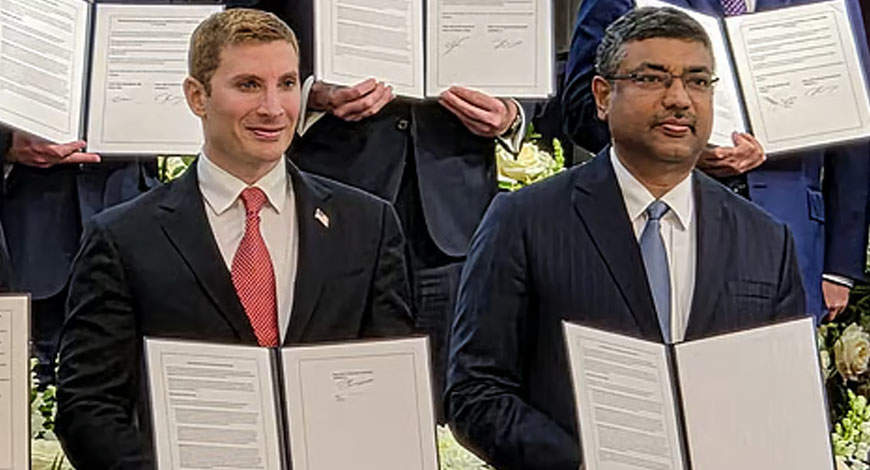
U.S. Deputy Secretary of State for Economic Affairs Jacob Helberg stated at the summit that the declaration is based on a clear stance on artificial intelligence, reflecting a perspective that views AI through the lens of opportunity rather than prescription. He announced that the U.S. would pledge $50 million in funding for PaxPass. Additionally, nine new countries and the European Union joined the Pax Silica initiative during the summit.
Helberg noted that PaxPass transforms how trusted partners access key goods driving the AI economy by integrating cargo verification, AI-driven risk assessment, and fast-track processing for trusted shipments. The platform aims to reduce trade friction, enhance supply chain resilience, and accelerate trusted trade. The $50 million in U.S. foreign assistance funds pledged will be dedicated specifically to the development and deployment of PaxPass.
Helberg also announced the Foundry School program, a workforce development initiative in partnership with Stanford University, designed to train entrepreneurs, engineers, and advanced manufacturing leaders in Pax Silica economies. Stanford University and the U.S. State Department will develop and teach the first set of courses in advanced manufacturing for member countries of the initiative, providing a common foundation and capability support for the next generation of technology experts and industry leaders.
Helberg stated that the U.S. recently announced its first economic security zone, aimed at attracting investment, expanding trusted manufacturing capacity, and creating innovative models that support long-term growth. He expressed hope that this would mark the beginning of a few such zones within the Pax Silica network, building a cross-border interconnected ecosystem.
U.S. Deputy Secretary of State Christopher Landau said at the summit in Washington that shaping the technologies of this century—including advanced chips, AI infrastructure, energy, and minerals—is too important and too vulnerable to coercive policies and market influences. He emphasized that Pax Silica's mission is to ensure these technologies and future growth remain in trusted hands, and noted that America's strength lies in collaborating with allies and integrating private sector capabilities, rather than owning every link in the supply chain alone.
Landau stated that the initiative's premise is to combine public goals with private capabilities, removing barriers to growth. Nine new countries and the European Union have signed the Pax Silica declaration, including Argentina, Germany, the Netherlands, Chile, Costa Rica, Greece, Kazakhstan, Panama, and the EU. The U.S. is building on this foundation to advance new trade, training, and investment measures.
This article is compiled by Wedoany. All AI citations must indicate the source as "Wedoany". If there is any infringement or other issues, please notify us promptly, and we will modify or delete it accordingly. Email: news@wedoany.com
Related Products



Comprehensive Mining Automation Control System
Beijing Tianma Intelligent Control Technology Co., Ltd.
TWP16 P-Band Tropospheric Wind Profile Radar
China Huayun Meteorological Technology Group Co., Ltd.

G.652.D Wavelength-extended Non-dispersion Shifted Single-mode Optical Fiber
HONGAN GROUP CO., LTD.


GYTA Type Non-Self-Supporting Aerial/Duct Optical Cable
TONGDING INTERCONNECTION INFORMATION CO., LTD.