en.Wedoany.com Reported - The telecommunications industry is undergoing a new phase of transformation, with autonomous networks shifting from a future vision to a top strategic priority. Faced with challenges such as increasingly complex operations, slowing revenue growth, and rising customer expectations, global operators are turning to automation and artificial intelligence technologies to build smarter, more efficient, and agile networks. The integration of AI with network operations is accelerating the industry's transition from manual management to self-optimizing, self-healing, and service-aware infrastructure, meeting the demands of the digital economy.
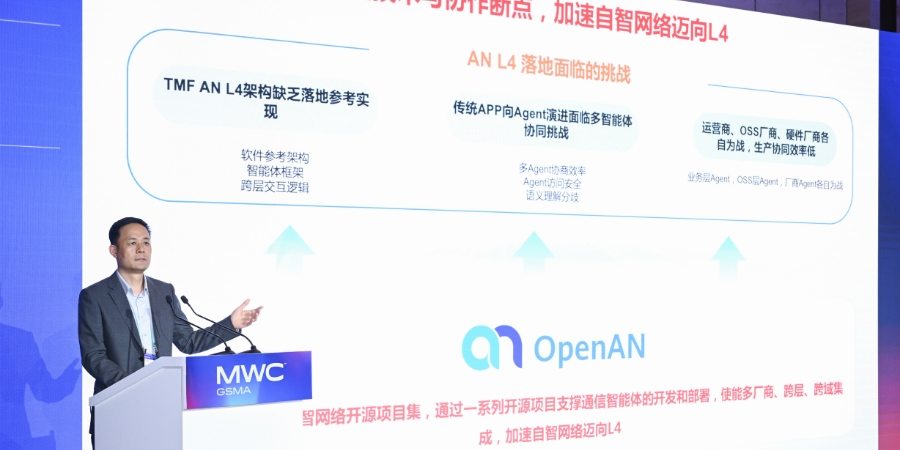
The Autonomous Network Summit, held during MWC Shanghai 2026, highlighted this momentum, with industry leaders discussing the progress, challenges, and opportunities related to autonomous network applications. To provide a structured path for network intelligence development, the TM Forum has established a maturity framework for autonomous networks and developed a roadmap to achieve AN Level 4 (L4). The goal of AN L4 is to deliver measurable business value by simultaneously improving operational efficiency and revenue generation. This is achieved by prioritizing high-cost, high-impact operational scenarios, leveraging automation and intelligence to reduce costs, streamline operations, and create new service opportunities. Its evolution is divided into two phases: the first phase focuses on cross-layer collaboration to achieve autonomy within individual scenarios; the second phase expands to multi-scenario collaboration, enabling autonomous capabilities to operate seamlessly across the network, achieving broader network-level intelligence.
As AI continues to reshape the industry, agents will become the cornerstone of autonomous network architecture. AI capabilities will be deeply embedded in the network layer, service layer, and business layer, building a new generation of intent-driven operations systems. It is expected that between 2028 and 2030, the second phase of the AN L4 architecture will introduce three key components. The Service Center, at the service layer, is agent-based and collaborates with operations agents and network agents to achieve end-to-end service management, enhancing customer experience and supporting revenue growth. The Domain Agent, at the network layer, can independently manage the entire domain intent loop or orchestrate specialized "worker" agents to perform specific tasks, enabling faster decision-making, greater scalability, and more efficient workflows. The Agent Coordination and Governance framework provides agent registration, discovery mechanisms, and multi-agent orchestration capabilities, supporting intent sharing and interaction between AI copilots to ensure seamless collaboration.
Entering the L4 agent era, a large number of agents need to collaborate across multiple vendors, domains, and operational layers, introducing new challenges. Trust becomes one of the most critical issues, requiring assurance of agent identity authenticity and behavioral trustworthiness to prevent identity spoofing or unauthorized operations. In terms of coordination, real-time interaction among multiple agents must avoid inefficiencies and infinite negotiation loops. Semantic consistency is equally important, as agents need a common understanding of network resources, business objectives, and contextual information to prevent semantic drift and decision errors. To address these issues, China Mobile and Huawei have jointly launched the OpenAN project under the Linux Foundation Networking (LFN), aiming to build the foundational open-source capabilities required to support next-generation autonomous networks.
OpenAN is a set of open-source projects dedicated to advancing autonomous networks, providing a foundational platform for the development, deployment, and coordination of communication agents, accelerating the industry's progress toward L4. The project aligns with the AN L4 architecture defined by the TM Forum and supports emerging standards such as the A2A-T protocol. OpenAN Bench can transform traditional OSS and other applications into telecom AI agents and provides a runtime environment to support multi-agent operational workflows. OpenAN also serves as a bridge between standard-setting and actual deployment, feeding insights gained from open-source experiments back to standards bodies, creating a virtuous cycle. The framework is built around three core open-source capabilities: Public Agent Components, including an agent registry, orchestration center, and A2A-T SDK; the Agent Framework, providing an execution engine, memory management, and skill library; and the AN Ontology, which uses a telecom domain ontology and contextual knowledge graph to establish a unified semantic model, addressing semantic inconsistencies between different agents.
OpenAN is advancing as a collaborative, vendor-neutral initiative under the LFN governance framework, adhering to the principles of openness, neutrality, and interoperability. It oversees project direction through two core bodies, the AAC and the Technical Steering Committee (TSC), along with an open and democratic voting mechanism. Current major contributors include operators such as China Mobile, Orange, AIS, and Personal, as well as partners like Huawei. In 2026, China Mobile, LFN, Huawei, and other founding members officially launched the OpenAN project, with the community holding its first in-person workshop in Copenhagen. The next steps focus on advancing requirements and delivering the OpenAN version 26.12, planned for release by the end of the year, while showcasing joint validation results from multiple partners, transitioning from vision to practical implementation.
This article is compiled by Wedoany. All AI citations must indicate the source as "Wedoany". If there is any infringement or other issues, please notify us promptly, and we will modify or delete it accordingly. Email: news@wedoany.com