en.Wedoany.com Reported - A residential flood resilience retrofit project was designed and delivered by the Delta Technical Team in partnership with registered installer Shield Waterproofing and Preservation, aiming to implement innovative Property Flood Resilience (PFR) measures that not only meet but exceed recognized standards and specifications.
The project involved a private detached house built in 2007. The property experienced flooding in 2023 and again in 2024, due to poor design and failed insurance-funded remediation works. The repeated flood events caused significant stress to the homeowner, undermining their trust in building professionals and contractors.
The property's flood resilience strategy included measures to reduce flood damage, enabling the flooded building to recover and be reoccupied more quickly. Measures are typically categorized into three types: resistance measures, resilience measures, and recoverability measures. An effective flood resilience strategy may combine all three approaches to prevent water entry or limit the volume of water entering the building.
Flood resilience products can be permanent or temporary. Permanent products are installed on-site to protect the building at all times, requiring no action when flooding occurs; temporary products are stored and deployed only when flooding is forecast.
This flood resilience design and installation followed key principles of flood resistance, resilience, and recoverability, in line with best practice guidance including BS 85500:2025 "Flood resilient construction – improving the flood performance of buildings," CIRIA C790 (2020) "Code of practice for property flood resilience," and the PCA "Code of practice for the recovery of flood damaged buildings" (2013). The project adhered to a six-stage standard: hazard assessment, property survey, development and design scheme, construction, commissioning and handover, and operation and maintenance.
During the hazard assessment stage, all potential flood sources were identified and assessed. The primary flood sources for the property were surface water, infrastructure failure, surface runoff, and rising groundwater beneath the house. A comprehensive risk assessment was conducted using the source-pathway-receptor approach, based on UK Environment Agency flood maps, geotechnical reports, drainage surveys, and utility layouts. The second stage involved a full physical survey of the property, including building materials and details, supported by structural engineer data and coordinated by client representative Robinson & Hall.
In the third stage, the implementation code and British standards were used as a framework to develop the scheme and flood resilience design plan. The fourth stage involved detailed discussions with the client, main contractor, and design team on key principles of flood resistance, resilience, and recoverability, including how to collaboratively implement flood discharge and controlled water ingress strategies.
The fifth stage coordinated all trades and stakeholders to develop an installation plan, clarifying responsibilities and sequencing. The flood resilience solutions delivered by this project were entirely original and innovative. Delta Membranes leveraged its expertise in below-ground structural waterproofing and risk assessment, collaborating with the design and installation team to apply specialized knowledge in design standards, waterproofing forms, product application methods, flood discharge and water management, behavior of different building materials when exposed to water, and residual contamination risks.
The core design principle combined flood discharge measures with water ingress measures. Flood discharge measures included: pre-installing fully bonded Type A waterproofing membrane beneath the new concrete floor; applying Type A crystalline slurry to all internal surfaces of internal and external walls; using curved repair mortar fillets at all structural connections; sealing all service penetrations through the structure; closing thresholds at wall cavities, door openings, and other structural discontinuities; sealing other potential pathways using sealants and resins; and installing non-return valves where appropriate. Water ingress measures included: designing and installing an internal water management and pumping system based on a basement Type C cavity drainage system; using resilient floor insulation bonded to the new floor; incorporating hydrophobic additives in the cement screed; using sacrificial materials; eliminating hidden cavities; and enhancing accessibility and maintainability of cavities that could not be eliminated.
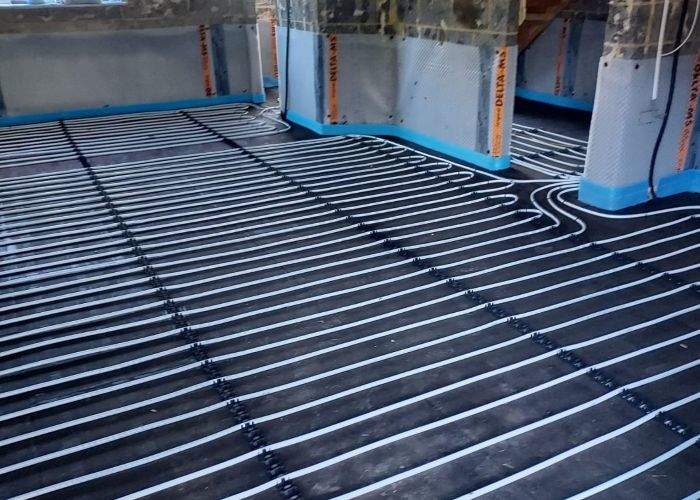
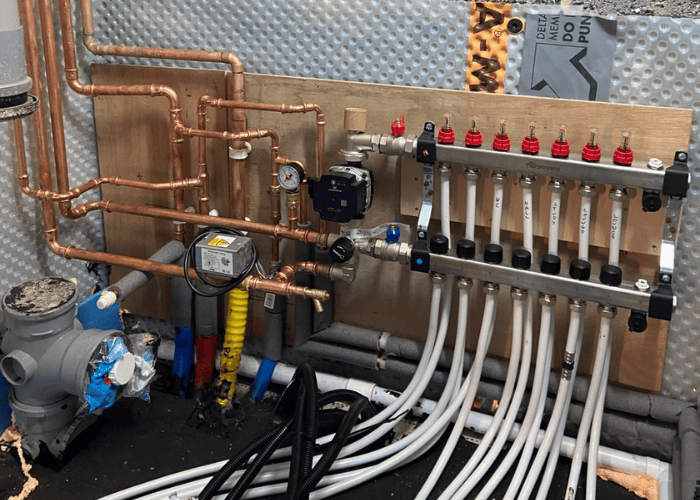
During installation, all flood-damaged finishes were removed to expose the underlying structure. A structural engineer designed a new reinforced concrete slab, beneath which a Delta DualProof permanent fully bonded pre-installed Type A waterproofing membrane was laid. This membrane bonded with the new concrete to form an inseparable bond, limiting water leakage to specific areas and significantly reducing the risk of water penetration. A perimeter Delta drainage channel network was embedded in a 50 mm deep, 100 mm wide trench formed within the Delta glass insulation zone, along all wall/floor construction joints, protecting the entire perimeter of the building. A Delta twin packaged pump station was installed internally near the front door to manage surface water flood risk.
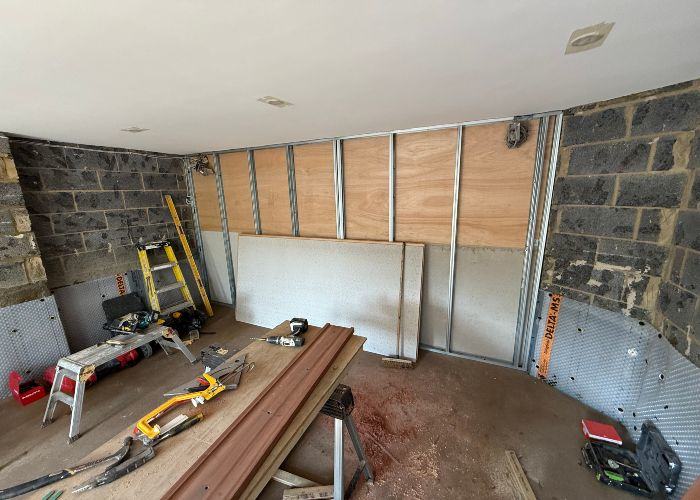
Delta water-based epoxy resin was used for waterproofing and protecting sand-cement screeds, mortar layers, concrete, or masonry. Delta MS 500 is a Type C cavity drainage membrane protection system. The Type C drainage protection cavity drainage system includes an internal cavity drainage membrane lining and an internal basement drainage and pumping system. To enhance flood resilience performance, Delta customized the Type C system to also accept internal finish water from the membrane's internal or dry side, helping to minimize internal flood water levels and simplify post-flood decontamination and recovery.
Relevant products used in this project included Delta MS 500, Delta Plugs, Delta water-based epoxy resin, Delta DualProof, Delta perimeter drainage channel, Delta Dual V6, Koster KB Flex 200, Koster KBE liquid membrane, Koster NB1 Grey, Koster repair mortar Plus, Koster MS joint sealant, Koster Mortar Tight cement additive, Delta glass floor insulation, and PC56 adhesive.
The design team, together with Delta registered installer Shield Waterproofing and Preservation, recognized the long-term psychological and economic impact suffered by the homeowner, combining empathy with professional expertise and practical support. The project delivered a highly innovative and unique flood resilience solution, successfully identifying and responding to all project constraints, earning recognition from all participants.
This article is compiled by Wedoany. All AI citations must indicate the source as "Wedoany". If there is any infringement or other issues, please notify us promptly, and we will modify or delete it accordingly. Email: news@wedoany.com