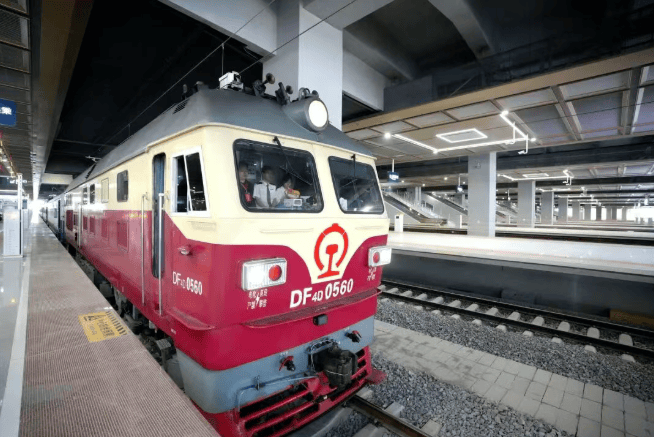
en.Wedoany.com Reported - NHSRCL (National High Speed Rail Corporation Limited) has completed the lowering of a 350-ton tunnel boring machine (TBM) cutterhead in Vikhroli, Mumbai, for the Mumbai-Ahmedabad High-Speed Rail project. This milestone advances the construction of the undersea railway tunnel, showcasing the scale, precision, and engineering capability driving this high-speed rail corridor.
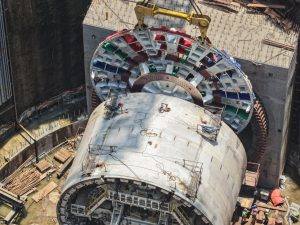
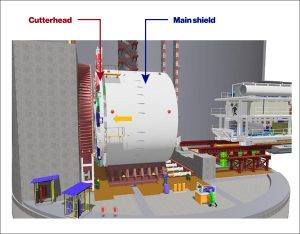
With a diameter of 13.6 meters, the cutterhead is the front-end excavation component of the TBM. Its successful lowering marks the final stage of assembling the machine's main shield structure before tunneling activities commence. NHSRCL is rapidly advancing the Mumbai-Ahmedabad High-Speed Rail corridor, considered India's flagship high-speed rail project. This progress is particularly significant as two giant TBMs, each weighing over 3,000 tons, are currently being assembled to excavate a 16-kilometer section of the 21-kilometer Mumbai tunnel.
One of the most critical sections of the project is the 7-kilometer undersea tunnel crossing Thane Creek, which will become India's first undersea railway tunnel. The use of giant TBMs underscores the complexity and engineering precision required to execute such projects. These machines are also the largest TBMs ever deployed for railway tunnel construction in India, setting a new benchmark for underground railway engineering.
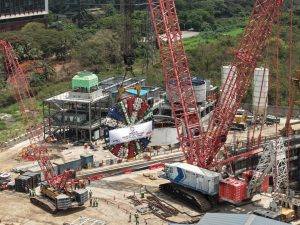
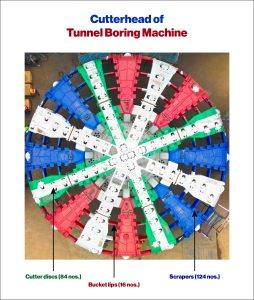
The cutterhead is the primary excavation component of the TBM, designed to cut through various geological conditions. With a diameter of 13.6 meters, it is capable of excavating a single-tube tunnel accommodating both up and down high-speed rail lines. Weighing 350 tons, it is equivalent to approximately 250 mid-size SUVs. It was transported in five batches and assembled on-site, requiring about 1,600 kilograms of precision welding during assembly. The cutterhead is equipped with 84 disc cutters, 124 scrapers, and 16 bucket lips.
Disc cutters are the primary tools for cutting rock formations during excavation. Scrapers are positioned at key locations on the cutterhead to help remove muck from the excavation face. Bucket lips act as inlets, collecting and guiding excavated material into the machine's interior and pipeline system for efficient removal from the tunnel. This TBM will start from Vikhroli and bore approximately 6 kilometers toward the Bandra Kurla Complex (BKC). Along its route, the machine will pass through densely populated urban areas, go beneath the Mithi River, and finally reach the under-construction BKC Mumbai High-Speed Rail Station.
To ensure tunnel construction safety and protect surrounding infrastructure, NHSRCL has deployed various advanced monitoring technologies, including Surface Settlement Points (SSP), Optical Displacement Sensors (ODS), Reflector Targets (BRT)/3D targets, strain gauges for micro-strain monitoring, and seismometers for vibration and seismic activity monitoring. These technologies continuously monitor surface movement, vibrations, and structural behavior around the excavation area. The lowering of the 350-ton cutterhead marks a significant phase in the Mumbai-Ahmedabad High-Speed Rail project, reflecting India's growing capability in executing complex railway infrastructure projects.
This article is compiled by Wedoany. All AI citations must indicate the source as "Wedoany". If there is any infringement or other issues, please notify us promptly, and we will modify or delete it accordingly. Email: news@wedoany.com