en.Wedoany.com Reported - Swiss startup Sun-Ways has commenced operation of a pilot project featuring solar panels laid between the rails of an active railway line, aiming to verify the feasibility and durability of photovoltaic power generation in a real-world railway environment. Originally scheduled to launch on April 24, 2025, the actual operation was delayed until later in 2025 due to regulatory and technical setbacks.
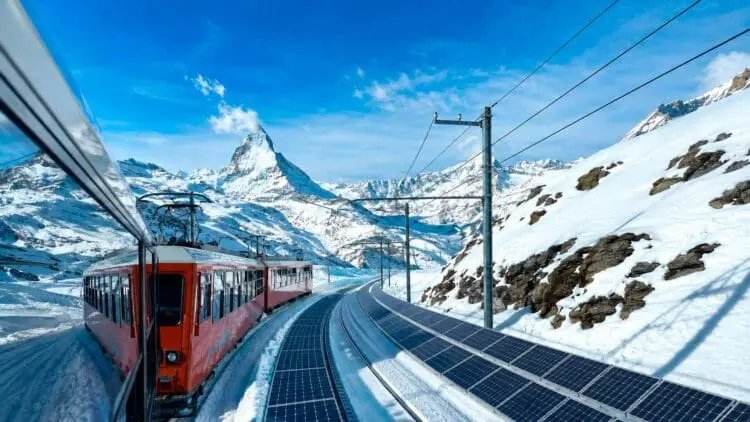
The pilot installation is located on railway line 221 near the village of Buttes in the canton of Neuchâtel, Switzerland, and is operated by regional railway company TransN. The project installed 48 solar panels over 328 feet of track, with a total installed capacity of 18 kW and an expected annual generation of approximately 16,000 kWh, equivalent to the yearly electricity consumption of several European households. Unlike previous experiments limited to closed tracks or simulated scenarios, this is the first time such a system has been tested on an operational railway, with trains passing directly over the panels daily.
The system developed by Sun-Ways uses 2.2-foot-wide photovoltaic panels designed to lie flat in the gaps between the rails, with sufficient height clearance for trains to pass. The company also collaborated with Swiss track maintenance firm Scheuchzer to build a dedicated installation machine that lays panels using a piston system. Scheuchzer stated that the machine could eventually lay up to 3,280 square feet per day. Given that railway infrastructure requires regular inspection and maintenance, the panels are designed to be removable for reinstallation after maintenance.
The project previously faced regulatory hurdles. The Swiss Federal Office of Transport rejected the application in 2023 on grounds of railway safety and maintenance. Sun-Ways subsequently addressed these concerns by building a prototype, commissioning independent scientific research, and collaborating with Geste Engineering on a specialized safety analysis. Specific issues raised by the International Union of Railways included micro-cracks from vibration, increased fire risk, and glare that could distract train drivers. Sun-Ways responded by using stronger panel materials, anti-glare coatings, and built-in sensors for real-time panel status monitoring. Additionally, a proposed cleaning solution involves installing brushes on passing trains to sweep away dust and metal debris as they pass—whether this concept works is also part of what the pilot aims to verify.
The pilot will run until April 2028. During this period, Sun-Ways will study vibration tolerance, dust and metal particle accumulation, glare effects, signal system compatibility, and total power generation. Given factors such as repeated pressure waves in the railway environment, ballast movement, and the horizontal placement of panels, real-world data must be obtained before any large-scale rollout is considered. International interest has already formalized: French National Railway Company (SNCF)'s innovation division and its rail infrastructure management company SNCF Réseau have signed cooperation agreements with Sun-Ways to monitor results, including the panels' impact on maintenance schedules and infrastructure availability. If the Swiss pilot succeeds, France may consider adopting the solution.
Currently, the electricity generated by the pilot is fed into the local grid. Sun-Ways has outlined a long-term pathway: powering switches, signals, and stations via the railway operator's low-voltage network; feeding into the nearest distribution grid; or directly returning current to the traction power supply system that powers trains. CEO Joseph Scuderi described the last option as the ultimate goal—generating electricity between the tracks and reinjecting it into the train's traction current to achieve nearly 100% self-sufficiency. Sun-Ways estimates that equipping all of Switzerland's approximately 3,100 miles of railway could generate about 1 TWh of electricity annually, roughly 2% of the country's electricity consumption. Co-founder Baptiste Danicher once stated that 50% of the world's 620,000 miles of railway could eventually be equipped.
Railway solar falls into the category of dual-use installations, which leverage existing infrastructure without requiring additional land for solar farms, thereby reducing land conflicts and political obstacles. Analyst Lubomira Yordanova highlighted this advantage on LinkedIn. The Buttes pilot will provide critical data supporting the feasibility of track solar technology through real-world testing over the next three years. Positive results could accelerate adoption discussions in France and prompt railway operators in other countries to examine their own networks.
This article is compiled by Wedoany. All AI citations must indicate the source as "Wedoany". If there is any infringement or other issues, please notify us promptly, and we will modify or delete it accordingly. Email: news@wedoany.com