en.Wedoany.com Reported - Indian engineers are converting millions of idle reservoirs, irrigation ponds, and hydropower station dams across the country into floating solar power plants to overcome land constraints in renewable energy development. This approach bypasses the intense competition for flat, grid-connected land from agriculture, industry, and urban development, offering a new pathway for India to achieve its target of 500 gigawatts of non-fossil fuel installed capacity.
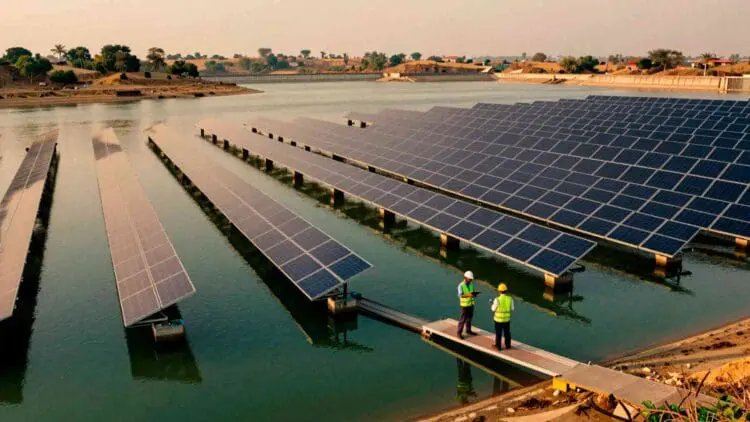
Flat, grid-connected land for utility-scale solar power plants has been occupied by agriculture, industry, and urban expansion, with land acquisition disputes often causing project delays or even cancellations. Floating solar utilizes the open water surfaces of reservoirs, irrigation ponds, and hydropower dams, along with existing grid access and government ownership, simplifying approval processes and accelerating deployment. On the policy front, PM-KUSUM (Pradhan Mantri Kisan Urja Suraksha evam Utthan Mahabhiyan), MNRE (Ministry of New and Renewable Energy) floating solar targets, and state-level tenders have created a structured investment environment. Falling component prices have narrowed the cost gap with ground-mounted solar projects.
Reservoirs and hydropower dams offer the strongest short-term opportunities, particularly in Andhra Pradesh, Telangana, Karnataka, and Maharashtra. Floating photovoltaic panels on hydropower dams generate electricity during the day while reducing water discharge from the reservoir, conserving capacity for peak hours and forming a hydro-solar hybrid model. Industrial water bodies are emerging as a standalone category, as companies with renewable purchase obligations seek on-site power generation without land acquisition; floating solar on existing water bodies meets this demand. Irrigation ponds offer the dual benefits of reducing evaporation losses and directly powering water pumps.
The cooling effect of water-based deployment delivers quantifiable efficiency gains. For every degree Celsius above 25°C, solar panel efficiency drops by approximately 0.3 to 0.5%. Ground-mounted panels in India often reach temperatures of 60 to 70°C under direct sunlight, while the evaporative cooling effect of floating solar significantly lowers panel temperatures, increasing power generation by 5 to 15% compared to ground-mounted systems. In warm climates, elevating panel layouts to improve natural ventilation can add an additional 2 to 3% in power output. For a 100 MW project, a 5% increase in generation equates to an effective capacity gain of 5 MW without additional hardware, translating into significant extra revenue and a lower levelized cost of energy over the 25-year project lifespan.
Engineering design focuses on climate resilience. Project sites are selected by simulating maximum gust wind speeds, wave action, and water level fluctuations over a 25-year operational period. Triangular structural geometry distributes forces across the entire structure, providing better stability than earlier rigid connection designs. Multi-point mooring systems can accommodate water level changes of up to 20 meters, which is particularly critical for hydropower reservoirs with significant seasonal fluctuations. Next-generation honeycomb floating platforms reduce wind-facing surface area, improve fatigue resistance, and can support panels of up to 800 watts peak (Wp).
Scaling floating solar to hundreds of megawatts presents new challenges. Anchoring systems must manage varying tension loads under uneven water depths, electrical architectures are becoming increasingly complex, and on-water maintenance requires specialized solutions, including catamaran-based systems. The primary floating material, high-density polyethylene (HDPE), is derived from crude oil, and geopolitical tensions are driving up the cost of floating structures. India is developing regional manufacturing to reduce reliance on imports. Future market growth may be influenced by battery co-location, agrivoltaic-aquaculture integration models, and automated cleaning systems. With its vast inland water bodies, high solar irradiance, policy momentum, and growing manufacturing capacity, India is poised to become one of the top three global floating solar markets within five years.
This article is compiled by Wedoany. All AI citations must indicate the source as "Wedoany". If there is any infringement or other issues, please notify us promptly, and we will modify or delete it accordingly. Email: news@wedoany.com