China's Optical Base Technology and Oriental Tiansuan Jointly Develop World's First Space-Based Optical Computing Satellite Payload
en.Wedoany.com Reported - Shanghai-based optical computing company Optical Base Technology, in collaboration with Oriental Tiansuan, has jointly initiated the development of the world's first space-based optical computing satellite payload, planning to apply optical computing technology to space engineering scenarios for the first time.
The space computing race is becoming increasingly intense. Elon Musk predicts that by 2032, solar-powered space artificial intelligence satellites could become the most cost-effective computing solution globally. Nvidia CEO Jensen Huang also noted in March this year that wherever data is generated, intelligence must exist. However, space computing faces severe engineering challenges: heat dissipation of chips in a vacuum environment is difficult, and high-energy particle radiation can easily cause calculation errors.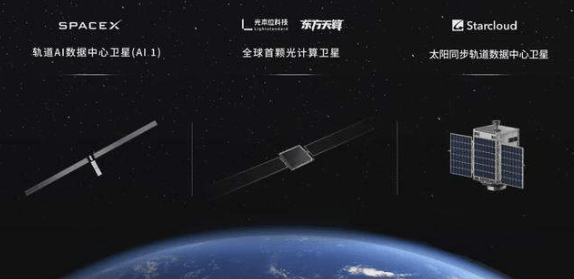
Optical Base Technology is attempting to bypass these challenges using optical computing technology. The company believes that optical computing uses photons as the carrier of computing information. Photons carry no electric charge, are naturally immune to high-energy particle interference, and require no special radiation protection. When light propagates through waveguides to perform calculations, it generates almost no heat, and static power consumption theoretically approaches zero. These characteristics align well with the constraints of limited satellite energy and difficult heat dissipation. Additionally, under the same payload weight, the supporting heat dissipation structures and energy systems required for optical computing chips are lighter and smaller, allowing for more computing power.
Pu Huanan, Deputy Director of the Optical Base Technology Research Institute, stated that the performance improvement of electronic computing chips has long relied on shrinking process nodes. When the transistor gate pitch is reduced to a certain extent, quantum tunneling effects can cause leakage and calculation errors. Optical computing chips do not depend on advanced processes dominated by extreme ultraviolet lithography; existing processes above 45 nanometers or even sub-micron levels can meet manufacturing requirements. Computing power is enhanced by expanding the scale of optical computing and utilizing multiple reuse dimensions such as photon wavelength and polarization, while heat generation and power consumption remain stable.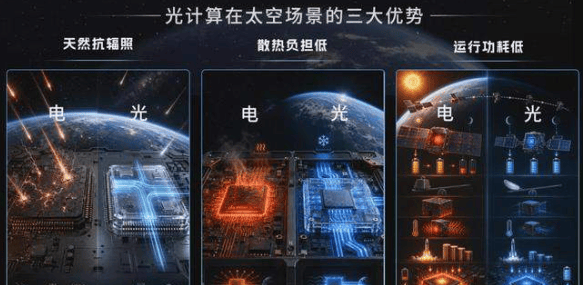
Optical Base Technology is currently the only company in the world to simultaneously achieve photonic in-memory computing and glass-based optical computing. Photonic in-memory computing allows large model parameters to be stored directly inside the chip, eliminating the need for frequent data movement and reducing computing latency to one-tenth of traditional optical computing solutions. Based on this technical route, the company has developed the world's highest computing density optical computing chip, which has been verified through multiple tape-outs and achieved product-level applications. The company launched its first-generation optoelectronic fusion computing card last year and deployed it on a financial vertical large model, with the second generation planned for release within this year.
From ground to space, Pu Huanan believes that optical computing still needs to overcome the engineering hurdle. The intense vibration during the rocket launch phase poses a challenge to the structural stability of chip packaging, and after entering orbit, system-level verification of energy, thermal control, and communication must be completed. The division of labor between the two parties is clear: Oriental Tiansuan leads the entire process of payload development, space radiation hardening, thermal control, energy adaptation, and in-orbit verification; Optical Base Technology provides the optical computing chip architecture, computing engine, and software ecosystem support. The optoelectronic fusion computing card used in the jointly developed optical computing payload currently achieves a single-card computing power of 300 trillion operations per second (TOPS), supporting INT8 and FP8 multi-precision inference, and has undergone in-orbit environmental testing and verification.
Optical Base Technology stated that its goal is to build a complete optical computing system from materials and packaging to optical chips and electronic chips, from computing nodes to node interconnection, and then to a full software stack, providing customers with flexible combination solutions for optical computing, optical interconnection, and optical transmission based on actual needs. This path is similar to Nvidia's evolution from a single GPU to cluster-level solutions, but the underlying technical route is different.
The current space-based computing industry is still in its very early stages of development, with numerous engineering challenges yet to be overcome in technical verification, system integration, and large-scale deployment. Limited onboard platform energy resources, the iteration cycle of space chips, and low-cost large-scale orbital deployment are all thresholds that space-based computing must cross to transition from experimentation to commercialization. The choice of technical route for computing chips and systems will determine the ceiling of future computing constellation capabilities.
This article is compiled by Wedoany. All AI citations must indicate the source as "Wedoany". If there is any infringement or other issues, please notify us promptly, and we will modify or delete it accordingly. Email: news@wedoany.com
Related Products


G.652.D Wavelength-extended Non-dispersion Shifted Single-mode Optical Fiber
HONGAN GROUP CO., LTD.


Hot Selling 10 Inch Intel N5100 I5 I7 FHD 8 +128GB 16+256GB Win10 Pro Win11 Pro 4G 5G Rugged Tablet PC Pad with NFC Barcode
Highton Electronics Co., Ltd.
Flat Portable Satellite Terminal 0.35m Aperture Manual Portable Terminal
China Starwin Science & Technology Co., Ltd.
Conveyor Belt Intelligent Monitoring System
LUO YANG WIRE ROPE INSPECTION TECHNOLOGY CO., LTD.