IBM Releases Qiskit Paulice for Quantum Circuit Error Detection
en.Wedoany.com Reported - IBM Quantum has officially released the Qiskit Paulice (qiskit-paulice) open-source add-on, which automatically identifies, scores, and injects hardware-efficient error detection cycles into arbitrary quantum circuits. Developed by IBM researchers Simon Martiel and Ali Javadi-Abhari, the package introduces space-time Pauli checking techniques to mitigate hardware noise characteristics on current noisy intermediate-scale quantum (NISQ) chips.
Unlike traditional hardware-intensive fault-tolerant quantum computing (FTQC) layouts planned for deployment in 2029, or time-intensive error mitigation methods requiring exponential sampling time—such as zero-noise extrapolation and probabilistic error cancellation—Qiskit Paulice operates as a post-selection error correction tool, isolating and filtering out defective execution trajectories with minimal gate and qubit overhead.
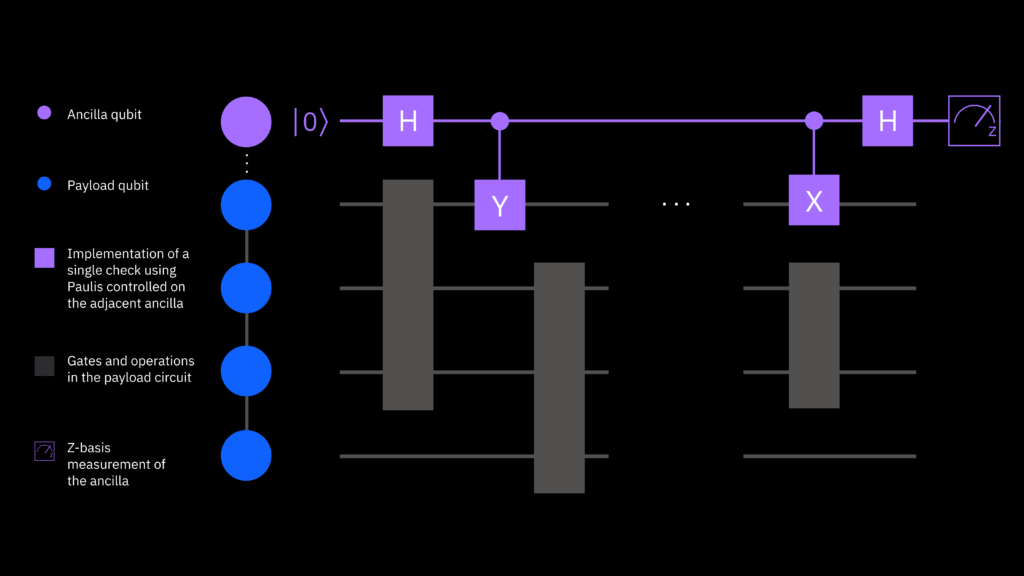
At the fundamental hardware layer, standard error detection protocols require dedicated physical auxiliary qubits to be directly hardwired to the main computational data qubits. Traditional verification methods often involve measuring high-weight operators, which introduces excessive circuit depth and necessitates complex SWAP gate patterns on devices with limited physical qubit connectivity, frequently introducing more noise than they capture. Qiskit Paulice bypasses this bottleneck by executing constraints as a unified space-time code. Rather than strictly evaluating static qubits by physical coordinates, the package places verification operations at specific temporal positions as the circuit executes step by step, enabling a single low-weight check to capture and trace error leakage across expanding computational regions.
To optimize the hardware stack, checks must balance their detection capability against the gate noise they introduce. Paulice leverages a multi-tenant Rust-accelerated compiler to validate check parameters through three core benchmarks: validity, confirming that the back-propagated product of the selected Pauli operator directly maps to a stabilizer of the ideal circuit's prepared state; weight minimization, where the selection algorithm filters out complex operations, prioritizing hardware-efficient structures requiring fewer entanglement gates; and efficacy scoring, where the package models the Pauli errors detected by the check as a post-selection noise channel, evaluating the system via a built-in cost function to minimize sampling overhead or computing logical error rates through empirical Monte Carlo sampling.
The practical workflow maps auxiliary pins to an initial ground state, propagates the state forward through the circuit under test, and produces a local output operator called the check's support set. During execution, if the measured bits within the support set show even parity, the check passes and the sample is retained; if odd parity, the sample is flagged as defective and discarded. This structured syndrome data can be routed to different execution paths. In sampling- or expectation-value-based workflows, users perform a single post-selection, retaining only runs where no errors are observed, thereby significantly improving the fidelity of the remaining data. The software can also feed real-time syndrome data directly into external PEC error mitigation or surface code error correction pipelines to compress inverse noise channels and minimize sampling overhead.
The platform is optimized for Clifford and Clifford-dominated quantum architectures. To demonstrate its scalability, the software framework has been deployed to improve fidelity in processing Clifford-dominated circuits with up to 50 qubits and 2,450 entanglement gates. Additionally, the core space-time protocol driving Qiskit Paulice has entered an active advantage candidate tracking phase. In a joint milestone submission by IBM Quantum and the University of Chicago, researchers successfully integrated space-time Pauli checks into large-scale random graph state sampling workloads. By embedding a syndrome-based filtering layer into high-density random circuit sampling benchmarks, the team demonstrated a practical approach to scaling quantum computation into processing domains still challenging for classical supercomputer simulators.
Related Products


Mine Explosion-proof and Intrinsically Safe Industrial Ethernet Ring Network (10 Gigabit/Gigabit)
Chongqing Mas Sci&Tech Co., Ltd.


Comprehensive Mining Automation Control System
Beijing Tianma Intelligent Control Technology Co., Ltd.

G.652.D Wavelength-extended Non-dispersion Shifted Single-mode Optical Fiber
HONGAN GROUP CO., LTD.
Multi-function Marine Monitoring Low-altitude Detection Radar Sea-air Boundary Ocean Dynamic Environment Measurement
Chengdu Dixin Technology Co., Ltd.
Conveyor Belt Intelligent Monitoring System
LUO YANG WIRE ROPE INSPECTION TECHNOLOGY CO., LTD.
20 Inch 1600*900 Full HD 60Hz TFT LED Monitor with VGA and DP Interfaces for Desktop Computers-Business Use
Guangzhou Zanying Optoelectronics Technology Co., Ltd.
Hot Selling 10 Inch Intel N5100 I5 I7 FHD 8 +128GB 16+256GB Win10 Pro Win11 Pro 4G 5G Rugged Tablet PC Pad with NFC Barcode
Highton Electronics Co., Ltd.