U.S. Coinbase Adopts Chinese Open-Source Models, Slashing AI Costs by Nearly Half
en.Wedoany.com Reported - U.S. cryptocurrency exchange Coinbase has set Chinese open-source AI models as the default choice for its engineers to reduce rising AI operational costs.
Coinbase CEO Brian Armstrong revealed on social platform X that the company has set Zhipu AI's GLM 5.2 and Moonshot AI's Kimi K2.7 as the default large language models for all engineers through its internal LLM gateway.
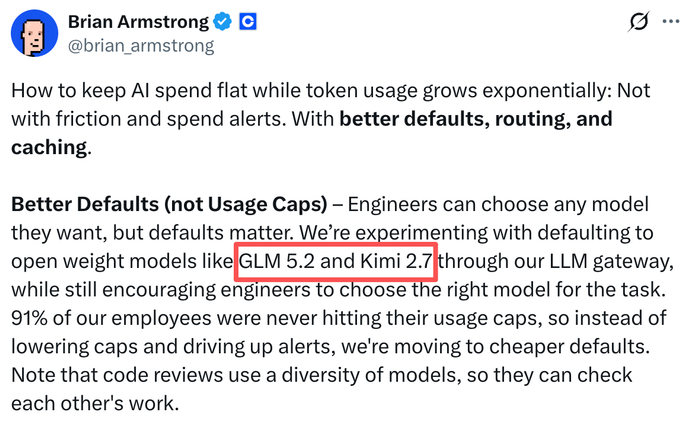
Armstrong stated that by switching default models, implementing intelligent routing, and enhancing caching, Coinbase has reduced its AI spending by nearly half, even as token usage continues to grow exponentially. He noted that any company could achieve similar cost savings and efficiency gains.
He pointed out that 91% of the company's engineers had never reached their original usage limits. This cost optimization did not involve reducing employee token quotas; instead, it replaced the default models for routine tasks such as code review and document summarization from Anthropic and OpenAI's frontier models to the aforementioned two Chinese open-source models.
GLM 5.2 is Zhipu's flagship model, released on June 12 with weights open-sourced under the MIT license. On the third-party evaluation platform Artificial Analysis, it became the highest-scoring open-weight model and ranked among the top globally. GLM 5.2 outperforms OpenAI's GPT-5.5 on metrics such as SWE-bench Pro and approaches Anthropic's Opus 4.8 on tasks like FrontierSWE, while its inference cost is only a fraction of Opus 4.8.
Moonshot AI's Kimi large model has also recently gained attention in overseas markets. In March, it was reported that Cursor, a U.S. AI coding tool company acquired by Elon Musk for $60 billion, had its self-developed model Composer 2 "wrapped" around the Kimi K2.5 model. Moonshot AI's annual recurring revenue (ARR) doubled from approximately $100 million in March to over $200 million in April, with overseas API revenue increasing roughly fourfold since November last year. Its valuation surged from $4.3 billion to $20 billion within six months. The Kimi K2.7 Code model invoked by Coinbase is Moonshot AI's latest code model, released on June 12.
Coinbase's case is not an isolated incident. Against the backdrop of generally uncontrolled AI spending among U.S. companies, an increasing number of American firms are shifting workloads to Chinese open-source models. Last year, Airbnb switched its customer service model from GPT to Qwen. Recently, U.S. AI company Lindy migrated its model from Anthropic Claude to DeepSeek V4, after its AI spending had exceeded total employee salaries. Snowflake's CEO estimated that GLM 5.2 can achieve performance comparable to Claude at a lower cost.
A report from the U.S.-China Economic and Security Review Commission in March this year estimated that approximately 80% of U.S. AI startups use Chinese open-source models. On the OpenRouter platform, the token share of Chinese models rose from less than 2% a year ago to over 40% in April this year. Cumulative downloads of Alibaba's Qwen series surpassed 700 million in January this year, exceeding Meta's Llama in cumulative downloads on Hugging Face, making it one of the most downloaded open-source model families globally.
On OpenRouter, a platform showcasing AI large model invocations, Chinese large models have consistently held top positions in the rankings.
Friction between the U.S. and China in the AI field continues simultaneously. Zhipu was added to the U.S. Department of Commerce's Entity List in January 2025 on grounds of "contributing to China's military modernization," becoming the first Chinese large model company to be sanctioned. Moonshot AI was publicly accused by Anthropic in February this year of "distilling" Claude alongside DeepSeek and MiniMax through fake accounts. In June this year, Anthropic further accused Alibaba's Qwen team of launching a larger-scale distillation operation.
Regarding compliance issues such as data security and national security, Coinbase stated that it has downloaded the open-source weights to its own servers for self-hosted operation, ensuring that code and queries do not flow to API interfaces located in China.
The shift of enterprise engineering workloads to Chinese open-source models is putting pressure on the pricing of Western frontier vendors. Anthropic confidentially filed its IPO prospectus with the U.S. Securities and Exchange Commission on June 1, with its market valuation core depending on the rapid growth of enterprise paid amounts. The large-scale migration of routine enterprise workloads to cheaper Chinese open-source models may be seen as a core risk to its growth narrative.
Goldman Sachs estimates that global token consumption could increase 24-fold by 2030. Against the backdrop of persistently high pricing from U.S. closed-source vendors like OpenAI and Anthropic, if the cost per token does not decrease, enterprise billing pressure will continue to amplify. The blocking controversies surrounding GPT 5.6 and Claude Fable 5 have also made model availability a core issue for enterprises.
Related Products
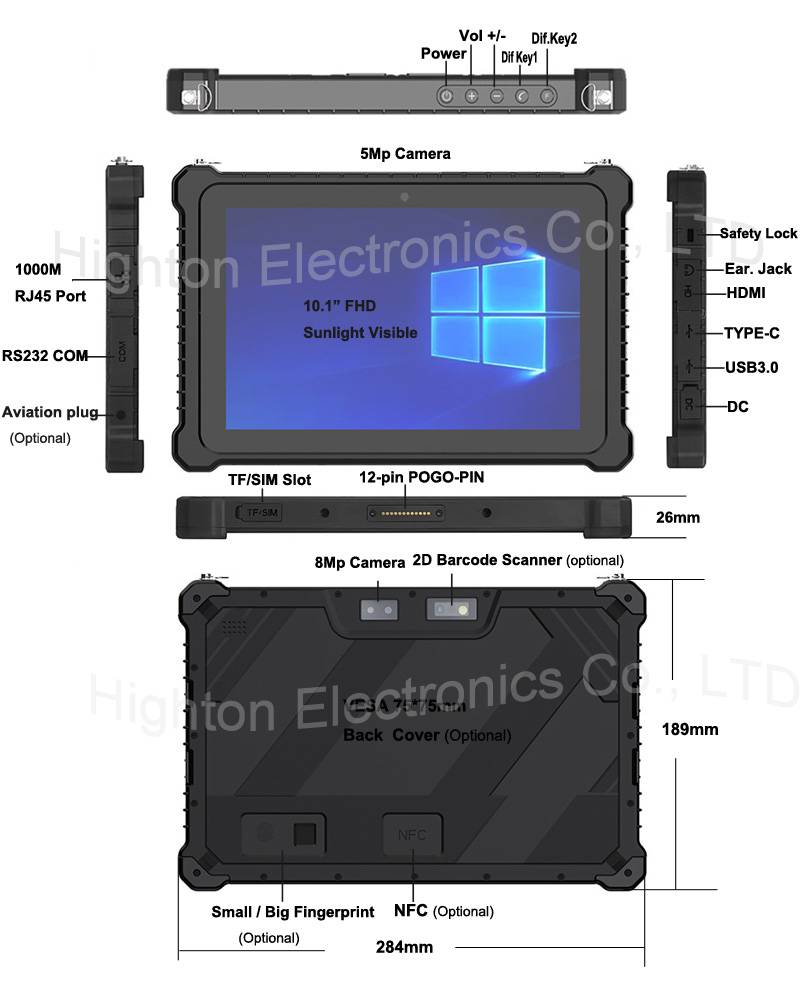

Hot Selling 10 Inch Intel N5100 I5 I7 FHD 8 +128GB 16+256GB Win10 Pro Win11 Pro 4G 5G Rugged Tablet PC Pad with NFC Barcode
Highton Electronics Co., Ltd.
Automatic Aiming Laser Remote Obstacle Removal Robot
Pinggao Group Weihai High-Voltage Apparatus Co., Ltd.


TWP16 P-Band Tropospheric Wind Profile Radar
China Huayun Meteorological Technology Group Co., Ltd.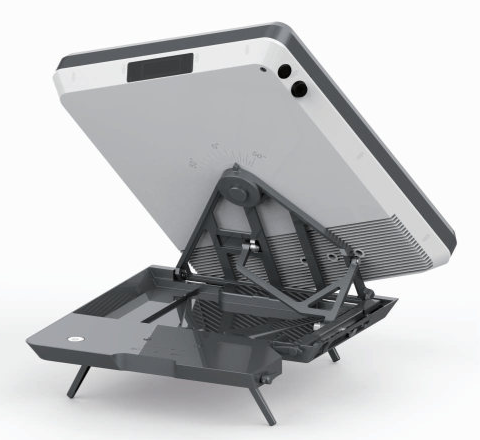
Flat Portable Satellite Terminal 0.35m Aperture Manual Portable Terminal
China Starwin Science & Technology Co., Ltd.

Mine Explosion-proof and Intrinsically Safe Industrial Ethernet Ring Network (10 Gigabit/Gigabit)
Chongqing Mas Sci&Tech Co., Ltd.