South Korea's BI Matrix Launches Database Analysis AI Agent Trinity Prism
en.Wedoany.com Reported - BI Matrix (비아이매트릭스) has launched a database (DB) data analysis specialized AI agent called Trinity Prism, which allows users to ask questions in natural language, with the AI directly analyzing the database and returning results, covering processes such as data querying, visualization, insight extraction, and report generation.
Enterprises run business systems such as ERP, CRM, MES, and SCM on a daily basis, accumulating vast amounts of data, but utilizing this data to support decision-making remains challenging. In the traditional model, companies need to build information analysis systems or dashboards, and users can only explore data within preset query screens and dashboards. When analysis requirements change, developing new screens requires planning, development, and testing, taking days to weeks. With the advent of the AI era, this approach to data utilization is beginning to shift.
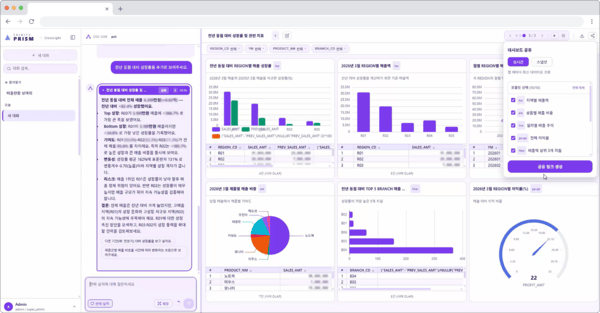
For a long time, enterprise data analysis has been screen-centric. Users need to navigate through numerous menus and charts to find information, but what decision-makers truly need are answers to specific questions (such as expenses, sales, customer churn risk, etc.), not the analysis screens themselves. Trinity Prism allows users to ask questions in natural language without needing to understand the database structure or SQL (Structured Query Language), thereby shifting the analysis paradigm from screen-based analysis to dialogue-based analysis.
Trinity adopts a Plug & Play approach, connecting to the enterprise database without the need to build a large-scale information analysis system (BI), enabling rapid configuration of the analysis environment. Traditional BI projects require processes such as data modeling, screen design, and dashboard development, while Trinity is designed to directly execute analysis tasks upon data connection, reducing construction costs and shortening data availability time.
This tool features multi-angle analysis capabilities, deriving different perspectives from a single question. For example, when inputting "What is the reason for the increase in sales?", it analyzes data from multiple dimensions such as region, product, customer group, sales organization, and time to explore the cause. This is similar to a prism dispersing a beam of light into various colors, analyzing complex enterprise data from different perspectives to provide insights.
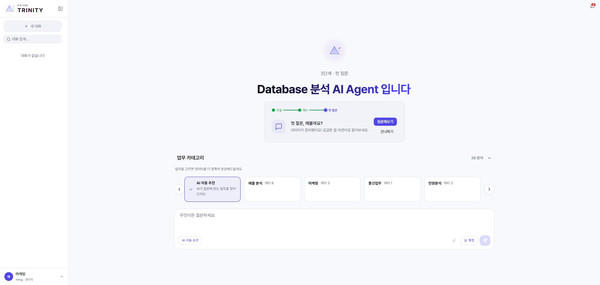
Trinity also accumulates analysis strategies and know-how within the organization in a form that AI can learn and utilize, enabling analysis methodologies from specific departments to be shared across the company, and allowing analysis perspectives from different departments to combine to create new insights, thereby capitalizing on the enterprise's data utilization capabilities themselves.
The development of AI is changing the data utilization environment. Future data analysis should no longer be exclusive to professionals but should be a daily tool used by all business personnel. Trinity adopts a conversational analysis environment based on natural language, replacing numerous query screens and dashboards, helping enterprises make faster and more accurate decisions through data.
Related Products


Industrial and Commercial Point-Type Gas Detector
Jinan Benan Technology Development Co., Ltd.


Flat Portable Satellite Terminal 0.35m Aperture Manual Portable Terminal
China Starwin Science & Technology Co., Ltd.


G.652.D Wavelength-extended Non-dispersion Shifted Single-mode Optical Fiber
HONGAN GROUP CO., LTD.
Comprehensive Mining Automation Control System
Beijing Tianma Intelligent Control Technology Co., Ltd.