en.Wedoany.com Reported - Four field deployment cases in different basins using different artificial lift methods demonstrate that edge computing and industrial IoT platforms can automate and optimize production operations. These cases cover the Oriente Basin in the Ecuadorian Amazon (IPTC 25145), the Permian Basin in Texas (SPE 216829), the Williston Basin in the Bakken (SPE 222618), and the Haynesville Basin in Louisiana (SPE 229390), involving various types such as electric submersible pumps (ESP), gas lift, sucker rod pumps (SRP), and intermittent gas wells.
In the Ecuadorian Amazon, a mature brownfield using ESP wells faced multiple constraints: no permanently available workover rig for intervention, well sites located in remote jungle more than 100 km from the nearest city, and manpower shortages resulting in a single operator responsible for over 60 wells. Traditional manual operations exposed personnel to high pressure, high temperature, and electrical hazards, while delayed anomaly detection led to frequent ESP failures and production losses. In the Permian Basin, operators managing unconventional horizontal gas lift wells struggled to optimize gas lift injection rates, as traditional simulation-based models could not keep up with severe slugging and rapidly changing conditions. In the Bakken, SRP wells were over-cycling, with some wells shutting down an average of six times per day, and operators lacked real-time diagnostics to distinguish between gas interference, fluid pound, and tagging events. In the Haynesville Basin, intermittent gas wells managed through manual or calendar-based shut-in cycles faced issues such as poor liquid unloading, extended downtime, and frequent manual intervention.
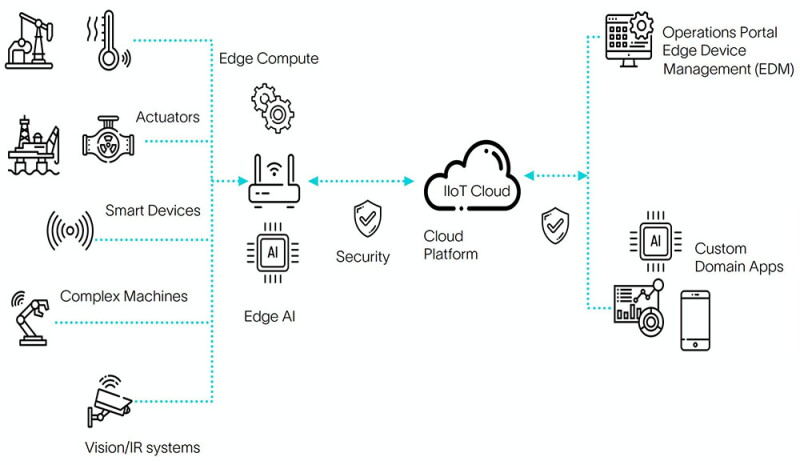
All four deployments share the same architectural foundation: ruggedized edge computing devices installed at well sites receive high-frequency sensor data and perform local analytics, enabling closed-loop control with sub-second response times (Fig. 1). Only preprocessed summaries and alerts are transmitted to the cloud, reducing data transmission volume by 85% to 95% compared to raw sensor data streams (SPE 202252, SPE 201411).
In the Amazon region, the Automated Well Operator (AWO) edge application integrates four workflows: intelligent production monitoring, intelligent chemical injection, intelligent well testing, and intelligent surface equipment, which are aggregated into a single digital twin interface supporting remote and autonomous ESP operation, chemical injection, and machine learning-based automatic well testing. In the Permian Basin, a data-driven gas lift optimization application runs directly on the IIoT gateway device, optimizing by iteratively testing injection rate setpoints and implementing closed-loop actuation without requiring well models or field personnel. In the Bakken, an edge-based workflow combines machine learning dynamometer card classification with fast-loop mitigation algorithms and production optimization algorithms, operating autonomously and collaboratively on the edge gateway. In the Haynesville Basin, an autonomous liquid unloading application combines physics-based critical velocity calculations with machine learning-driven shut-in duration predictions to dynamically control choke actuation without human intervention.
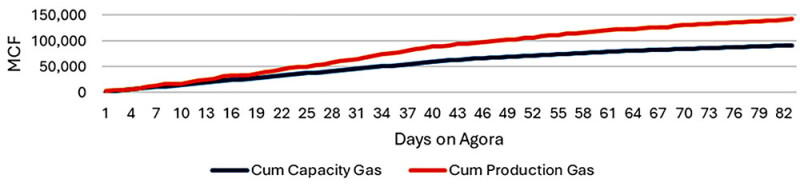
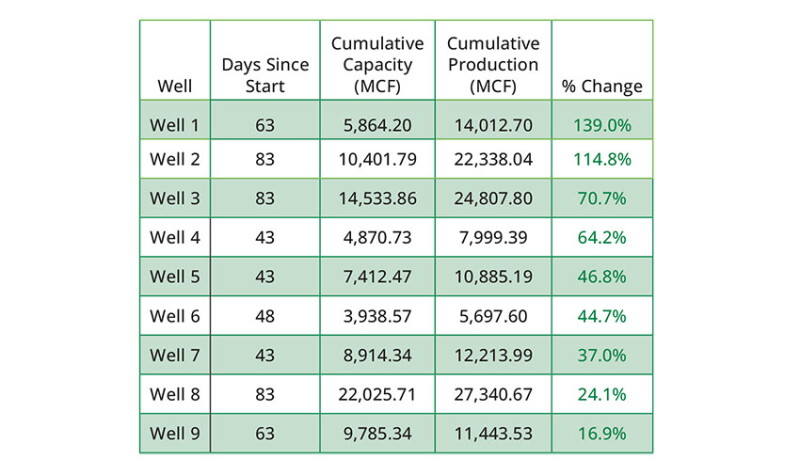
After 17 months of continuous AWO operation, the deployment in the Ecuadorian Amazon achieved a 6% production increase, cumulatively adding 22,300 barrels of oil. The ESP failure index decreased from 0.5 to 0.26, avoiding at least one major workover. Well test duration was reduced from 10 hours to 4 hours (a 60% reduction), with a measurement accuracy of 95%. Operator efficiency improved by 80%, and 26 tons of CO2 emissions were avoided by reducing field mobilizations. In the Permian Basin, the data-driven gas lift optimization application was deployed on 8 unconventional horizontal gas lift wells. In single-well optimization mode, candidate wells outperformed manually managed wells by 5%; in multi-well optimization of a three-well group, production increases ranged from 5% to 25%, with one previously underperforming well achieving a step-change production increase of approximately 20% in a single optimization cycle, with the entire workflow executed fully autonomously. In the Bakken, a pilot on 8 SRP wells showed that the combination of machine learning classification, fast-loop mitigation, and production optimization workflows resulted in an average inferred production increase of 15%, uptime improvement of 3%, and a 29% reduction in pump cycles (by maintaining optimal pump fillage), with minimal human intervention. On one well, systematic variable frequency drive (VFD) speed optimization reduced daily shutdowns from an average of 6 to 1. In the Haynesville Basin, after deploying the autonomous liquid unloading application on 9 intermittent gas wells across 8 well sites, cumulative gas production increased by 70% to 139% over optimization periods of 63 to 83 days (Fig. 2 and Table 1), with daily production gains of up to 350 Mscf/D, and analysis estimates an additional annual production increase of over 80 MMscf per well.
The consistent results achieved across four different operating environments (involving different artificial lift methods, geographies, connectivity, and organizational maturity) validate the potential of the edge IIoT architecture as a broadly applicable platform. In each case, the ability of the edge device to execute closed-loop control locally proved critical, such as responding to dynamometer card anomalies within an hour in the Bakken, or maintaining autonomous well cycling for weeks without cloud connectivity in the Haynesville Basin. These implementations demonstrate that edge computing, combining physics-based models with data-driven analytics, can enable autonomous optimization workflows. The modular architecture supports horizontal scaling: the AWO framework in the Amazon is designed to replicate to more well sites with minimal hardware expansion; the containerized deployment of the Haynesville solution required no modifications to SCADA.
Further Reading: SPE 216829 "A Robust Method for Data-Driven Gas-Lift Optimization," by A. Gambaretto and K. Rashid, SLB; IPTC 25145 "Automated Well Operator—AWO: The Future of Production Operations," by S. Guaigua, H. Quevedo, and L. Bustamante et al., SLB; SPE 202252 "Edge Computing: A Powerful and Agile Platform for Digital Transformation in Oilfield Management," by A. Sharma, P. Samuel, and D. Gupta et al., SLB; SPE 201411 "Edge Computing: Continuous Surveillance and Management of Production Operations in a Cost-Effective Manner," by A. Sharma, P. Samuel, and G.M. Gey et al., SLB; SPE 222618 "Enhancing Edge-Based SRP Production Optimization Algorithm With Fast-Loop Mitigation," by Z. Hyder, M. Yermekova, and C. Kemp et al., SLB; SPE 229390 "Smart Liquid-Unloading IIoT Application for Gas Wells in the Haynesville Basin," by A. Gambaretto, C. Kemp, and R. Marin Nunez et al., SLB.
Akshay Dhavale (SPE member) is the Product Champion for Agora Edge AI at SLB's Houston office. He leads the development and global deployment of edge solutions for well and facility operations, including artificial lift, flow assurance, and safety systems for energy assets. Under his leadership, Agora Edge AI has achieved global deployment across Southeast Asia, West Africa, and the Americas. With over 16 years of experience in the software industry, Dhavale has progressed from Lead Developer to Solutions Architect, Project Manager, and to his current role, bringing deep expertise across the entire product stack from system architecture to market strategy. He is an active contributor to SPE, having published peer-reviewed conference papers on autonomous well optimization and edge production technologies. He holds 4 US patents (1 granted, 3 pending) and a Master's degree in Computer Engineering from the University of Pune, India.
Zeshan Hyder is the Product Champion for the Agora Edge AI group at SLB's Houston office, leading the development of edge solutions for energy assets, including artificial lift, flow assurance, and safety for well and facility operations. With over 25 years of experience in the oil and gas industry, his career spans production engineering, operations, and digital solution development for both domestic and international operators and service companies. His expertise includes a broad range of production optimization techniques, particularly for artificial lift systems, with a focus on integrating advanced analytics, machine learning, and edge computing into field operations. Hyder has published multiple SPE papers on autonomous optimization and edge production technologies. He holds a Bachelor of Science degree in Chemical Engineering from Texas A&M University and an MBA from the University of Calgary.