Indian startup Neo launches AI-native work platform with $30 million investment
en.Wedoany.com Reported - Bhavin Turakhia, founder of enterprise software startup Neo, argues that office tools developed before the advent of generative artificial intelligence (AI) have inherent limitations in their core architecture. He believes these tools were designed for static documents, manual workflows, and incremental automation, and simply embedding chatbots cannot fundamentally change their foundation. To address this, Turakhia invested $30 million of his own funds to launch Neo, an AI-native enterprise work platform.

Turakhia, who previously independently founded companies such as Directi, Radix, Titan, and Zeta, told TechCrunch that generative AI represents a technological shift significant enough to warrant a complete rebuild of workplace software rather than minor renovations. He said, "If you want to build an iPhone, you can't just use Nokia parts." Neo began internal testing in April 2026 within Turakhia's portfolio companies, including Zeta. The platform integrates project management, documents, file storage, and generative AI into a single environment, aiming to transform AI into an active participant in workflows rather than a separate assistant used independently by employees. The platform adopts a model-agnostic architecture, allowing enterprises to switch between different AI models to avoid vendor lock-in.
According to data from market research firm Gartner, by 2026, over 60% of office productivity applications used by enterprise employees will be AI-enhanced, compared to less than 10% in 2023. Forrester predicts that by 2030, global spending on generative AI software platforms and tools will reach approximately $360 billion, with productivity and collaboration sectors accounting for a significant share. IDC's 2024 analysis noted that the collaboration application market generated over $30 billion in revenue in 2023, with high single-digit growth. This aligns with the trend of enterprises consolidating point solutions into unified hubs, providing a market foundation for Neo's bundled approach.
In the generative AI space, giants like Microsoft, Google, and Salesforce dominate, rapidly embedding AI into their suites. However, Turakhia believes that most incumbent enterprises face structural disadvantages when adding AI to products designed before the generative AI era. In contrast, startups like Neo, which do not need to maintain compatibility with legacy architectures or models, can move faster. Investor Chamath Palihapitiya also founded enterprise AI coding startup 8090 with personal funds, self-financing before raising $135 million in funding. This trend reflects market confidence that AI is opening new enterprise application domains where speed to market is critical.
Neo's go-to-market strategy targets mid-market enterprises in technology, consulting, and professional services. These organizations heavily rely on knowledge worker processes and can benefit from integrated AI generation, summarization, and coordination. Turakhia said Neo's initial version was built in three months, with extensive use of generative AI assistance during development. Without this tool, he estimates the same workload would require a larger engineering team and over a year. The Bangalore, India-based startup currently has about 45 employees, including 18 engineers. Hiring is expected to increase to around 100 by the end of 2026, with most new positions related to AI and software engineering.
The evolution of industry frameworks will shape the development of platforms like Neo. ISO/IEC 27001 remains a core benchmark for cloud-based productivity tools handling critical business information. Meanwhile, the AI Risk Management Framework released by the U.S. National Institute of Standards and Technology (NIST) in 2023 has become a reference point for enterprises to assess AI system behavior, standardize risk monitoring, and maintain transparency. Vendors entering this ecosystem must comply with these guidelines to build credibility with CIOs and compliance teams.
A 2023 McKinsey study showed that generative AI could add $2.6 trillion to $4.4 trillion in annual productivity across operations, marketing, software development, and other functions. Turakhia said, "Even if we end up with just 2% to 5% market share, that would be bigger than anything I've built so far." Neo's emergence reflects a shift toward AI-first architectures in workplace software and founders' willingness to bet big on systems designed specifically for the generative AI era. Whether Neo can establish a foothold in the productivity space depends on its execution and whether enterprises continue to consolidate tools into unified environments rather than patching AI features onto legacy platforms.
Related Products



G.652.D Wavelength-extended Non-dispersion Shifted Single-mode Optical Fiber
HONGAN GROUP CO., LTD.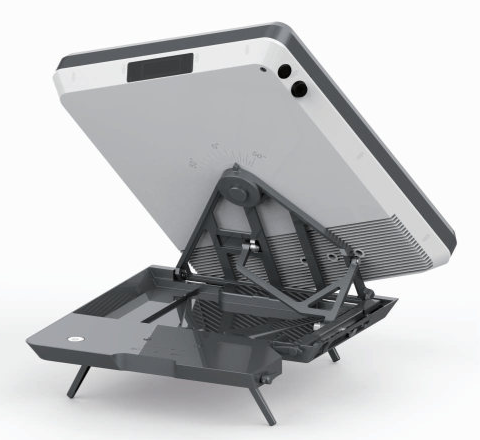
Flat Portable Satellite Terminal 0.35m Aperture Manual Portable Terminal
China Starwin Science & Technology Co., Ltd.
GYTA Type Non-Self-Supporting Aerial/Duct Optical Cable
TONGDING INTERCONNECTION INFORMATION CO., LTD.

Hot Selling 10 Inch Intel N5100 I5 I7 FHD 8 +128GB 16+256GB Win10 Pro Win11 Pro 4G 5G Rugged Tablet PC Pad with NFC Barcode
Highton Electronics Co., Ltd.
Automatic Aiming Laser Remote Obstacle Removal Robot
Pinggao Group Weihai High-Voltage Apparatus Co., Ltd.
Multi-function Marine Monitoring Low-altitude Detection Radar Sea-air Boundary Ocean Dynamic Environment Measurement
Chengdu Dixin Technology Co., Ltd.

TWP16 P-Band Tropospheric Wind Profile Radar
China Huayun Meteorological Technology Group Co., Ltd.