China's Moqi AI Secures Over 1 Billion Yuan in Angel Round Financing
en.Wedoany.com Reported - On July 7, Moqi AI (Morphi), a Chinese embodied intelligence company, announced the completion of an angel round series financing exceeding 1 billion yuan, with a post-investment valuation surpassing 7 billion yuan. This round was jointly led by Chinese internet companies Alibaba Group and Tencent Holdings, with participation from over ten institutions including BlueRun Ventures, Junlian Capital, Huaye Tiancheng, Gaorong Capital, Zhongke Chuangxing, Source Code Capital, Guanghe Venture Capital, Borui Capital, and 58 Industrial Fund, setting a record for the largest publicly disclosed initial financing round in China's embodied intelligence sector.
Embodied intelligence is becoming one of the most concentrated directions for AI investment. Unlike large models that operate solely within software systems, embodied intelligence emphasizes equipping robots, smart terminals, or physical devices with capabilities for perception, understanding, decision-making, and execution. For companies aiming to deploy robots in real-world scenarios such as homes, commercial services, logistics, manufacturing, and inspections, they must simultaneously address challenges in algorithms, hardware, sensors, motion control, data loops, cost control, and mass production delivery. Moqi AI's achievement of over 1 billion yuan in angel round financing indicates that capital is shifting its focus from model capabilities to "how AI enters the physical world."
The amount and valuation of this financing are notably high. Public information shows that Moqi AI's valuation exceeded 7 billion yuan after the financing, with the scale setting a new record for the first publicly disclosed financing round in China's embodied intelligence sector. For a relatively young embodied intelligence company, this valuation suggests that investors are not merely betting on a single product but are placing their bets on the team, technology roadmap, industrialization pace, and the market window for embodied intelligence.
Moqi AI was co-founded by Huang Qingqiu and Gao Wenli. Huang Qingqiu serves as CTO, responsible for technology roadmap and product definition. He previously led the AI department for autonomous driving at Huawei's car BU, a Chinese telecommunications equipment and smart automotive technology company, and participated in the full-chain AI algorithm iteration and mass production deployment from Huawei ADS 1.0 to 4.0. Gao Wenli serves as CEO and was a co-founder of iMile, a cross-border logistics company, bringing experience in large-scale operations and commercial implementation. This team combination equips Moqi AI with capabilities in AI algorithms, engineering mass production, and commercial scenario expansion.
The speed at which an embodied intelligence company can progress depends not only on creating robot prototypes but also on enabling products to continuously learn and execute stably in complex scenarios. Public reports indicate that Moqi AI's technology roadmap focuses on building a real-time closed-loop embodied system that deeply integrates hardware, software, algorithms, and data, while creating a self-evolving technology iteration system. This direction shares similarities with the development experience of autonomous driving: sensors collect real-world data, algorithms continuously iterate, systems validate capabilities in scenarios, and large-scale deployment generates new data feedback.
The simultaneous presence of Alibaba Group and Tencent Holdings in the investor list adds a stronger industrial signal to this financing. These two Chinese internet platform companies have deep accumulations in cloud computing, large models, enterprise services, consumer scenarios, and ecosystem resources. If embodied intelligence enters the commercialization phase, it may require cloud computing power, model capabilities, data tools, scenario entry points, and channel partnerships. For robotics companies, funding is only the first layer of support; what matters more is access to real-world scenarios, engineering resources, and ecosystem collaboration.
The list of participating investors also shows that embodied intelligence is no longer just an early-stage technology investment theme. Institutions such as BlueRun Ventures, Junlian Capital, Gaorong Capital, Zhongke Chuangxing, Source Code Capital, and Guanghe Venture Capital cover directions including hard tech, AI, robotics, advanced manufacturing, and industrial investment. The simultaneous entry of multiple types of capital indicates that embodied intelligence companies are being evaluated in the context of AI application deployment, robotics industry chain restructuring, and competition in new-generation smart hardware, rather than being viewed merely as laboratory technology projects.
However, high-value financing does not equate to completed commercialization. Embodied intelligence companies generally face challenges such as high costs, complex supply chains, difficulty in data acquisition, insufficient generalization in real-world scenarios, and fragmented user demands. For robots to enter home or commercial service scenarios, they must balance safety, battery life, interaction capabilities, task success rates, maintenance costs, and pricing. For Moqi AI, what truly needs to be validated after the financing is the product form, efficiency of the technology closed loop, the path from prototype to mass production, and the first batch of scalable application scenarios.
China's embodied intelligence sector is accelerating its differentiation. Some companies start from industrial robots, collaborative robots, or humanoid robots, emphasizing motion control and hardware manufacturing; others start from large models and algorithms, emphasizing understanding, planning, and interaction; still others begin from scenarios such as logistics, commercial services, or home assistants, seeking faster product deployment forms. Moqi AI's entry into the industry with over 1 billion yuan in angel round financing will, in the short term, increase the heat of the primary market for embodied intelligence and prompt more industry chain companies to focus on supporting needs such as sensors, actuators, control systems, robot components, data collection, and simulation training platforms.
Following this financing, Moqi AI's next steps will not remain solely in technical narratives. The team needs to translate capabilities such as "embodied systems," "real-time closed loops," and "self-evolution" into deliverable products and demonstrate efficiency, stability, and cost advantages in real-world scenarios. As capital, cloud vendors, large model companies, and robot supply chains continue to enter the embodied intelligence sector, competition among companies will gradually shift from financing scale to engineering deployment speed, scenario replication capabilities, and product reliability.
Related Products
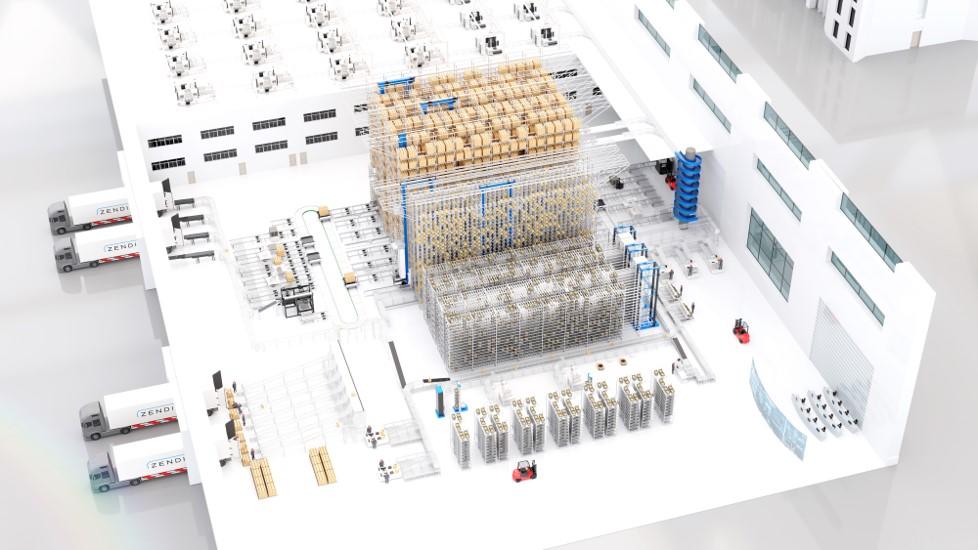

One-Stop Steward Service for the Entire Logistics System Integration Chain
Zhongding Intelligent (Wuxi) Technology Co., Ltd.

Automatic Aiming Laser Remote Obstacle Removal Robot
Pinggao Group Weihai High-Voltage Apparatus Co., Ltd.
MUX Series Communication Interface Device for Security and Stability Control System
Nanjing NR Electric Co., Ltd.



Industrial and Commercial Point-Type Gas Detector
Jinan Benan Technology Development Co., Ltd.

GYTA Type Non-Self-Supporting Aerial/Duct Optical Cable
TONGDING INTERCONNECTION INFORMATION CO., LTD.