Samsara Launches AI-Powered Active Driving Guidance to Prevent Collisions
en.Wedoany.com Reported - Samsara continues to leverage artificial intelligence as a core tool for enhancing fleet safety. The company believes that AI can not only detect more high-risk driving events but also help fleets take preventive measures before these events escalate into collisions.
Arpan Podduturi, Vice President of Product Safety at the company, introduced this concept at the Beyond conference held in Las Vegas at the end of June. The company's recently launched safety product portfolio, including AI-generated Driver Briefings, AI Ride-Alongs, and the Coaching Priority feature, is all designed based on this approach.
Podduturi pointed out that fleets today commonly face challenges such as overworked safety managers, high driver turnover rates, and a small number of high-risk drivers causing the majority of collisions.
"Data shows that the top 10% of high-risk drivers are responsible for one-third of collisions, while the top 25% account for nearly two-thirds of collisions," he explained, detailing why the company is heavily investing in AI-driven coaching and automation technologies.
These efforts are built on Samsara's Connected Operations Platform, which currently processes approximately 20 trillion data points accumulated over the past decade. This enables the company to identify driving patterns, evaluate coaching effectiveness, and continuously optimize safety models.
However, Podduturi believes that improving AI is only one aspect; equally important is changing drivers' perceptions of this technology.
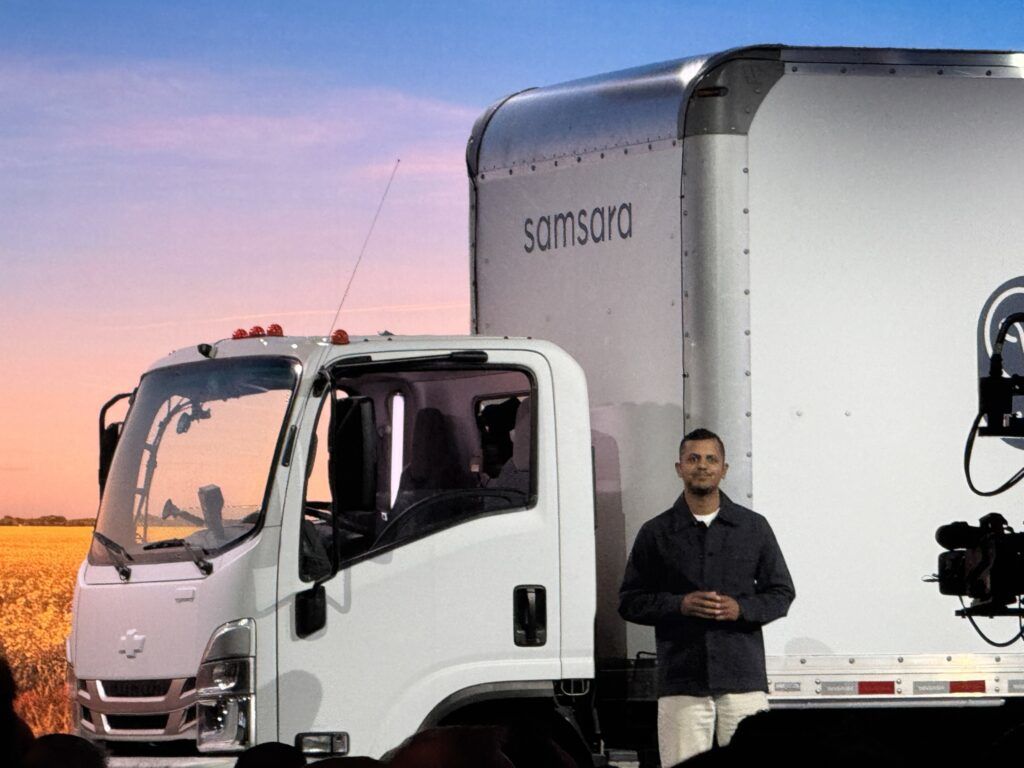
"In the past, drivers viewed Samsara as a tool that could get them into trouble. It would capture mistakes and then require them to undergo coaching," Podduturi said. "What we are doing now is empowering drivers by providing an intelligent agent that accompanies them throughout the journey, condensing everything needed for driving into a two-minute update."
To this end, the company launched AI Driver Briefings. This is an in-vehicle, context-aware AI assistant that not only focuses on post-event handling of high-risk incidents but also emphasizes preparing drivers before they start their trips and providing guidance along the way. Before a shift begins, the AI can summarize weather, traffic, route information, and high-risk locations. While driving, the system can continuously send voice alerts, reducing the need for drivers to check navigation or other mobile apps. Podduturi explained that this aims to keep drivers' eyes on the road and eliminate distractions.
Real-time safety features, such as collision warnings and distracted driving detection, operate in real-time via edge computing on the vehicle. "Almost all detection runs on the edge. We have custom models trained by ourselves that achieve millisecond-level responses because road conditions are dynamic." Meanwhile, cloud-based AI is used to analyze driving behavior over time, aggregating individual events into broader patterns to help safety managers understand coaching effectiveness, needs, and emerging risks.
Podduturi stated that once events are sent to the backend, they can be evaluated, verified, and labeled offline. "We have the ability to stitch events together and identify patterns in driving behavior, which was not possible a few years ago. This new technology allows us to pinpoint contributing risk events and provide coaches with a complete picture that includes contextual background."
The company's growing dataset also reveals regional differences in driver behavior. For example, in Canada, due to its vast geography, speeding is one of the most common behaviors among Samsara users; whereas in Mexico, fleets are more focused on phone usage, cargo security, and GPS interference.
The Coaching Priority feature identifies context and patterns, helping fleets concentrate their limited coaching efforts on critical areas. Instead of flagging a single hard braking event, this AI tool observes how factors such as driving behavior, weather, road conditions, and travel time interact to build a more complete risk picture and determine coaching priorities accordingly. In a media product demonstration, Samsara stated that internal analysis shows this feature identifies drivers who later become involved in accidents and marks them as high priority with approximately 80% accuracy at least five days before the event occurs. The company also noted that the "Coaching Priority Score" is entirely independent of the "Safety Score" used for fleet configuration or gamification; it examines all risk factors, including those beyond the driver's control, to assist managers in deciding where to focus coaching.
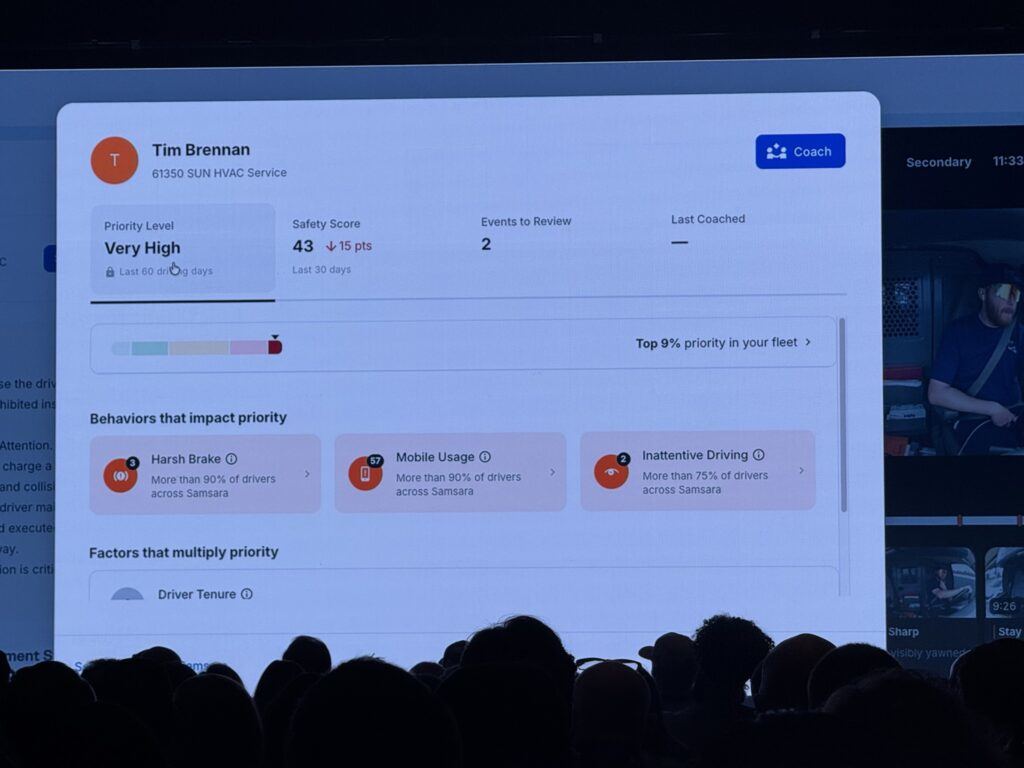
Podduturi stated that this feature does not replace the judgment of safety managers. Coaching Priority does not recommend specific actions but rather lists drivers who may need attention, leaving the fleet flexible in deciding how to respond. Depending on their policies, organizations can assign automated coaching, self-paced training, group coaching, or one-on-one sessions. "It's entirely up to the customer," he said. "We don't give specific recommendations, but we provide the tools for customers to decide how to intervene."
For large fleets, this visibility is particularly important. Instead of reviewing thousands of drivers individually, managers can quickly identify the few who need immediate attention. "Who are the 50 people I really need to focus on? How does their tenure overlap? How are their scores changing over time?" Podduturi noted that these are the questions managers can now get answers to. "Sometimes we see a slight decline in scores for drivers who have been performing well. The coach just needs to proactively reach out: 'What's happening in your life? Can I help you?' It's like putting data on top of intuition."
Related Products




G.652.D Wavelength-extended Non-dispersion Shifted Single-mode Optical Fiber
HONGAN GROUP CO., LTD.
TWP16 P-Band Tropospheric Wind Profile Radar
China Huayun Meteorological Technology Group Co., Ltd.

GYTA Type Non-Self-Supporting Aerial/Duct Optical Cable
TONGDING INTERCONNECTION INFORMATION CO., LTD.