NTU Singapore and Waseda University Use 3D-Printed Diving Suit to Keep Cyborg Cockroaches Alive Underwater for Three Hours
en.Wedoany.com Reported - A research team from Nanyang Technological University, Singapore (NTU Singapore) and Waseda University, Japan, has successfully developed a 3D-printed diving suit that enables cyborg cockroaches to survive for up to three hours while performing tasks underwater.
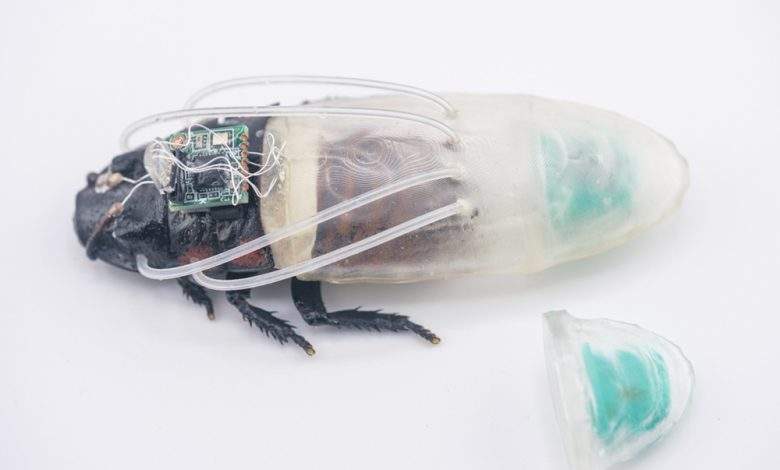
Cyborg insects are living insects (such as cockroaches) fitted with miniature electronic controllers, allowing their movements to be directed. They can also be equipped with sensors and cameras for reconnaissance and search-and-rescue operations. Such cyborg organisms require far less power than miniature robots because they utilize the insect's own muscles for efficient movement, and their size makes them suitable for navigating hard-to-reach places like earthquake rubble. The key to solving the waterproofing problem for cyborg cockroaches lies in creating a device that allows the insect to breathe underwater or in low-oxygen environments. This 3D-printed diving suit delivers oxygen to the insect's respiratory system through its breathing pores, lasting for up to three hours.
Professor Hirotaka Sato from the School of Mechanical and Aerospace Engineering at NTU Singapore explained that the new insect diving suit functions like an oxygen tank for human divers, generating oxygen and delivering it directly to the insect's breathing pores, enabling the cyborg cockroach to survive and move underwater or in low-oxygen environments. Real disaster sites, after heavy rain or flooding, can block passages in rubble, drains, and narrow crevices. Expanding the operational parameters of cyborg insects to include underwater movement could enhance search-and-rescue efforts.
The diving suit consists of a 3D-printed oxygen generation tank, a silicone oxygen supply tube, and a flexible outer shell. The oxygen tank is printed using transparent PMMA-type resin and contains a sponge with manganese dioxide. When this sponge comes into contact with diluted hydrogen peroxide, the manganese dioxide acts as a catalyst to produce oxygen, which is then delivered to the cockroach's respiratory system via the silicone tube. The suit is harmless to the cockroach; the tube connects to the insect's thoracic spiracles and can be easily removed. In tests, the suit was fitted onto a cyborg Madagascar hissing cockroach (a larger, flightless species). After donning the suit, the insect could move naturally and survive in wet terrain.
Professor Shinjiro Umezu from the School of Creative Science and Engineering at Waseda University added that the key engineering challenge was to build a wearable system for the insect that is sufficiently small, lightweight, and flexible, while also generating enough oxygen to support prolonged underwater movement. This approach combines a soft, waterproof outer shell with a simple and reliable chemical oxygen generator, allowing the insect to maintain its natural mobility while being protected from an otherwise uninhabitable environment.
Professor Sato has worked in the field of cyborg insects for over a decade, and his cyborg insects have already been deployed in real-world applications. Following the major earthquake in Myanmar this March, cyborg cockroaches were deployed as part of "Operation Lionheart" to locate survivors in the rubble. Currently, the diving suit is being tested and refined in simulated disaster environments. Leveraging the underwater capability, the research team also hopes to use cyborg cockroaches to inspect damp and hard-to-reach infrastructure, such as pipes, drains, and tunnels, and is exploring the use of other insect species, such as locusts and beetles.
Related Products


Industrial and Commercial Point-Type Gas Detector
Jinan Benan Technology Development Co., Ltd.

Pneumatic high-pressure wear-resistant ball valve
Zhejiang Deca Control Valve Meter Co., Ltd.
LBH4000 Batch Environmental Protection Asphalt Mixing Plant | Asphalt Batching Plant | Asphalt Mixing Plant
Jilin Province Road Construction Machinery Co., Ltd.

CAP1400 main feedwater flow nozzle flowmeter.
Jiangsu Hongda Instrument Technology Co., LTD.

Standard Nozzle Flowmeter
Jinggong Automatic Control Instrument Complete Technology Development Company