en.Wedoany.com Reported - KROHNE has officially launched the PipePatrol NEO platform, an integrated software and instrumentation system for internal leak detection, theft monitoring, and multi-parameter pipeline surveillance. This system combines artificial intelligence with deterministic physics-based algorithms to manage operational risks in complex midstream assets and industrial utility networks.
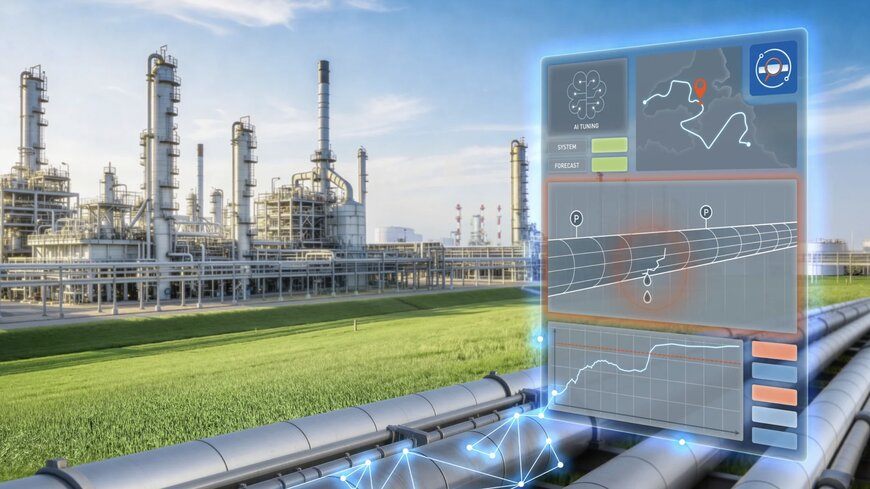
At the core of the system is the Neural Engine Pipeline Monitoring (NEPM) subsystem, KROHNE's next-generation framework for continuous internal fluid tracking. NEPM evolves from traditional Real-Time Transient Model (RTTM) and Extended RTTM (E-RTTM) platforms, which rely on rigid, non-adaptive mathematical models. The system unifies a multi-method analysis cycle by executing multiple diagnostics in parallel: a dynamic digital twin continuously runs a "virtual pipeline" simulation alongside active operations, establishing baseline thermodynamic and hydrodynamic profiles along the entire pipeline length; real-time instrument data ingestion captures physical telemetry, including high-frequency flow, pressure, temperature, and fluid density measurements from local control valves, pump stations, and terminal stations; AI pattern recognition cross-references deviations between the virtual model and empirical telemetry data against leak signatures and unauthorized extraction profiles to distinguish genuine faults from sensor drift. The underlying algorithms continuously learn from historical operational data, automatically optimizing system sensitivity thresholds without manual adjustment of instrument hardware. This adaptive capability minimizes false alarm triggers during dynamic, non-steady-state events such as rapid valve closures, pump start/stop sequences, product batch transitions, or sudden communication network interruptions.
The monitoring suite adopts a modular software architecture, allowing pipeline operators to customize functional configurations based on specific asset setups and regulatory requirements. Features include: leak and rupture alarms, providing local leak coordinates and volume indicators within minutes, along with local PLC-level execution capabilities for immediate pipeline isolation during major ruptures; theft identification, using specialized pattern recognition to locate illegal small-volume extractions or product siphoning operations; tightness testing, offering fully automated hydrostatic seal monitoring for high-consequence areas, capable of discerning slow leaks as low as 0.02 liters per cubic meter per hour; stress monitoring, automatically recording and statistically analyzing structural load cycles and transient pressure peaks per DIN 45667 standards, generating data to assess mechanical fatigue and estimate remaining asset service life; predictive modeling, simulating operator-defined hydraulic scenarios to forecast throughput trends, predict delivery constraints, and support proactive operational scheduling. The platform is designed to retrofit existing pipeline networks using current field instrumentation and interfaces with centralized Supervisory Control and Data Acquisition (SCADA) and Distributed Control System (DCS) architectures. The solution supports compliance protocols required by international pipeline regulations such as API RP 1130, API 1175, TRFL, and CSA Z662, and can monitor multiple fluid types, including crude oil and refined hydrocarbons, natural gas, complex chemical processes, wastewater networks, district heating systems, and high-pressure hydrogen distribution infrastructure.
The transient hydraulic calculations driving the digital twin are governed by the equations of conservation of mass, momentum, and energy in one-dimensional fluid flow. The mathematical model solves partial differential equations describing fluid continuity and momentum, considering internal pipeline pressure, fluid mass flow rate, fluid density, structural inner diameter, pipe roughness friction, and local pipe inclination angles. By solving the equations through discrete spatial steps along the pipeline grid, the software continuously estimates the expected pressure and flow distribution at any point in time. When a leak occurs, local pressure drops instantly, and a negative pressure wave propagates in both directions at the speed of sound. The NEPM framework identifies this transient phenomenon by combining the mathematical model with a Convolutional Neural Network (CNN) trained on time-series wave attenuation data. The system calculates the precise longitudinal location of fluid escape based on a time-of-arrival algorithm, which utilizes the total known installation distance between sensors and the time difference recorded by respective high-speed pressure transmitters for the negative pressure wavefront. The neural layer enhances this calculation by evaluating secondary variables such as local boundary layer turbulence and thermal conductivity changes, thereby improving positional accuracy to within ten meters over pipeline segments extending several kilometers.