en.Wedoany.com Reported - Ocean Engine officially launched its self-developed advertising content governance large model, Mamoda 2.5, at the 2026 Global Digital Economy Conference. This model is the first to combine the MoE (Mixture of Experts) architecture with the DiT (Diffusion Transformer) diffusion model, making it the industry's first DiT-MoE video generation foundation model.
In the past, small and medium-sized merchants often encountered issues during ad reviews where platforms would reject materials without specifying the violation points or providing guidance on modifications. Ocean Engine's Mamoda 2.5 aims to address this industry pain point by offering efficient ad governance capabilities for platforms, while providing merchants with a full-service process from risk diagnosis and violation pinpointing to automatic material repair, helping them reduce compliance costs and improve material approval rates.
Based on real-world usage cases from merchant users, Mamoda 2.5 can automate the correction of various types of non-compliant materials. For example, in one ad material, a character holding a cigarette in the frame violated platform guidelines prohibiting tobacco and smoking imagery. After processing, the cigarette was precisely removed, while the original visual effect of the frame was fully restored.
In another short video material, the copy at the 9-second mark contained exaggerated claims implying superiority over competitors, posing a risk of violating relevant provisions of the Advertising Law. The system quickly located the non-compliant text and automatically corrected it. Once the repair was complete, the material could be directly submitted for advertiser confirmation and deployment.
On three authoritative benchmarks in the field of instruction-based AI video editing—OpenVE-Bench, FiVE-Bench, and ReCo-Bench—Mamoda 2.5 achieved outstanding results, with T2V inference efficiency improved by 11 to 15 times compared to mainstream open-source models in the industry. The model has a total of 25 billion parameters, but only activates approximately 3 billion parameters per inference, with a sparsity of about 12%. It features 128 fine-grained experts (including one shared expert) and employs a Top-8 token-level routing strategy. Through reinforcement learning combined with self-distillation, the team reduced the number of inference steps from 50 to 4, cutting the latency for 480p video editing from 69 seconds to 9 seconds, an efficiency improvement of nearly 8 times.
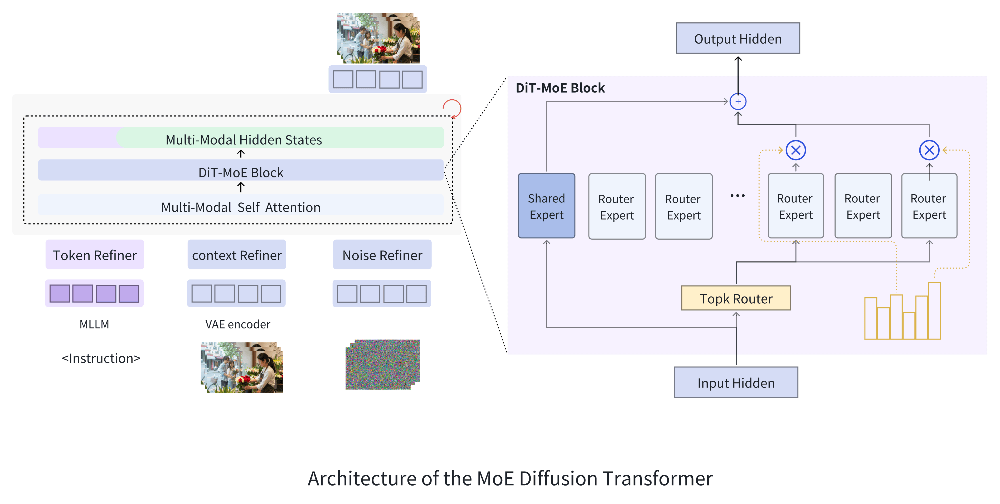
The Mamoda team did not simply adapt a general-purpose large model; instead, they conducted full-chain independent and full-stack self-developed efforts tailored to the ad governance scenario, covering architecture design, data solutions, and training strategies. The team added a shared expert to the architecture, responsible for expressing general visual knowledge. After three years and four iterations, Mamoda evolved from version 1.0, which focused on single-point risk detection for text-based ads, to version 2.5, released in July 2026, achieving a full-chain breakthrough with capabilities covering all video formats. The team expects version 3.0, to be released within 2026, to further deepen audio understanding and editing capabilities, enabling full-modal governance. For small and medium-sized merchants, the Mamoda team hopes this model will transform compliance from a "speed bump" on the path to ad deployment into an "accelerator" that helps merchants create and optimize content correctly. In terms of repair boundaries, Mamoda 2.5 only fixes content that is definitively non-compliant, pinpointing issues to the smallest unit—which frame, which sentence, or which segment of audio poses a risk—and then performs precise diagnosis and repair based on that. The team likens Mamoda to an "external compliance team" for small and medium-sized advertisers. Over the past year, Mamoda's supported platform governance capabilities have intercepted billions of non-compliant materials preemptively, shut down over 4 million non-compliant accounts, and processed a peak of over 200,000 black-market accounts in a single day. Platform content CCR decreased by 56.2% year-over-year, and compliance CCR dropped by 67.1%. The team noted that in the area of portrait authorization verification, less well-known portraits and voices are more easily counterfeited by unscrupulous merchants using AI, posing greater challenges for platform authenticity verification. The team revealed that the next step is to develop an adaptive intelligent risk control system, using generative capabilities to reversely enhance understanding capabilities, allowing the system to continuously self-evolve in adversarial scenarios.