en.Wedoany.com Reported - Portugal's rural connectivity continues to improve, bringing the country closer to the targets set by the European Digital Decade program. On World Rural Development Day (July 6), the Portuguese Communications Authority (ANACOM) emphasized that electronic communication networks are crucial for promoting regional cohesion and rural economic and social development. High-capacity digital infrastructure is key to enhancing business competitiveness, supporting agricultural innovation, and improving access to public services.
According to the "Connectivity Coverage in Europe 2025" report, Portugal outperforms the EU average in most indicators for rural coverage. Although total fixed broadband coverage (88.9%) remains below the European average, the deployment of Very High-Capacity Networks (VHCN) stands out: rural coverage reached 81.6% in 2025, 8.9 percentage points above the EU average and an increase of about 8% compared to 2024. Fiber-to-the-Home (FTTH) now covers 73.1% of rural areas, exceeding the European average, while 5G coverage has reached 95.3%, achieving near-universal access.
With the signing of the relevant agreement, Portugal's national network coverage gains new momentum. The agreement allows for the installation of fiber in 288 municipalities and 1,967 locations identified as "white areas" (i.e., areas without high-capacity communication networks). The contracts were signed by five Regional Coordination and Development Commissions (Comissões de Coordenação e Desenvolvimento Regional) with DSTelecom, which won the international tender launched in 2023 to build these high-capacity networks. The installation covers all residential and non-residential buildings, including industrial, commercial, and agricultural facilities, enabling approximately 500,000 households currently without fiber access to connect to high-performance networks.
The project took a long time from preparation to implementation and experienced several setbacks. ANACOM delineated the "white areas" in 2022, but subsequent negotiations with the European Commission, three public consultations, and administrative issues such as the resignation of the evaluation panel and pending legal challenges delayed the launch of the tender process until 2023. The total investment under the current agreement is €172.3 million, lower than the initially planned €425 million. Public funding amounts to approximately €30 million, sourced from the European Regional Development Fund (FEDER, Portugal 2030) and proceeds from the 5G auction. At the signing ceremony, the Minister of Economy and Regional Cohesion stated that this initiative goes beyond infrastructure deployment, reflecting a national strategic vision to ensure no region is left out of economic, technological, and social change. The project is decisive in making the potential of 5G, and even future 6G, a shared reality for all citizens.
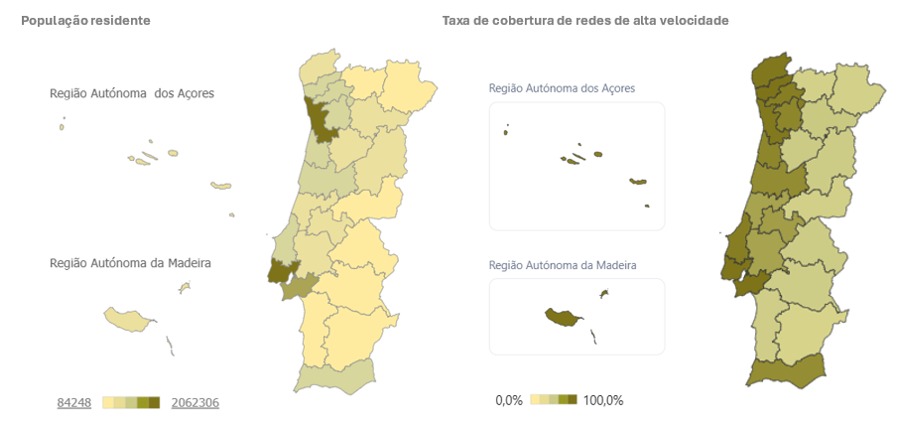
DSTelecom will be responsible for the construction, management, operation, and maintenance of networks in five regions: Norte, Centro, Alentejo, Algarve, and Lisbon. The company, which currently covers 1 million households across 154 municipalities, emphasized that this project reflects a commitment to regional cohesion and equal access opportunities, helping to enhance national competitiveness in an increasingly digital context. ANACOM considers the public tender launched in 2023 a strategic tool to ensure nationwide access to gigabit networks by 2030, while also highlighting the need for continued investment in low-density areas and public project support for the expansion of high-capacity networks.