NTT of Japan Begins Construction of Bangkok 4 Data Center in Thailand
en.Wedoany.com Reported - Recently, NTT Global Data Centers, the data center operating arm of Japan's NTT, held a groundbreaking ceremony for the Bangkok 4 data center campus in Chonburi Province, Thailand, marking the official start of physical construction. Located in the data center cluster area of the Bangkok metropolitan region, this campus will become the fourth data center operated by NTT in Thailand. Currently, the project is scheduled to achieve power-on in the second quarter of 2027, providing the foundational conditions for subsequent equipment installation, system debugging, and customer business deployment.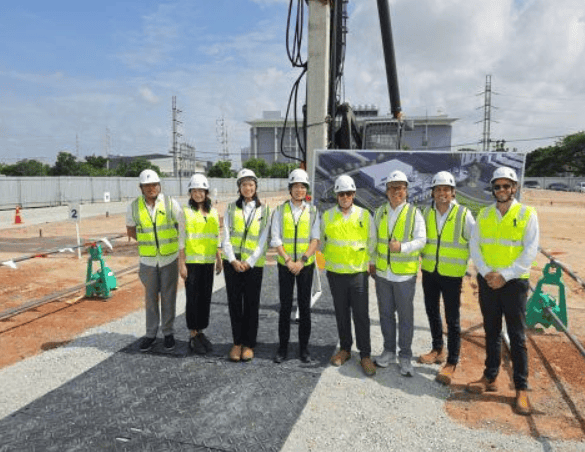
This groundbreaking signifies that Bangkok 4 has transitioned from preliminary power resource allocation and engineering preparation to the stages of site construction, building development, and electromechanical infrastructure implementation. Japan's NTT has not yet disclosed the campus's floor area, number of server rooms, IT load capacity, or phased construction plan. Therefore, at this stage, the scale of the project's power supply agreement cannot be directly equated to the available server capacity. According to publicly available information, Fuji Electric Thailand will be responsible for constructing the campus substation, which will serve as a critical engineering node for connecting Bangkok 4 to the external power grid and supplying electricity to the server rooms and supporting systems.
To secure power for the project, NTT Global Data Centers has signed a 100MW power purchase agreement with Thai energy company B.Grimm Power. Its Amata B.Grimm Power business will secure long-term power resources for Bangkok 4. This agreement primarily indicates that the project has secured a power supply arrangement of up to 100MW, but it does not mean that the data center's initial phase will immediately generate 100MW of IT equipment load. Internally, the data center will still require the configuration of transformers, medium and low-voltage distribution, backup power sources, uninterruptible power supplies, and power monitoring systems to convert external electricity into stable power usable by servers, storage devices, network systems, and cooling facilities.
Subsequent engineering for Bangkok 4 will focus on systems including the main data center building, substation, server room power supply and distribution, cooling, fire protection, security, and communication access. For data centers targeting cloud computing and artificial intelligence businesses, after the main building is completed, work will proceed with electromechanical equipment installation, rack area construction, fiber optic line introduction, and network equipment deployment. Load testing will be conducted to verify whether the power and cooling systems can operate continuously. Japan's NTT has only confirmed the groundbreaking, the substation contractor, and the planned power-on time. Specific details such as the cooling method to be adopted, the number of high-density racks that can be accommodated, and when the first server rooms will become operational are still pending further disclosure.
Chonburi Province, where the project is located, has become a key area for Japan's NTT to expand its data centers in Thailand. NTT's existing Bangkok 2 and Bangkok 3 data centers are both located in the Amata City Chonburi Industrial Estate. Bangkok 2, which began operations in 2015, has an existing capacity of approximately 3.6MW and a floor area of about 3,800 square meters. Bangkok 3 has a floor area of about 4,000 square meters and a capacity of approximately 12MW. With the start of Bangkok 4 construction, NTT will establish a campus system composed of multiple data centers in the area, expanding its digital infrastructure capacity through unified power, fiber optic networks, and operational resources.
NTT's data centers operating in Bangkok adopt a carrier-neutral model, allowing connections to different telecommunications operators and network service providers. This provides server room and network access conditions for enterprise critical systems, cloud platforms, and other digital businesses. As Bangkok 4 construction progresses, in addition to connecting to Thailand's domestic communication backbone network, the campus will also need to establish high-speed interconnection with NTT's existing data centers. This will enable customers to deploy data backups, business disaster recovery, and computing resources across different server rooms. NTT states that its Thailand data center expansion is part of a global capacity growth plan, with existing facilities in Bangkok primarily targeting enterprise customers requiring high availability and multi-network connectivity.
According to the current plan, Bangkok 4 is scheduled to reach its power-on milestone in the second quarter of 2027. Before this, the project must complete the substation and external power connection, main structure, server room electromechanical systems, and internal power distribution facilities. After power-on, the project will still need to proceed with equipment commissioning, system integration, and load testing before gradually entering the phases of server room delivery and business launch. Key points to watch for in the future include the campus's initial IT capacity, number of server rooms, cooling system design, and the specific timeline for official operation.
Related Products



Multi-function Marine Monitoring Low-altitude Detection Radar Sea-air Boundary Ocean Dynamic Environment Measurement
Chengdu Dixin Technology Co., Ltd.
Mine Explosion-proof and Intrinsically Safe Industrial Ethernet Ring Network (10 Gigabit/Gigabit)
Chongqing Mas Sci&Tech Co., Ltd.



Automatic Aiming Laser Remote Obstacle Removal Robot
Pinggao Group Weihai High-Voltage Apparatus Co., Ltd.
Industrial and Commercial Point-Type Gas Detector
Jinan Benan Technology Development Co., Ltd.
TWP16 P-Band Tropospheric Wind Profile Radar
China Huayun Meteorological Technology Group Co., Ltd.
Comprehensive Mining Automation Control System
Beijing Tianma Intelligent Control Technology Co., Ltd.