en.Wedoany.com Reported - PJM Interconnection has announced the results of the 2028/2029 Base Residual Auction, which secured 138,318 megawatts of unforced capacity (UCAP) and demand response to meet the projected electricity needs of over 67 million people across 13 states and the District of Columbia.
Areas under Fixed Resource Requirements (FRR) obtained an additional 10,864 MW of UCAP, bringing the total UCAP available to meet the forecasted peak load and reserve margin to 149,182 MW. UCAP represents the adjusted maximum output of generation resources, accounting for their reliable operation during periods of highest system risk.
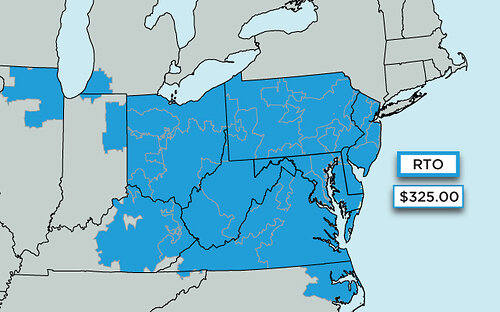
In coordination with the governors of all 13 PJM states and the Federal Energy Regulatory Commission (FERC), PJM set price caps and floors (i.e., price collars) for four capacity auctions to protect consumers and investors from market volatility. This is the third consecutive auction with price collars. Prices reached the FERC-approved cap of $325/MW-day (UCAP) for the entire PJM region, a 2.5% decrease from the $333.44/MW-day cap in the 2027/2028 Base Residual Auction. This cap is calculated based on the accredited capacity of PJM's reference resource. The total supply procured in the auction multiplied by the clearing price amounts to $16.4 billion. This total value does not equate to the total cost for load, as load hedged through self-supply or bilateral contracts is not exposed to the auction clearing price.
The resource capacity procured in the auction, combined with FRR resources, falls short of PJM's reliability requirement by 6,831 MW, meaning the committed supply is below the capacity needed to meet the one-in-ten-year reliability standard. Given the approximately 6,500 MW shortfall in PJM's previous capacity auction (for the 2027/2028 delivery year), this shortfall is not unexpected. Recent auctions mark the first time in PJM's history that the entire RTO has failed to meet the reliability requirement. PJM plans to seek FERC approval to hold a special reliability backstop procurement in September to help address near-term power supply shortfalls. Such shortfalls do not necessarily mean the PJM system cannot reliably serve load during the delivery year, but rather that PJM may need to operate with thinner reserves and at a higher risk level. PJM maintains a 14.7% reserve margin for the 2028/2029 delivery year.
PJM President and CEO David Mills stated that these auction results show electricity demand continues to grow faster than power supply. Recognizing the impact of this supply-demand imbalance on system reliability and consumer costs, PJM is collaborating with government and industry leaders on multiple fronts to restore balance by bringing new generation facilities online as quickly as possible and managing the growth of new load on the grid. While price caps and floors may reduce volatility, they cannot resolve the fundamental supply-demand imbalance. Addressing this challenge requires bringing more resources into the system to match the pace of demand growth.
PJM's actions to increase supply and manage demand include: clearing the generation interconnection backlog and implementing new streamlined cycle processes, including partnering with Google's Tapestry to leverage artificial intelligence to shorten study times; planning reliability backstop procurement to address near-term reliability needs and allocating costs according to state preferences; developing an interconnection and management framework allowing large new loads (such as data centers) to connect to the system while operating flexibly when needed to limit impacts on other users; creating a FERC-approved temporary accelerated interconnection lane for up to ten state-funded, high-capacity generation projects ready for immediate construction to come online quickly and meet short- and long-term supply needs; maximizing the performance and availability of existing generation resources; and advancing long-term market reforms with stakeholders, as outlined in PJM's report "Reliability Through Market Design" (PDF). PJM plans to submit proposals to FERC regarding its reliability backstop and interconnection and management frameworks in the coming weeks.
In addition to these actions, PJM began facilitating new bilateral long-term agreements between large load customers and generation suppliers on June 9. These contracts, typically lasting 10 years or longer, allow buyers to secure supply from new generation, energy storage, or demand-side resources. PJM issued a request for proposals to support this matching process, while market participants can still independently pursue such bilateral arrangements.
The RPM forecasted peak load for the 2028/2029 delivery year is approximately 2,000 MW higher than the forecast used for the 2027/2028 capacity auction. The supply mix (by UCAP) of RPM-cleared and FRR-committed resources in this auction includes: 46% natural gas, 20% nuclear, 18% coal, 5% demand response, 4% hydro, 2% wind, 2% oil, and 1% solar. Natural gas increased by 5,639 MW UCAP, primarily due to higher accredited UCAP factors, coal-to-gas conversions, and units participating in this auction that did not participate in the previous one. Coal decreased by 2,941 MW UCAP, mainly due to retirements or conversions to natural gas. Solar increased by 651 MW UCAP, from new or planned resources. Total supply in the 2028/2029 BRA increased by 3,447 MW (UCAP) compared to 136,148 MW in the 2027/2028 BRA, reaching 139,595 MW. The auction cleared 525 MW UCAP of new generation and generation uprates. Total cleared capacity increased by 3,733 MW UCAP, from 134,585 MW in 2027/2028 to 138,318 MW UCAP in 2028/2029. Total supply within the PJM service area increased from 200,994 MW to 202,288 MW, an increase of 1,294 MW in installed capacity (ICAP). ICAP represents the total amount a generation resource can produce, while UCAP represents the accredited capacity that can be offered in the capacity auction. This auction also continued the trend of large data center load being added to the load forecast, which underpins the reliability requirement.
PJM remains focused on maintaining a transparent market framework that accurately reflects supply and demand conditions, streamlining the interconnection process, and collaborating with states, developers, and the industry to support solutions that bring needed capacity online. As is consistent with these capacity market auctions, market power mitigation rules imposed constraints on existing generation offers based on the three pivotal supplier test. The next Base Residual Auction (for the 2029/2030 delivery year) is scheduled for December, and PJM is working to return to its three-year forward planning cycle. A detailed report of the results will be available on PJM's capacity market webpage. Founded in 1927, PJM ensures the reliability of the high-voltage power system, serving 67 million people in all or parts of Delaware, Illinois, Indiana, Kentucky, Maryland, Michigan, New Jersey, North Carolina, Ohio, Pennsylvania, Tennessee, Virginia, West Virginia, and the District of Columbia. PJM coordinates and directs the operation of the regional transmission grid, which includes 88,417 miles of transmission lines; administers a competitive wholesale electricity market; and plans regional transmission expansion and upgrades to maintain grid reliability and relieve congestion. PJM's regional grid and market operations save $5 billion annually.