China Leads 29 Countries in Establishing World Artificial Intelligence Cooperation Organization
en.Wedoany.com Reported - Led by China and joined by 29 countries including Russia and Brazil, the World Artificial Intelligence Cooperation Organization (WAICO) was officially established in Shanghai. As the hegemonic competition between the US and China over AI technology and semiconductors continues, China is seeking to take the lead by building a global AI governance system centered on emerging nations. At last month's Group of Seven (G7) summit in France, CEOs from companies like Anthropic and Google DeepMind proposed establishing a US-led AI cooperation body, but China has established such an organization earlier than the US.
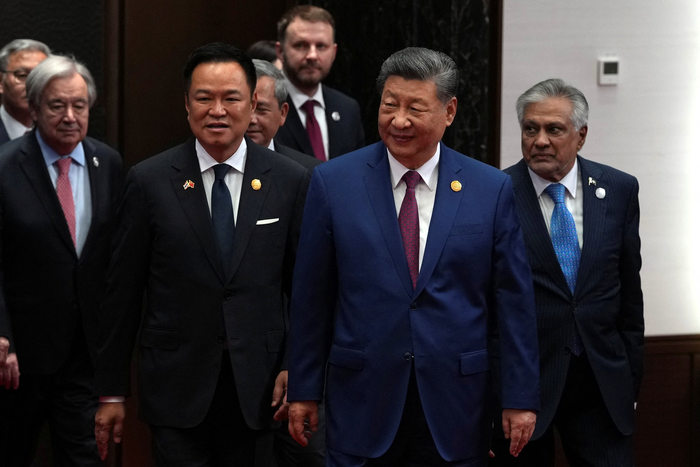
The previous evening, representatives from China and 28 other countries signed an agreement in Shanghai to establish the World Artificial Intelligence Cooperation Organization (WAICO). Xinhua News Agency reported this news on the 17th. Besides China, the founding member states of WAICO include Russia, Belarus, Serbia, Cuba, Brazil, Venezuela, as well as 10 African countries and 12 Asian countries. UN Secretary-General António Guterres attended the signing ceremony. The organization's headquarters is located in Shanghai, aiming to strengthen international cooperation and global governance in the AI field, supporting the safe, fair, and orderly development of AI.
In the US-China competition over AI technology and international norms, China is formally expanding its influence by establishing its own cooperative body. Bloomberg noted that global AI governance has become a new battleground for major world powers, all of which place high importance on AI technology for economic and national security reasons. Previously, Chinese President Xi Jinping proposed the "Global AI Governance Initiative" in 2023, and last year at the World Artificial Intelligence Conference (WAIC), he unveiled the "Global AI Governance Action Plan" and the concept of establishing WAICO.
The West is also discussing incorporating AI governance into international cooperation frameworks. At last month's G7 summit, leaders of major US technology companies proposed building a US-led international cooperation system to discuss AI norms and technical standards. OpenAI CEO Sam Altman advocated for establishing a global standards system modeled on the International Atomic Energy Agency (IAEA).
Against this competitive backdrop, President Xi Jinping attended the opening ceremony of the "2026 WAIC·AI Global Governance High-Level Meeting" in Shanghai on the morning of the same day and delivered a keynote speech, outlining China's vision for AI cooperation. This marks Xi's first personal attendance since WAIC's inception in 2018, with assessments suggesting that China has prioritized AI to promote economic growth, enhance technological competitiveness, and set global governance rules.
In his speech, Xi stated: "AI development should not be a solo performance by one country, but a symphony achieved through international cooperation," and called for "jointly opposing the excessive expansion of national security concepts in the AI field, and establishing a global AI governance system based on agreements as soon as possible." These remarks are seen as targeting the US's intensified restrictions on China in the AI and semiconductor sectors. He further emphasized: "With the joint efforts of all countries, WAICO has been established in Shanghai. This is a major measure by China to respond to the demands of the Global South and actively promote AI development and governance together with the international community."
China also announced an AI support plan for the next five years, including providing 5,000 specialized AI training and education courses for developing countries, establishing international AI application cooperation centers for BRICS, ASEAN, Latin America, the Arab League, and the African Union, and plans to promote the AI-based meteorological early warning system "Mazu" in 30 countries to enhance disaster prevention and response capabilities.
At this year's WAIC, China's achievements in technological self-reliance were also showcased. The previous day, Huawei publicly unveiled the physical model of its AI computing supernode system "Atlas 950 Superford." This technology integrates thousands of AI chips into a single computing resource using high-speed interconnections. Huawei stated that compared to Nvidia's next-generation product "NVL144," the Atlas 950 achieves 6.7 times the total computing performance and 15 times the memory capacity, making it the largest-scale system in the industry.
Related Products




Automatic Aiming Laser Remote Obstacle Removal Robot
Pinggao Group Weihai High-Voltage Apparatus Co., Ltd.


G.652.D Wavelength-extended Non-dispersion Shifted Single-mode Optical Fiber
HONGAN GROUP CO., LTD.

20 Inch 1600*900 Full HD 60Hz TFT LED Monitor with VGA and DP Interfaces for Desktop Computers-Business Use
Guangzhou Zanying Optoelectronics Technology Co., Ltd.

Mine Explosion-proof and Intrinsically Safe Industrial Ethernet Ring Network (10 Gigabit/Gigabit)
Chongqing Mas Sci&Tech Co., Ltd.