en.Wedoany.com Reported - On July 18, SenseTime announced the progress of large-scale commercial deployment of domestic AI infrastructure at the WAIC 2026 forum. Co-founder Yang Fan disclosed that the daily token service volume of its large-scale AI platform has reached 2.42 trillion, with an expected 25-fold increase in total service volume for 2026, reaching 10 trillion tokens per day in the fourth quarter. At the forum, SenseTime also launched the "Galaxy Plan" with nearly 20 ecosystem partners, signed a strategic cooperation on space computing with GuoXing Aerospace, and jointly initiated the "Science Discovery Platform" with five research institutions.
In his speech, Yang Fan pointed out that in the first year of the "15th Five-Year Plan," factors such as the explosion of the token market and the accelerated commercialization of domestic chips have ushered in a full-scale commercial deployment window for domestic AI infrastructure. Centered on domestic ecosystem innovation, SenseTime's large-scale platform is driving AI infrastructure to evolve from providing computing power to creating industrial value.
To address bottlenecks in the large-scale commercial deployment of domestic computing power, SenseTime has made breakthroughs in three areas: cost-effectiveness, compatibility, and energy efficiency. In terms of cost-effectiveness, leveraging heterogeneous hybrid inference technology, the MFU of mainstream domestic chips has increased by 85% to 152%, achieving an overall inference cost-effectiveness 1.25 times that of the NVIDIA H series. Compared to domestic homogeneous inference solutions, token output scale has expanded 2.5 times under the same cost. Based on the optimized hybrid inference cluster, it can transition from being usable to being profitable.
In terms of compatibility, SenseTime has built a full-stack adaptation system covering models, frameworks, operators, toolchains, and hardware. In the AI4S long-sequence protein prediction scenario, overall prediction time has been reduced by 3 times through fused operator optimization. In the AIGC video generation scenario, the multi-card parallel acceleration ratio for running DiT models on domestic chips reaches 93%. Major AI development tools can be migrated at zero cost.
In terms of energy efficiency, SenseTime has launched a computing-power-electricity collaborative agent, redefining TPW (Tokens Per Watt) as the value metric for AIDC. Through coordinated optimization of computing power and electricity, token output per unit of electricity cost has increased by 80%, the average electricity unit price is 10% lower than IDCs in the same region, and computing load prediction accuracy has reached 96%.
In ecosystem development, SenseTime's large-scale platform, together with leading domestic chip partners such as Cambricon, Muxi, Hygon, Huawei Ascend, Moore Threads, Sunway, and Biren Technology, as well as infrastructure vendors like Xizhi Technology, SiliconFlow, Qujing Technology, Zhongke Jiahe, Qingcheng Jizhi, Suanfeng Information, and Jiliu Technology, jointly launched the "Galaxy Plan." This plan will build one Token Operations Center and five 10,000-card domestic AI computing clusters, conduct joint innovation around ten core technology directions, and empower 200 AI startup organizations.
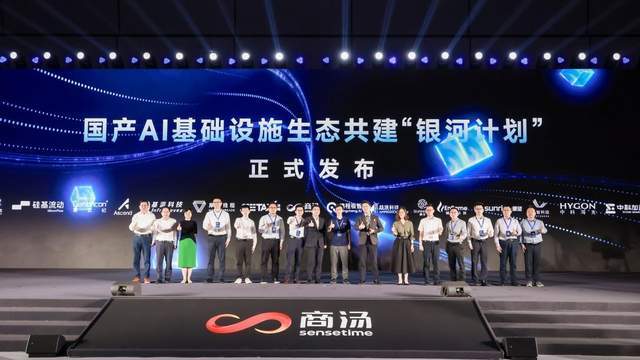
Yang Fan stated that domestic adoption is not merely about replacing a single chip, but about the full-chain synergy of China's entire innovation capability, from chips and components to infrastructure and application scenarios. Based on end-to-end capabilities, SenseTime aims to enable the domestic software and hardware ecosystem to quickly achieve a large-scale, profitable market cycle.
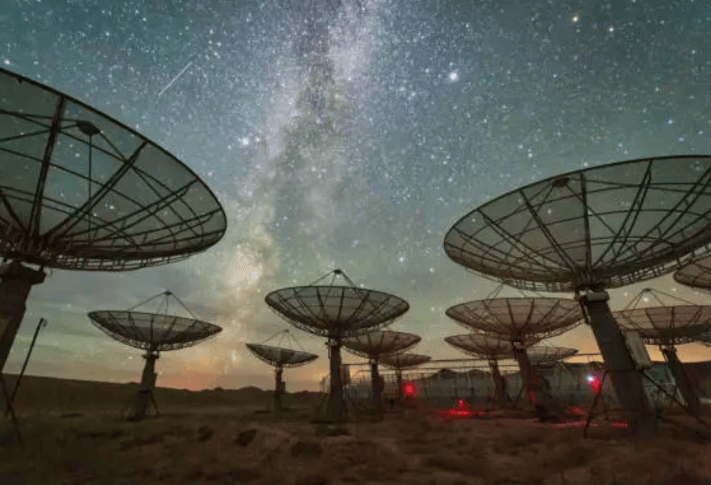
In terms of frontier technology deployment, SenseTime's large-scale platform has taken a forward-looking approach to three new computing pathways: optical computing, quantum computing, and space computing. In space computing, SenseTime has reached a strategic cooperation with GuoXing Aerospace to jointly build the "SenseTime Space Computing Constellation," which is expected to reach a scale of a thousand satellites and one exaFLOPS of computing power. In 2026, the first batch of "SenseTime" series computing satellites will be launched and networked. By 2030, a constellation consisting of thousands of computing satellites with a total computing power exceeding one exaFLOPS will be established, forming a global spatial intelligent computing network.
Yang Fan pointed out that space computing can fill coverage gaps in weak network environments such as emergency disaster relief, ocean-going vessels, and field operations, helping to radiate China's AI capabilities globally. In terms of regional deployment, the Shanghai 5A-level intelligent computing model has achieved a daily token service capacity of over 20 trillion, serving more than 20 industries. The Yancheng node has an initial construction of 3,000P of computing power, focusing on new energy, industrial manufacturing, and the low-altitude economy. Hong Kong is building the city's largest domestic AI computing center, targeting 40,000P by 2030. Saudi Arabia will host China's first overseas domestic computing cluster.
In the field of AI for Science, SenseTime's large-scale platform, together with the Shanghai Artificial Intelligence Laboratory, Beijing Zhongguancun Academy, Shenzhen Hetao Academy, Shanghai Algorithm Innovation Research Institute, and the School of Artificial Intelligence at Shanghai Jiao Tong University, has launched a strategic cooperation on the Science Discovery Platform. This initiative aims to build an integrated service system covering computing infrastructure, platform tools, model capabilities, and scientific research innovation, with a focus on supporting life sciences, new materials, and intelligent manufacturing.
Yang Fan stated that AI for Science is a core direction of the "AI+" action, and SenseTime hopes to support national-level scientific research forces in conducting frontier exploration with an autonomous and controllable computing foundation. After nine years of development, SenseTime's large-scale platform has evolved from the country's first 5A-level intelligent computing center to the industry leader in native AI cloud, pioneering a new paradigm of intelligent refining in global AI factories. Yang Fan said that SenseTime will firmly play the role of an industry service provider and enabler, promoting accessible AI for all.