U.S. Substack Launches AI Detection Feature in Partnership with Pangram
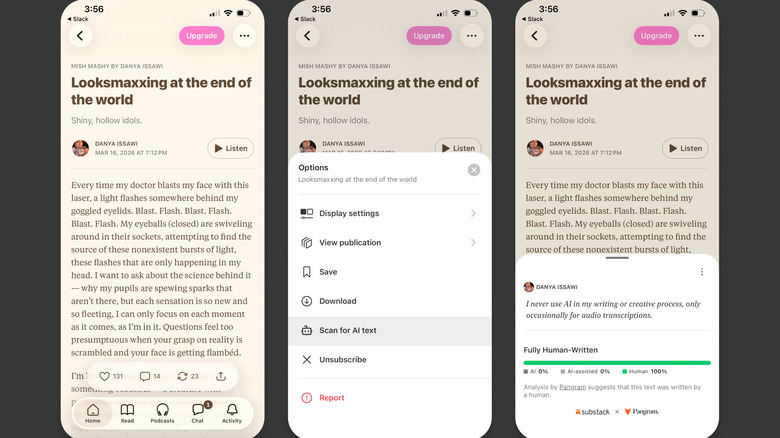
en.Wedoany.com Reported - U.S. Substack, in collaboration with the language model team Pangram, has launched an AI detection feature today, allowing readers to scan content published on the platform to understand the proportion written by artificial intelligence.

The feature applies to texts over 100 words starting July 21, 2026. Substack has also added a new declaration area for creators to clearly state whether and how they use AI-generated content.
The AI detection feature is available on the web and iOS from today, with Android support to follow. This move responds to growing concerns about AI-generated content on publishing platforms. In its announcement, Substack criticized the large amount of AI-generated content on LinkedIn and coined the term "Claudefishing" to describe the practice of using low-quality AI content to create false interpersonal connections.
However, this critical stance carries risks, as even the best AI detection tools cannot guarantee accurate assessments. The Atlantic has studied AI detection tools, particularly Pangram's accuracy, and results show these tools are far from perfect. Substack acknowledged in its blog post that there are limitations to what Pangram can detect and hinted at considering other features around AI content and user preferences.
The company emphasized that these new initiatives aim to set expectations for readers. Substack summarized its position with a clear statement: "People should know what they are getting." This move aligns with Substack's efforts to give creators more control. Previously, Substack introduced features allowing creators to better manage comments through "Reply Rules." The partnership with Pangram is a step in Substack's competition within the publishing platform space. Meanwhile, competitors like Beehiiv are also innovating, launching community features and AI Copilot for creators.
Substack's move indicates that AI content transparency has become a priority in the digital publishing industry. With this detection feature, readers can make more informed decisions about the content they consume. The feature's simultaneous launch on web and iOS underscores Substack's seriousness in responding to reader needs. Subsequent Android support will ensure most users on the platform can access this feature.
For creators, the new declaration area offers flexibility in disclosing their AI usage. This helps build trust with audiences and avoid misunderstandings about content origins. However, accuracy challenges remain a core issue. Substack's acknowledgment of Pangram's limitations suggests AI detection technology is still in development. Users are advised not to rely entirely on detection results.
The term "Claudefishing," introduced by Substack, adds new vocabulary to AI content discussions. It describes the practice of using AI to mimic real human interactions, a phenomenon increasingly common on social media platforms. Substack hopes to differentiate itself from other platforms through this transparency. The jab at LinkedIn indicates Substack views undisclosed AI content as a serious issue to address.
Looking ahead, Substack hints at more AI-related features. Although specific details remain undisclosed, this development direction shows the platform is adapting to the evolving content landscape. For readers, this AI detection feature provides an additional layer of information, allowing them to decide based on personal preferences whether to read content entirely written by humans or involving AI assistance.
Substack's initiative is an effort to enhance transparency in the age of AI content. Though imperfect, it sets a new standard for other publishing platforms. With this launch, Substack aims to create a healthier ecosystem where both readers and creators benefit. Transparency becomes key to building trust on the platform. The partnership with Pangram also demonstrates that leveraging third-party collaborations can be an effective solution to technical challenges. Substack chose to work with experts rather than develop an in-house solution. This decision reflects Substack's pragmatic approach to addressing AI content issues. With Pangram's expertise, Substack can offer more reliable features than if developed internally.
For the digital publishing industry, Substack's step could set a precedent. Other platforms may follow similar practices to meet user demands for transparency. Ultimately, the feature's success will depend on adoption by creators and readers. Substack has provided the tools; now it's up to the community to make full use of them. Substack's AI detection feature in partnership with Pangram is a significant step forward. Despite limitations, this initiative demonstrates the platform's commitment to transparency and user trust.
Related Products



TWP16 P-Band Tropospheric Wind Profile Radar
China Huayun Meteorological Technology Group Co., Ltd.
G.652.D Wavelength-extended Non-dispersion Shifted Single-mode Optical Fiber
HONGAN GROUP CO., LTD.
Mine Explosion-proof and Intrinsically Safe Industrial Ethernet Ring Network (10 Gigabit/Gigabit)
Chongqing Mas Sci&Tech Co., Ltd.



Flat Portable Satellite Terminal 0.35m Aperture Manual Portable Terminal
China Starwin Science & Technology Co., Ltd.

One-Stop Steward Service for the Entire Logistics System Integration Chain
Zhongding Intelligent (Wuxi) Technology Co., Ltd.
Hot Selling 10 Inch Intel N5100 I5 I7 FHD 8 +128GB 16+256GB Win10 Pro Win11 Pro 4G 5G Rugged Tablet PC Pad with NFC Barcode
Highton Electronics Co., Ltd.