China's Huawei Proposes IPv6+ Intelligent Network to Unite National Computing Power into One Computer
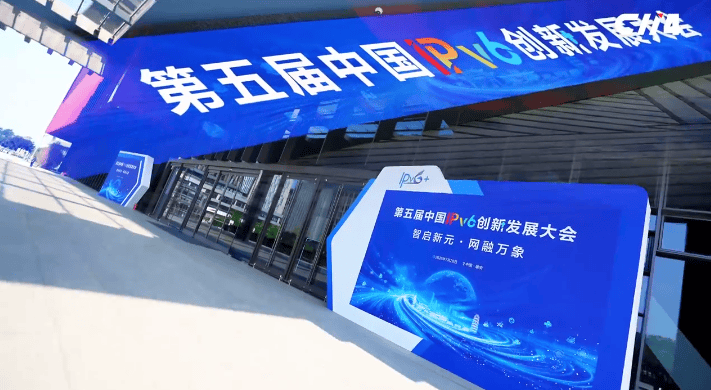
en.Wedoany.com Reported - The Central Cyberspace Affairs Commission recently issued the "Implementation Plan for Deepening the Innovation and Integrated Application of Internet Protocol Version 6 (IPv6) Technologies (2026–2030)," designating "IPv6 and Artificial Intelligence Integrated Innovation" as a key task. On July 28, the Fifth China IPv6 Innovation and Development Conference, themed "Intelligence Ushers in a New Era, Networks Integrate All Things," was held in Xiong'an, where the "China IPv6 Development Report (2026)" was released concurrently. IPv6+ 3.0, intelligent internet, and intelligent IP wide area network (AI WAN) became high-frequency terms both inside and outside the conference venue.
Data from the "China IPv6 Development Report (2026)" shows that by the end of 2025, the number of active IPv6 users in China reached 864 million, an increase of 88% during the "14th Five-Year Plan" period; IPv6 traffic on mobile networks accounted for 70.85%, and on fixed networks 32.38%, representing increases of 3.1 times and 4.1 times respectively compared to 2020; all eight major indicators of the "14th Five-Year Plan" exceeded their expected targets.
During the conference, Xue Wu, Vice President of Huawei's Data Communication Product Line, stated in an interview that the large-scale deployment of artificial intelligence has imposed new requirements on capabilities such as network address space, deterministic bearing, and security and trustworthiness. The 128-bit address space of IPv6 can provide a unique network identity for each intelligent terminal and intelligent agent. For every level of AI capability improvement, computing power demand increases by 10 to 100 times, and IPv6+ technology enables intelligent sensing of computing traffic and efficient scheduling of cross-domain computing resources. Over the past six months, Token consumption has grown sixfold, and the number of model invocations has increased by approximately 50 to 100 times.
Huawei has proposed a computing-centric "IPv6+ Intelligent Network" development approach, using it as a super bus to converge national computing power into one computer, achieving everything from computing power release within data centers to lossless and secure computing scheduling across wide area networks, while aligning with the national goals of building a new-generation communication network and an integrated computing network. To address the issue where the traditional TCP/IP protocol stack of wide area networks is prone to causing global synchronization waits when handling "elephant flows" in distributed training and inference, Huawei employs intelligent scheduling algorithms to achieve time-division multiplexing of bandwidth, improving bandwidth utilization efficiency by 5 times without changing physical bandwidth; precise intelligent computing flow scheduling achieves zero packet loss, keeping computing efficiency loss within 5%; and the launch of integrated computing-network devices supports enterprises in starting intelligent computing businesses with as few as 2 cards, while also supporting model partitioning and high-dimensional vector transmission.
In response to security risks such as APT attacks and quantum threats, Huawei has built a three-tier defense system covering the link layer, device layer, and network layer. At the link layer, noise suppression algorithms enable the "integration of two networks" for quantum key distribution networks and communication networks, allowing enterprises to obtain quantum security capabilities without adding new equipment or additional fiber, reducing construction costs by over 60%; at the device layer, intelligent built-in security boards can detect anomalies in files, memory, processes, and traffic, achieving a detection rate of over 95% for unknown threats; at the network layer, data fencing based on APN6 can control traffic paths across the entire network, ensuring that sensitive data flows only within trusted networks deployed with quantum encryption and security devices.
Domestic operators have already applied AI WAN in industries such as finance, transportation, and healthcare, integrating technologies like IPv6+, wide area RDMA lossless transmission, and AI intelligent scheduling to solve challenges in long-distance computing collaboration, including link packet loss, load imbalance, and latency fluctuations, achieving efficient computing interconnection and scheduling over distances ranging from hundreds to thousands of kilometers. In June 2026, the "National Excellent Practices of Intelligent IP Wide Area Network (AI WAN)" was released during the Mobile World Congress Shanghai, featuring 14 innovation cases from operators and enterprises. Xue Wu stated that AI WAN is an intelligent wide area network built on the IPv6+ foundation for the era of artificial intelligence, which will empower the construction of the national integrated computing network.
Regarding intelligent agent interconnection, Xue Wu noted that the global number of daily active intelligent agents is expected to approach 80 million in 2026, and could reach tens of billions or even hundreds of billions in the future; the cross-domain collaboration of massive intelligent agents requires support from new protocols and architectures such as unified identity identification, cross-domain registration and discovery, and semantic transmission. Huawei has participated in multiple discussions on intelligent agent interconnection standards in organizations such as IETF and CCSA, and led the IETF CATALIST BoF session. During the conference, Huawei, together with industry partners, released the "Technical and Practice Report on Network Architectures for Intelligent Agent Interconnection," proposing three core protocol directions: intelligent agent registration and discovery, intelligent agent metadata synchronization, and intelligent agent message transmission.
Xue Wu stated that IPv6+ innovation and AI WAN evolution require sustained collaboration among all industry parties, and the network foundation for the rapid development of artificial intelligence and industry digitalization will be progressively consolidated through this process.
Related Products


TWP16 P-Band Tropospheric Wind Profile Radar
China Huayun Meteorological Technology Group Co., Ltd.

GYTA Type Non-Self-Supporting Aerial/Duct Optical Cable
TONGDING INTERCONNECTION INFORMATION CO., LTD.

Industrial and Commercial Point-Type Gas Detector
Jinan Benan Technology Development Co., Ltd.
Mine Explosion-proof and Intrinsically Safe Industrial Ethernet Ring Network (10 Gigabit/Gigabit)
Chongqing Mas Sci&Tech Co., Ltd.
20 Inch 1600*900 Full HD 60Hz TFT LED Monitor with VGA and DP Interfaces for Desktop Computers-Business Use
Guangzhou Zanying Optoelectronics Technology Co., Ltd.