Ritsumeikan University Develops Circuit Model to Predict Mirror Hotspots in Half-Cell HJT Modules
en.Wedoany.com Reported - A research team at Ritsumeikan University in Japan has identified the driving mechanisms behind mirror hotspot phenomena in commercial 120 half-cell silicon heterojunction (HJT) photovoltaic modules under partial shading conditions through outdoor experiments and circuit-level simulations, and has developed a circuit-level model capable of predicting hotspot formation in affected cells.
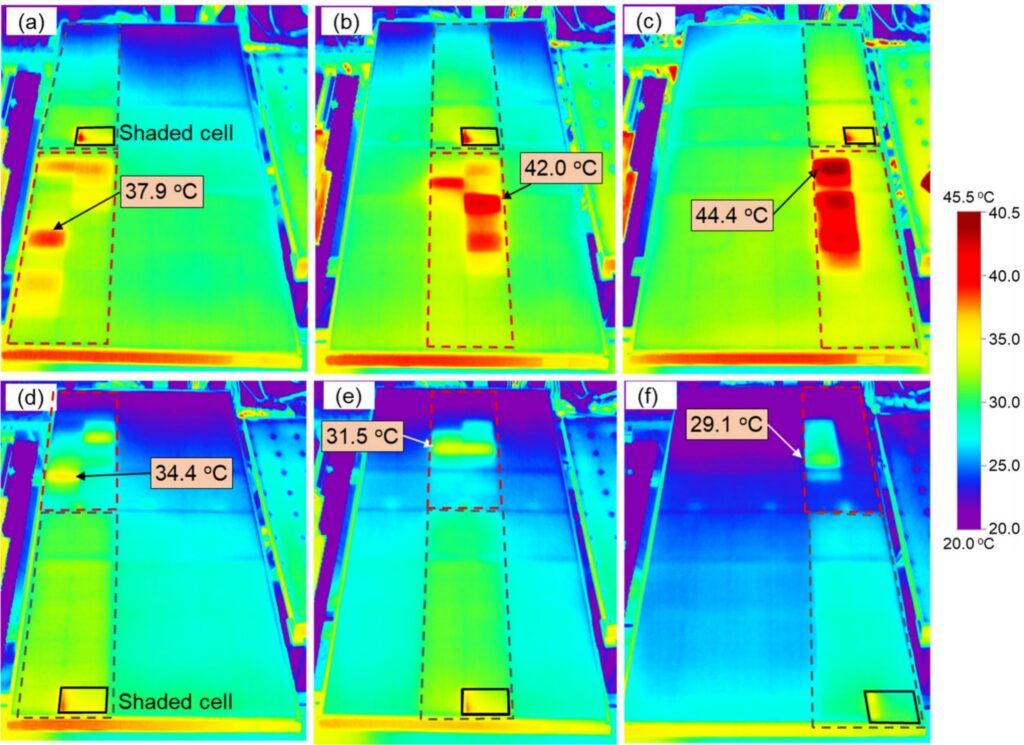
Mirror hotspots refer to a phenomenon in which, when partial shading in a half-cell module triggers bypass diodes, unshaded cells in the parallel mirrored substrings enter a reverse bias state and may experience localized overheating similar to shaded cells due to current mismatch. The research team noted that previous studies have confirmed this phenomenon occurs both under controlled laboratory conditions and in outdoor field environments, but have not provided quantitative circuit-level attribution of power dissipation in mirrored substrings and control parameters, nor have they incorporated temperature-power feedback regulating dissipation under real operating conditions into a validated predictive framework.
The experimental module comprised six substrings, each consisting of 20 series-connected half-cells, with two substrings connected in parallel to form one unit protected by a bypass diode, and three units connected in series at the module level. The prototype was installed under natural outdoor sunlight and connected to an electronic load. Researchers used shading plates to selectively block individual half-cells while monitoring temperature distribution with an infrared thermal camera. Measurements were maintained for 10 minutes at each of two fixed operating voltages, 36.5 V and 22.7 V, after which thermal images were captured.
Results showed that significant heating in unshaded mirrored substring cells occurred only when the operating voltage was low, i.e., when bypass diodes were activated. At 22.7 V, mirrored cells reached 44.4°C, 15.2°C above the surrounding temperature; at 36.5 V, no similar heating was observed.
To analyze the mechanisms, the research team built an equivalent circuit model using LTspice based on parameters from encapsulated HJT coupon cells. The model reproduced the module's measured current-voltage characteristics and was used to simulate cell-level voltage distribution and power dissipation under partial shading, as well as to examine the effects of short-circuit current mismatch (ΔIsc), shunt resistance, and temperature on hotspot formation. Cell-level simulations revealed that bypass activation is a necessary but not sufficient condition for localized mirror hotspot formation: if mirrored substring cells are perfectly identical, negative unit voltage is distributed broadly; a slight ΔIsc forces one mirrored cell into deep reverse bias, making it the primary dissipation point. In parameter analysis, ΔIsc had the greatest impact on hotspot power dissipation, followed by variations in shunt resistance.
The scholars concluded that this research provides outdoor-validated, circuit-level guidance for mitigating hotspots in half-cell modules, with applicability extending beyond scenarios that only assess shaded cells. The findings were published in the journal Solar Energy under the title "Outdoor validated mismatch driven mirror-cell hotspots in half-cell silicon heterojunction modules."