Yole: In 2026, the RF Industry's Center of Gravity Shifts from Smartphones to Defense, Automotive, and 6G
en.Wedoany.com Reported - Yole Group has released its "Status of the RF Industry 2026" report, indicating that the global RF industry is undergoing a shift in its center of gravity, with growth momentum moving from the long-reliant smartphone market toward defense, automotive, and early 6G sectors. The report projects that smartphone shipments will decline by approximately 13% year-over-year in 2026, with the RF market size expected to reach $55.8 billion, flat compared to 2025.
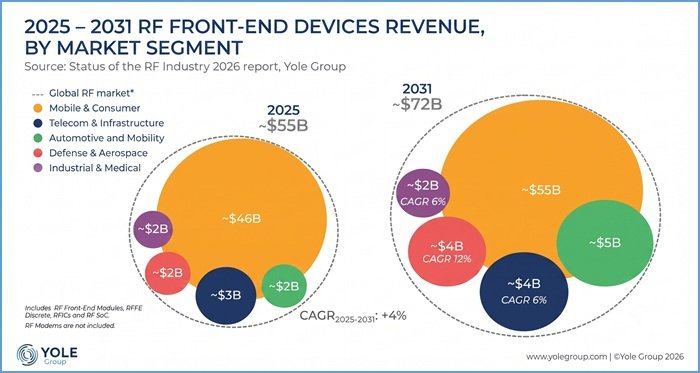
For over a decade, smartphones have been the core engine of growth for the RF industry. In its latest report, Yole Group analyzes that the market will experience a short-term slowdown in 2026, with mid- and low-end smartphone shipments being particularly affected. The markets for RF SoCs, RF front-end modules, and discrete devices are impacted as they fluctuate directly with smartphone shipments. Cyril Buey, RF Technology and Market Analyst at Yole Group, stated that 2026 appears to be a pause, but it is not a plateau; the industry's center of gravity is shifting from smartphones to defense, automotive, and 6G, with real growth accumulating in these areas.
Structural growth drivers have not stalled due to changes in the consumer cycle. The defense and aerospace sector is expected to grow to approximately $4 billion by 2031, driven by radar and electronic warfare modernization, sovereign procurement, and mass production of drones and counter-drone systems. This sector is increasingly reliant on gallium nitride (GaN)-based discrete power devices. The automotive and mobility sector is growing faster, expected to exceed $5 billion, with the adoption of radar, vehicle-to-everything (V2X), and advanced driver assistance systems (ADAS) continuing to drive demand.
The competitive landscape is simultaneously undergoing consolidation. Qualcomm remains the world's largest RF device supplier, followed by Broadcom, Skyworks, Qorvo, Murata, and NXP. MediaTek and Samsung maintain strong positions in Asia's high-volume markets. Skyworks and Qorvo signed a merger agreement at the end of 2025, which will create a U.S.-headquartered RF, analog, and mixed-signal company. Among Chinese suppliers, Maxscend, Vanchip, Smarter Micro, and HiSilicon are building a domestic RF supply chain.
From a regional perspective, the United States accounts for approximately 55% of global RF revenue, leading in mobile and consumer electronics, defense, and aerospace. China accounts for approximately 14%, with significant investment in consumer electronics while building capacity for telecommunications infrastructure ahead of 6G. Europe accounts for approximately 10%, leveraging strengths in automotive through NXP and Infineon Technologies, but relying on external semiconductor technology in defense. Japan and South Korea together account for approximately 10%, remaining focused on filters and RF SoCs.
Looking ahead to 2029–2031, 6G, defense, and space will become the primary directions for RF industry development, generating new RF front-end requirements. Telecommunications infrastructure revenue has remained around $3 billion for three years and is expected to climb to approximately $4 billion by 2031, driven by advances in 5G and early 6G massive MIMO architectures. This report provides valuable reference for device manufacturers, module suppliers, equipment providers, system integrators, and investors in assessing industry trends.
Related Products


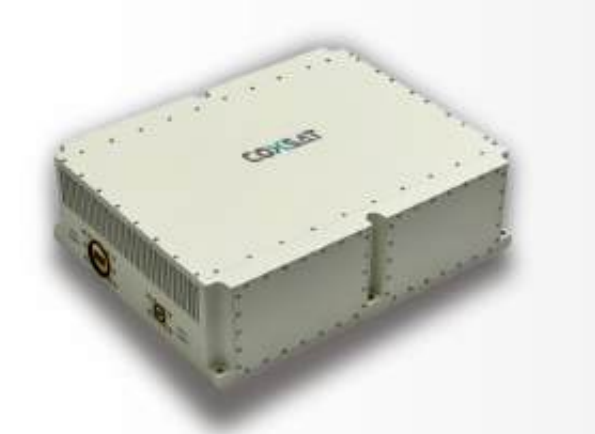
Flat Portable Satellite Terminal 0.35m Aperture Manual Portable Terminal
China Starwin Science & Technology Co., Ltd.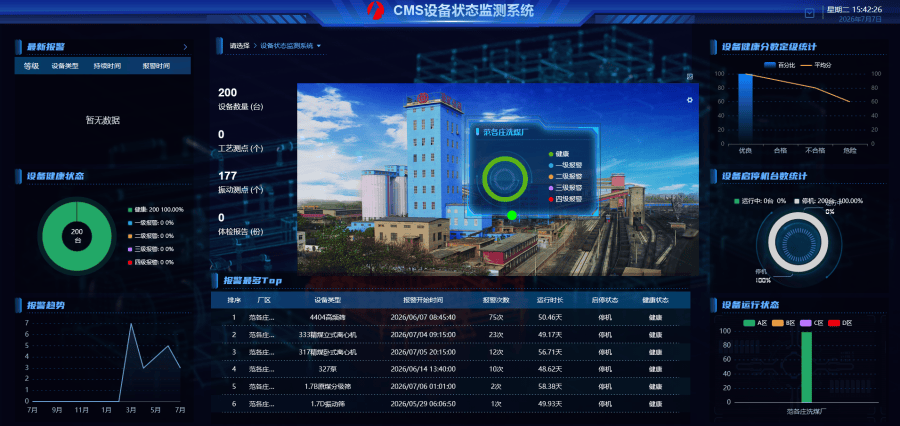
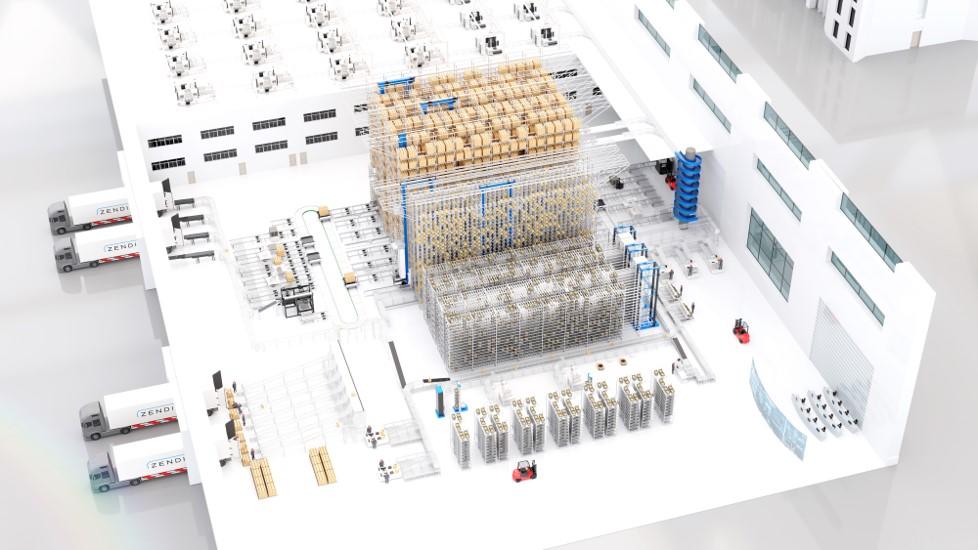
One-Stop Steward Service for the Entire Logistics System Integration Chain
Zhongding Intelligent (Wuxi) Technology Co., Ltd.


MUX Series Communication Interface Device for Security and Stability Control System
Nanjing NR Electric Co., Ltd.

Automatic Aiming Laser Remote Obstacle Removal Robot
Pinggao Group Weihai High-Voltage Apparatus Co., Ltd.

GYTA Type Non-Self-Supporting Aerial/Duct Optical Cable
TONGDING INTERCONNECTION INFORMATION CO., LTD.